
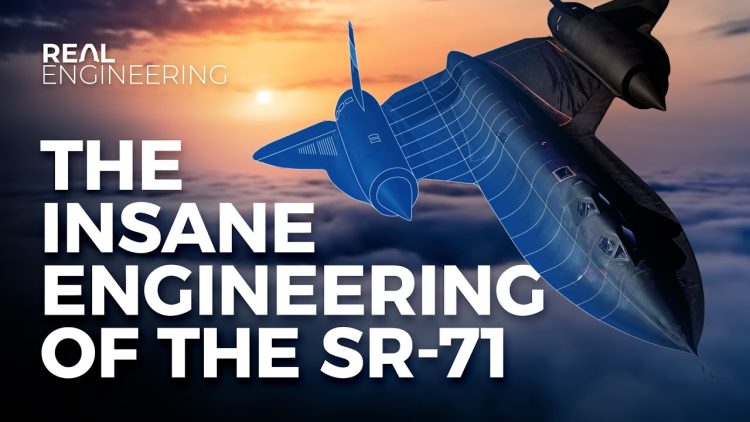
The Insane Engineering of the SR-71 Blackbird
The SR-71 Blackbird is the fastest air-breathing manned aircraft ever built, and it should not have been possible. It flew at more than three times the speed of sound, at 85,000 feet, in an airframe that leaked fuel on the runway and sealed itself only once it was hot enough in flight. This Real Engineering film, presented by Brian McManus, explains how Lockheed’s Skunk Works built the impossible.
The problem the Blackbird was built to solve was simple and brutal. After the U-2 spy plane was shot down over the Soviet Union, the United States needed a reconnaissance aircraft that could not be caught. Clarence “Kelly” Johnson, head of Lockheed’s Skunk Works division, gave the answer: fly higher and faster than any defender could follow. The SR-71, developed as a black project from the earlier A-12, was designed to operate at Mach 3.2 and 85,000 feet — so high and so fast that the only defence against it was to watch it go past.
Flying that fast creates a problem no ordinary aircraft faces: heat. At Mach 3, friction heats the skin to more than 500 degrees Fahrenheit, which rules out aluminium entirely. Lockheed built about 85 percent of the SR-71’s structure from titanium, a metal so hard to work with that the company had to develop new fabrication methods. The aircraft was painted almost black, both to radiate heat away and to hide against the night sky — the reason for the name Blackbird.
The titanium created a second problem, and it is the film’s most famous detail. Metal expands when it gets hot, and the Blackbird was designed to fit together properly only at cruising speed. On the ground its panels fit loosely and the fuel tanks leaked. The aircraft would take off, refuel in the air from a tanker, and only as the skin heated and expanded did the gaps close and the leaks stop. It used a special fuel, JP-7, chosen partly because it was hard to ignite — useful in an aircraft that dripped fuel onto the ramp.
The engines were just as strange. The Pratt & Whitney J58 was not one kind of engine but several, changing its character with speed: an afterburning turbojet for takeoff, something closer to a turbofan as the aircraft went supersonic, and at cruise, effectively a ramjet, with the inlet itself producing most of the thrust. The film explains how the inlets slowed supersonic air to subsonic speeds before it reached the engine — and why getting that wrong could stall the aircraft in an instant.
What the Film Explores
The film explores the central trade-off of the Blackbird: speed solves one problem and creates a dozen others. Every solution in the aircraft — the titanium, the leaking tanks, the shape-shifting engine, the black paint — answers a problem created by flying at Mach 3. The film’s pleasure is in following that chain of consequences, and showing how each insane detail follows logically from the decision to fly faster than a rifle bullet.
It also explores the human side of the machine. The SR-71 carried a crew of two in tandem cockpits: a pilot in front, and a Reconnaissance Systems Officer behind, monitoring the surveillance systems. They wore pressure suits and flew missions lasting hours at the edge of the atmosphere. The aircraft was a marvel of engineering, but it was flown by people, and the film never lets the viewer forget that the most extreme machine ever built was operated by human beings in an environment no human body was designed for. The story of Concorde shows the same pattern in civilian aviation: the dream of speed, and the price of chasing it.
The film looks closely at the Blackbird’s record in service. It first flew on 22 December 1964, entered service with the United States Air Force in January 1966, and was retired in 1989, briefly reactivated, and retired finally in 1998, with NASA flying the last two airframes until 1999. Of the 32 aircraft built, 12 were lost in accidents — but none was ever lost to enemy action. The film treats that record as the proof of Johnson’s original idea: the best defence is to be somewhere the enemy cannot reach.
Finally, the film explores why the Blackbird still matters. Retired for a quarter of a century, its role has been taken up by satellites and unmanned aircraft. But it still holds the world records for the fastest air-breathing manned aircraft, and the engineering in it — the titanium, the inlets, the engines that changed their nature in flight — remains a benchmark no successor has matched. The SR-71 was not just a fast aircraft. It was a demonstration of what engineering can do when it refuses to accept that something is impossible.
Key Themes
- Clarence “Kelly” Johnson and Lockheed’s Skunk Works, who built the Blackbird as a black project.
- Mach 3.2 at 85,000 feet: too high and too fast for any defender to catch.
- Titanium: about 85 percent of the structure, built with new fabrication methods.
- Fuel that leaked on the ground, and panels that sealed only when the skin heated in flight.
- The Pratt & Whitney J58, an engine that changed its character with speed.
- First flight on 22 December 1964; in service from January 1966; retired in 1998.
- Thirty-two aircraft built, and none ever lost to enemy action.
- World records that still stand: the fastest air-breathing manned aircraft ever built.
Production and Background
The video is a Real Engineering film from 2020, written and narrated by Brian McManus, with animation by Mike Ridolfi and editing by Stephanie Sammann. It draws on NASA technical papers, including the Dryden history of the aircraft, and on archival footage supplied by AP Archive. Real Engineering is known for explaining complex machines clearly, and this film is one of its most watched: a nineteen-minute account of an aircraft that was, by any normal measure, impossible, and that flew anyway for more than three decades.
Recommended Companion Viewing
Explore authoritative investigative documentaries on related historical events and investigative subjects.

World's Biggest Cargo Planes | Flying the Impossible
Falling from the Sky: Air Disasters FULL EPISODE
Concorde: Up in Flames - Air Disasters: Full Episode
Frequently Asked Questions
How fast was the SR-71? It operated at Mach 3.2 — more than three times the speed of sound, around 2,200 miles per hour — at an altitude of 85,000 feet.
Why did the SR-71 leak fuel on the ground? Its titanium panels were designed to fit together properly only when the skin heated and expanded at cruising speed. On the ground the panels fit loosely, so the fuel tanks leaked until the aircraft got hot in flight.
Who designed the Blackbird? Clarence “Kelly” Johnson, head of Lockheed’s Skunk Works division, working from the earlier A-12 reconnaissance aircraft.
Was an SR-71 ever shot down? No. Of the 32 aircraft built, 12 were lost in accidents, but none was ever lost to enemy action. No missile ever caught one.
When was the SR-71 retired? The United States Air Force retired it in 1989, briefly reactivated it, and retired it finally in 1998. NASA flew the last two airframes as research aircraft until 1999.
More to watch
- Falling from the Sky: Air Disasters FULL EPISODE
- Concorde: Up in Flames – Air Disasters: Full Episode
- World’s Biggest Cargo Planes | Flying the Impossible
- The rise and fall of Germany’s maglev supertrain







