
The Kanazawa railway hub – Where tradition and high-speed meet in Japan | DW Documentary
A huge wooden gate, like that of a Shinto shrine, is the landmark of Kanazawa. The main railway station of the metropolis in western Japan is reminiscent of a religious site, and that is no accident.
The gate is the Tsuzumi-mon, a 13.7-metre wooden gate at the station’s Kenrokuen Exit, modelled on the tsuzumi hand drum of Noh theatre, a performing art long popular in Kanazawa. Its two pillars twist in spirals like the cords of a drum. Behind it stands the Motenashi Dome, a canopy of glass and aluminium set with 3,019 panes, shaped like an open umbrella held out to arriving travellers — Kanazawa gets a great deal of rain and snow, and the dome’s name means hospitality.
The new high-speed railway line runs through the city on concrete tracks. The Hokuriku Shinkansen reached Kanazawa from Nagano in March 2015, bringing the journey from Tokyo down to about two and a half hours on the fastest Kagayaki services, and in March 2024 the line was extended west to Tsuruga in Fukui Prefecture. Even the Shinkansen’s livery is based on the colours of a local palace, a small detail that says a great deal about how Kanazawa treats its railway: not as something imposed on the city, but as something dressed in the city’s own colours.
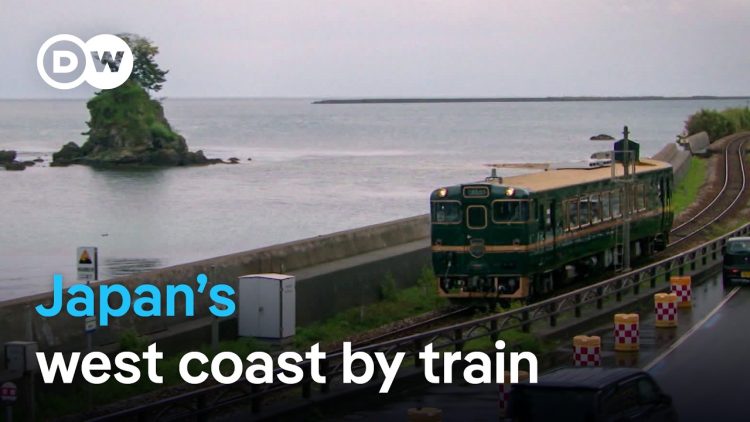
But the film is not only about the station. It also visits one of Japan’s few surviving ancient towns, as well as one of the country’s most famous gardens. Kanazawa is the capital of Ishikawa Prefecture on Japan’s Sea of Japan coast, and it was spared the wartime bombing that flattened much of urban Japan, so it kept an unusually large share of its Edo-period layout intact: a moated castle, one of the country’s three great gardens directly across from it, and two historic geisha districts still built from real early-19th-century wood. Kenroku-en Garden, landscaped by the Maeda lords over roughly two centuries and completed in its present form in the 1840s, is genuinely one of Japan’s three great gardens. The Maeda clan ruled Kanazawa for over two and a half centuries as the wealthiest feudal domain in Japan outside the Tokugawa shogunate itself, and that wealth built the garden. One tourist highlight the film visits is a small special train that hugs the coastline and serves sushi — a reminder that in Japan, even a meal can be part of the journey.
What the Film Explores
The film explores how a railway station can be a city’s front door. Most stations are places you pass through. Kanazawa’s is a place you arrive at: a wooden gate modelled on a Noh drum, a glass dome shaped like an umbrella, and a plaza designed to make a first impression. The film shows how that was a deliberate choice, made when the station’s east side was redeveloped in the early 2000s, and how it works in practice — travellers step off the Shinkansen, walk out under the dome, pass under the gate, and are in the city. The station does not hide the railway.
It also explores the tension between preservation and speed. Kanazawa is a city that kept its Edo-period layout because it escaped the bombing, and it is also a city on one of Japan’s newest high-speed lines. The film shows how those two facts sit together: the Shinkansen arrives on concrete tracks, but its livery wears the colours of a local palace, and the garden it serves was landscaped by feudal lords two centuries ago. The railway did not erase the old city.
Finally, the film explores the railway as a way of seeing Japan. The Kanazawa hub is a microcosm of the national network, and the film uses it to show how the network works: high-speed lines for distance, regional lines for the coast, local buses for the last few kilometres to the garden and the castle. The little coastal train that serves sushi is the film’s lightest touch, but it makes a serious point: in Japan, the train is not only transport. It is part of the experience of the place, and the journey is part of the destination.
Key Themes
- A station as a front door: the Tsuzumi-mon gate and the Motenashi Dome turn Kanazawa’s station exit into a deliberate welcome, not a passageway.
- Tradition in the design: the 13.7-metre gate is modelled on the tsuzumi drum of Noh theatre, and the dome is an umbrella offered to travellers in a rainy city.
- High-speed arrival: the Hokuriku Shinkansen reached Kanazawa in March 2015 and was extended to Tsuruga in 2024, putting Tokyo about two and a half hours away.
- A city that survived: spared wartime bombing, Kanazawa kept its Edo-period layout, its castle and its historic geisha districts.
- Kenroku-en Garden: one of Japan’s three great gardens, landscaped by the Maeda lords over two centuries, lies a short bus ride from the station.
- The railway as experience: from the Shinkansen’s palace-coloured livery to the little coastal train that serves sushi, the journey is part of the visit.
Production and Background
The film is a DW Documentary production, in the broadcaster’s travel-documentary style: a single city, explored on foot and by train, with the camera doing most of the explaining.
Kanazawa’s station first opened in 1898 on the Hokuriku main line. Its east side was redeveloped in the early 2000s, and the dome and gate were completed in 2005. The film was made after the Shinkansen’s arrival, and it captures the city at a moment of change: newly connected to Tokyo by high-speed rail, and newly visible to visitors who had previously passed it by.
Recommended Companion Viewing
Explore authoritative investigative documentaries on related historical events and investigative subjects.

The Technology We Build- A
Inside Iran's secret security state - Two defectors break their silence
How a small Chinese company tricked the German state
The mystery of the Holy Grail
Frequently Asked Questions
What is the Tsuzumi-mon? It is a 13.7-metre wooden gate at Kanazawa Station’s Kenrokuen Exit, modelled on the tsuzumi hand drum of Noh theatre. Its two pillars twist in spirals like the cords of a drum, and it is the city’s most photographed modern landmark.
What is the Motenashi Dome? It is the glass-and-aluminium canopy over the station’s Kenrokuen Exit, set with 3,019 panes and shaped like an open umbrella. Its name means hospitality, and it shelters arriving travellers from Kanazawa’s rain and snow.
How long does the Shinkansen take from Tokyo to Kanazawa? About two and a half hours on the fastest Kagayaki services. The Hokuriku Shinkansen reached Kanazawa in March 2015 and was extended to Tsuruga in March 2024.
What is Kenroku-en Garden? It is one of Japan’s three great gardens, landscaped by the Maeda lords over roughly two centuries and completed in its present form in the 1840s, directly across from Kanazawa Castle and a short bus ride from the station.
More to watch
- The rise and fall of Germany’s maglev supertrain
- How this tiny country became the best at night trains in Europe
- Through Kazakhstan by Train
- World’s Toughest Trains: Surviving the Most Extreme Railways on Earth
Kanazawa shows a railway at its most graceful; The rise and fall of Germany’s maglev supertrain shows what happens when a bold railway idea goes wrong.







