
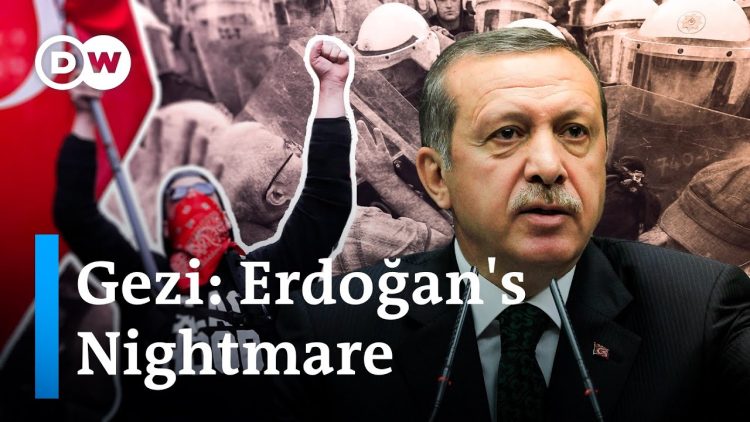
Turkey: How Artists Challenge(d) Erdoğan with Gezi Protests
When the Gezi Park protests erupted on 28 May 2013 in Istanbul, they quickly developed into major uprisings throughout Turkey against the authoritarian government led by Prime Minister Recep Tayyip Erdoğan. What began as an environmentalist protest against the demolition of a park in the heart of Istanbul became something much larger: hundreds of thousands of people wanted to reclaim democratic rights for their country, and to fight back against censorship, despotism and violence at the hands of the state police. Gezi Park soon became synonymous with a young, creative and cosmopolitan movement, supported by actors, writers, filmmakers and musicians, a symbol of resistance, solidarity and upheaval.
The government’s reaction was harsh. It singled out prominent and important protestors and blamed them for the uprisings, with the aim of intimidating and spreading fear among the movement. Osman Kavala, a patron of the arts and a human rights activist, was charged with attempting to overthrow the Turkish government and given a life sentence. Fifteen other activists who allegedly supported him were also imprisoned. The message was clear: the protest would be punished, and the people who had made it visible would pay the price.
This episode of Arts Unveiled meets five artists who were on the streets during the Gezi Park protests, and whose lives are still shaped by what happened there. Barış Atay, an actor and artist, was part of the movement from the beginning. Memet Ali Alabora, an exiled actor, left Turkey because of his role in the protests. Cansu Yapıcı, an architect, is the daughter of Mücella Yapıcı, who was imprisoned for her part in the movement. Tuncay Akgün is a cartoonist and the editor of the satirical magazine LeMan, which has mocked power for decades. And Sinem Sakaoğlu is a friend and colleague of Çiğdem Mater, the imprisoned filmmaker. Each of them tells a different part of the same story, and together they show what the protests cost the people who took part in them.
To this day, the consequences of their participation overshadow their lives. They are unable to practise their professions, have been forced into exile, or were sentenced to years in prison. The film does not treat them as symbols, but as people: an actor who cannot act, an architect whose mother is in prison, a cartoonist who works under the threat of prosecution, a filmmaker’s friend who watches her colleague serve a sentence for a protest. The film shows how the crackdown worked, not only through prison sentences, but through the slow pressure of censorship, blacklisting and fear, which made it harder and harder for artists to work in Turkey at all.
What the Film Explores
The film explores what happened at Gezi Park first, and it wants the viewer to understand how a protest about a park became a national uprising. The plan to demolish Gezi Park, one of the last green spaces in central Istanbul, and replace it with a shopping mall and a replica of an Ottoman barracks, was the spark, but the fuel was years of frustration with a government that had grown increasingly authoritarian. The film shows how the protest spread from a small group of environmentalists to hundreds of thousands of people across Turkey, and how it became a movement that included students, workers, artists and families, united by a demand for democratic rights and an end to police violence.
A second thread follows the artists and their fight for freedom, and the film shows why artists were at the centre of Gezi. The movement was young, creative and cosmopolitan, and its symbols were made by artists: the cartoons, the songs, the performances and the images that spread through the park and across social media. The film meets the five artists in their own worlds, and shows how their work and their protest were the same thing: Barış Atay on stage and in the streets, Memet Ali Alabora using his fame to speak out, Tuncay Akgün drawing the cartoons that mocked the government, and Cansu Yapıcı and Sinem Sakaoğlu carrying the personal cost of the movement in their families and friendships.
A third thread follows how the protests were dispersed, and how the state oppressed the voices of opposition afterwards. The film shows the police operation that cleared the park, and the violence that accompanied it, and it traces the longer campaign that followed: the prosecutions, the imprisonment of Osman Kavala and the fifteen others, the censorship of arts and opinions, and the pressure on media, theatres and publishers. The film is clear about the strategy: by punishing the most prominent figures, the government aimed to intimidate the whole movement, and to make other artists think twice before speaking out.
Key Themes & Topics Examined
- Gezi Park, 28 May 2013: an environmental protest that became a national uprising
- Hundreds of thousands demanding democratic rights, and an end to censorship and police violence
- Osman Kavala, sentenced to life, and fifteen other activists imprisoned
- Barış Atay, Memet Ali Alabora, Cansu Yapıcı, Tuncay Akgün and Sinem Sakaoğlu
- Exile, prison and blacklisting: the price of taking part
- How the protests were dispersed, and the violence that followed
Production & Background
The film is a DW History and Culture production, part of the Arts Unveiled series, which looks at the stories behind art, culture and history. Its chapters run from the introduction through what happened at Gezi Park, the artists and their fight for freedom, how the protests were dispersed, how Erdoğan and the state oppress voices of opposition, censorship of arts and opinions, how artists still find ways of expression, and the conclusion.
Recommended Companion Viewing
Explore authoritative investigative documentaries on related historical events and investigative subjects.

The Scramble to Rewrite Biden's Record on Gaza
Secret Mission: Former Child Soldier's Risks His Life To Save His Son
North Korea - Propaganda and the next generation
Girls Make a Comeback - What India and China Are Doing About the Women Shortage
Frequently Asked Questions
What is the film about?
How artists challenged the Erdoğan government through the Gezi Park protests of 2013, and what the crackdown that followed cost them.
When did the Gezi Park protests begin?
On 28 May 2013, in Istanbul, as an environmentalist protest against the demolition of Gezi Park, which quickly grew into major uprisings throughout Turkey.
Who is Osman Kavala?
A patron of the arts and human rights activist who was charged with attempting to overthrow the Turkish government and given a life sentence; fifteen other activists were also imprisoned.
Which artists does the film meet?
The actor Barış Atay, the exiled actor Memet Ali Alabora, the architect Cansu Yapıcı, the cartoonist Tuncay Akgün, and Sinem Sakaoğlu, friend and colleague of the imprisoned filmmaker Çiğdem Mater.







