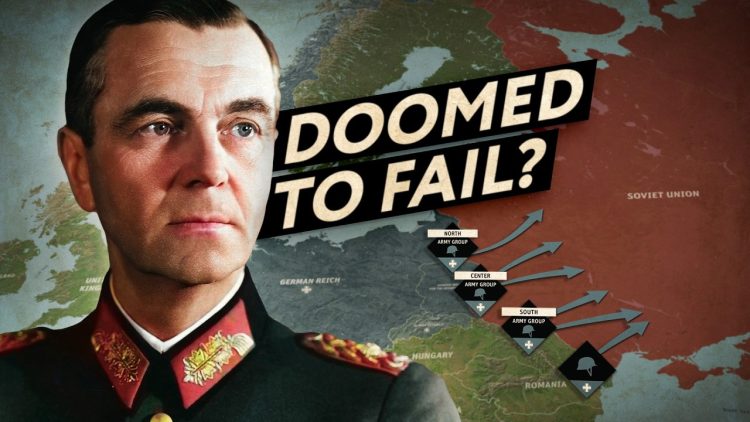
Was Operation Barbarossa Doomed to Fail?
When Nazi Germany invaded the Soviet Union on 22 June 1941, in an operation codenamed Barbarossa, observers around the world expected a quick German victory, and so did Adolf Hitler and the Wehrmacht leadership. The German army had swept through Poland, France and the Balkans in a matter of weeks. The Soviet Union, purged of many of its officers and humiliated in its war with Finland, looked like the next domino to fall. This film from Real Time History asks whether that confidence was ever justified, and whether the invasion was doomed from the start.
The film’s starting point is the German plan itself. Barbarossa called for a rapid campaign: three army groups driving into the Soviet Union, destroying the Red Army in great encirclement battles near the border, and reaching a line from Archangel to Astrakhan before the winter. The planners assumed the Soviet state would collapse once its armies were destroyed, much as France had collapsed the year before. The film shows how many of those assumptions turned out to be flawed, and how the flaws compounded as the campaign went on.
One of the central problems was intelligence. German estimates of Soviet strength were badly wrong. The planners counted the divisions the Red Army could field at the start of the campaign, but they underestimated the reserves the Soviet Union could raise, the speed with which it could raise them, and the scale of its industrial capacity once factories were moved east of the Urals. As the summer wore on, the Germans kept meeting fresh Soviet armies that their intelligence had said did not exist.
The film also looks at the argument inside the German high command. Hitler and his Chief of the General Staff, Franz Halder, disagreed about the campaign’s priorities: Hitler wanted the economic prizes of Ukraine and the Caucasus, while Halder wanted a direct drive on Moscow. The argument it presents is that neither man could be wrong in his own system, so the campaign drifted between competing objectives instead of committing to one. The result was a summer of spectacular tactical victories that never added up to the strategic decision the plan required.
By the autumn the campaign was running out of time, men and supplies. The German advance slowed in the autumn rains, and then the Russian winter arrived with the army still in summer uniforms and its vehicles unprepared for the cold. The Soviet counter-offensive outside Moscow in December 1941 ended any hope of a quick victory. The war in the east would last another three and a half years and would become the largest and deadliest land campaign in history.
What the Film Explores
The film explores the planning of Barbarossa in detail, drawing on the work of historians including David Stahel, whose research on the campaign has reshaped how it is understood. Stahel’s argument, which the film presents, is that the German plan was built on a series of optimistic assumptions about Soviet weakness, and that the campaign was in trouble far earlier than the traditional story allows, well before the winter set in. The film also draws on the official German history of the war, on Alan Clark’s classic account, and on the work of David Glantz and Jonathan House on how the Red Army stopped the invasion.
It also explores the human and material scale of the invasion. More than three million German soldiers crossed the border in June 1941, supported by hundreds of thousands of troops from Germany’s allies. The Soviet Union would lose millions of soldiers in the first months of the war, killed or captured, and yet it kept fighting. The film asks how a state that suffered such catastrophic losses was able to survive, and finds part of the answer in the depth of Soviet manpower, the relocation of industry, and the sheer size of the country the Germans were trying to conquer.
A third thread is the question in the title: was the invasion doomed to fail? The film does not give a simple yes or no. It shows that a quick victory was unlikely given what the Germans knew and did not know, but it also shows that the campaign came closer to success than is sometimes remembered, and that the outcome depended on decisions and accidents along the way. What it establishes is that the plan’s assumptions were wrong in ways that mattered, and that the German leadership’s inability to admit that was itself part of the failure.
Key Themes
- The German plan for a rapid campaign and its flawed assumptions
- Intelligence failures and the underestimation of Soviet reserves
- The disagreement between Hitler and Franz Halder over priorities
- The encirclement battles of the summer of 1941
- The Soviet Union’s relocation of industry beyond the Urals
- The autumn rains, the Russian winter and the stalling of the advance
- The Soviet counter-offensive outside Moscow in December 1941
- Whether Barbarossa was doomed, or merely badly planned
Production and Background
Was Operation Barbarossa Doomed to Fail? is a film by Real Time History, a channel known for detailed, source-driven military history. The film runs for about twenty-two minutes and is built around maps, archival footage and a careful reading of the sources, with a full source list published alongside it, including the multi-volume official German history of the Second World War, David Stahel’s studies of the campaign, and the work of Richard Overy and Roger Moorhouse. The channel’s historical consultant for its Second World War series is Professor Richard Overy of the University of Exeter.
The film is part of a wider reconsideration of Barbarossa that has taken place among historians in recent decades. Older accounts often presented the invasion as a near-run thing, defeated by the winter and by Hitler’s interference. More recent scholarship has stressed the structural problems in the German plan, the scale of Soviet resistance, and the fact that the German army was logistically overstretched from the first weeks. This film sits squarely in that newer tradition, and it is a good entry point for anyone who wants to understand why the largest invasion in history failed.
Recommended Companion Viewing
Explore authoritative investigative documentaries on related historical events and investigative subjects.

Road to Defeat: Adolf Hitler's Fatal Mistakes
The Truth About YouTube
Rise of China
Countdown to War: 1930s Europe in Colour
Frequently Asked Questions
What was Operation Barbarossa? The codename for Nazi Germany’s invasion of the Soviet Union, launched on 22 June 1941. It was the largest military invasion in history, involving more than three million German troops.
Who was Franz Halder? The Chief of the General Staff of the German Army, who helped plan Barbarossa and disagreed with Hitler about whether the main effort should go towards Moscow or towards Ukraine and the Caucasus.
Why did the Germans expect a quick victory? They had defeated France in six weeks the year before, and they believed the Soviet state was weak and would collapse once its armies were destroyed. That belief proved wrong.
What stopped the German advance? A combination of Soviet resistance, vast distances, overstretched supply lines, the autumn rains, and the winter of 1941, followed by the Soviet counter-offensive outside Moscow in December.
How long did the war in the east last? From June 1941 until May 1945, nearly four years, and it accounted for the great majority of German military deaths in the Second World War.