
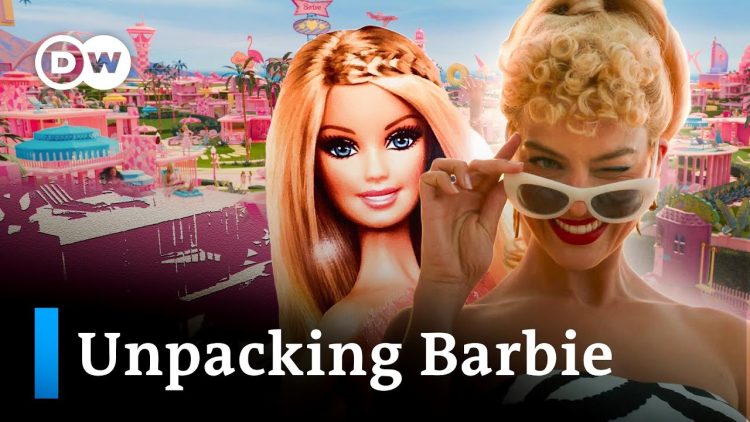
Why Barbie Matters
Barbie is the most famous doll in the world. And at the same time, she is the most controversial. Some see her as a danger to little girls, a plastic ideal of beauty that no real body can match. For others, Barbie is a role model, a versatile and independent woman who has had more than two hundred careers, and entirely compatible with a contemporary feminist self-image. Now Barbie has been brought to life in a wild and quirky comedy starring Margot Robbie and Ryan Gosling, directed by the feminist filmmaker Greta Gerwig. On this episode of Arts Unveiled, DW asks the question in the title: does Barbie still matter today, and did she ever?
The story begins in 1959, when Ruth Handler, the co-founder of the toy company Mattel, unveiled the first Barbie at the American International Toy Fair in New York on 9 March. Handler had watched her daughter Barbara play with paper dolls, giving them adult roles, and she saw a gap in the market for a three-dimensional doll that was a grown woman rather than a baby. She modelled the doll on the German Bild Lilli doll, redesigned it, and named it after her daughter. The first Barbie wore a black-and-white striped swimsuit, had a blonde or brunette ponytail, and sold 350,000 units in her first year. Ken, her boyfriend, arrived two years later, in 1961, named after Handler’s son, and the film asks whether he was ever more than a sidekick.
The criticism came early and never stopped. Barbie’s proportions, impossibly thin, impossibly tall, impossibly blonde, were attacked as a beauty standard that made real girls feel inadequate. The film takes that criticism seriously, and it also takes the other side seriously: for many girls, Barbie was the first doll that was not a baby to be looked after, but an adult woman with a job, a house and a life of her own. The film tells the story of the protest that made the point most vividly: in 1993, activists swapped the voice boxes of Barbie and GI Joe dolls, so that Barbie said things like let’s go kill, and GI Joe said let’s go shopping, and returned them to the shelves, a prank that exposed how deeply gender was built into the toys.
The film then turns to the question of whether Barbie can be a feminist icon, and it finds the answer in her history of reinvention. Barbie has been an astronaut, a surgeon, a president and a computer engineer, and the film argues that her endless careers made her a figure girls could project their ambitions onto, even when her body sent a different message. The story of Black Barbie is the film’s most powerful chapter: the first Black doll, Christie, arrived in 1968 as Barbie’s friend, but it was not until 1980 that Mattel released a doll actually called Black Barbie, designed by Kitty Black Perkins, the company’s first Black designer, after the Mattel employee Beulah Mae Mitchell asked the company for one. The film shows what that doll meant to Black girls who had never seen a Barbie who looked like them.
What the Film Explores
The film explores Barbie’s early history first, and it wants the viewer to understand how radical she was in 1959. Before Barbie, dolls were babies, and girls were expected to practise being mothers. Barbie was an adult, with adult clothes, adult jobs and an adult life, and the film shows how that simple fact made her both liberating and controversial from the start. Ken’s arrival in 1961 is treated as a footnote with a point: he was named after Handler’s son, he was marketed as Barbie’s boyfriend, and the film asks, with a smile, whether he was ever anything more than an accessory to her story.
A second thread follows the criticism, and the film gives it a full hearing. The body-image argument is the best known, and the film presents it fairly: a doll whose proportions no human body can match, sold to girls at the age when they are forming their sense of what is beautiful. But the film also presents the defence, which is that Barbie’s careers, not her body, were the point for many of the girls who played with her. The voice-box protest of 1993 is the film’s favourite example of the criticism in action: activists who swapped Barbie’s and GI Joe’s voices showed, in a single prank, that the toys were teaching children what boys and girls were supposed to be.
A third thread follows the story of Black Barbie, and the film treats it as the heart of the question of whether Barbie matters. Christie, the first Black doll in the Barbie line, came in 1968, but she was Barbie’s friend, not Barbie herself, and the film is clear about what that distinction meant: Black girls could be the friend, but not the heroine. The 1980 Black Barbie, designed by Kitty Black Perkins after Beulah Mae Mitchell’s request, changed that, and the film shows the doll’s arrival as a moment of recognition. The later diversification of the line, into different body types, skin tones, hair textures and disabilities, is presented as the continuation of that story, slow and incomplete, but real.
Key Themes & Topics Examined
- The first Barbie, unveiled at the American Toy Fair on 9 March 1959
- Ruth Handler, and the doll named after her daughter Barbara
- Ken, the boyfriend who arrived in 1961, and the question of whether he was ever more than a sidekick
- The criticism: a beauty standard no real body can match
- The 1993 protest that swapped Barbie’s and GI Joe’s voices
- Is Barbie a feminist icon? Two hundred careers, and an adult woman to play with
Production & Background
The film is a DW History and Culture production, part of the Arts Unveiled series, which looks at the stories behind art, culture and history. Its chapters run from the introduction through the early history of the Barbie doll, Ken the sidekick, the criticism of Barbie, the voice-swap protest, the feminist question, Barbie in pop culture, the story of Black Barbie, Barbie’s diversification, the mutilation of dolls, the environmental question, the new movie, and the conclusion.
Recommended Companion Viewing
Explore authoritative investigative documentaries on related historical events and investigative subjects.

Backbreaking Work: Deep-Sea Fishing in the Arctic Ocean
Behind the Polarization
How War Affects Civilians for Generations
1 Town, 13 Prisons | Inside America's Prison Capital
Frequently Asked Questions
What is the film about?
Whether Barbie still matters, from her debut in 1959 to Black Barbie, her diversification, and Greta Gerwig’s 2023 film.
When was Barbie first released?
On 9 March 1959, at the American International Toy Fair in New York, created by Ruth Handler, co-founder of Mattel, and named after her daughter Barbara.
What was the voice-swap protest?
In 1993, activists swapped the voice boxes of Barbie and GI Joe dolls, so Barbie said aggressive lines and GI Joe said shopping lines, to expose how gender was built into the toys.
When did the first Black Barbie appear?
Christie, Barbie’s Black friend, arrived in 1968, but the first doll actually called Black Barbie was released in 1980, designed by Kitty Black Perkins.







