
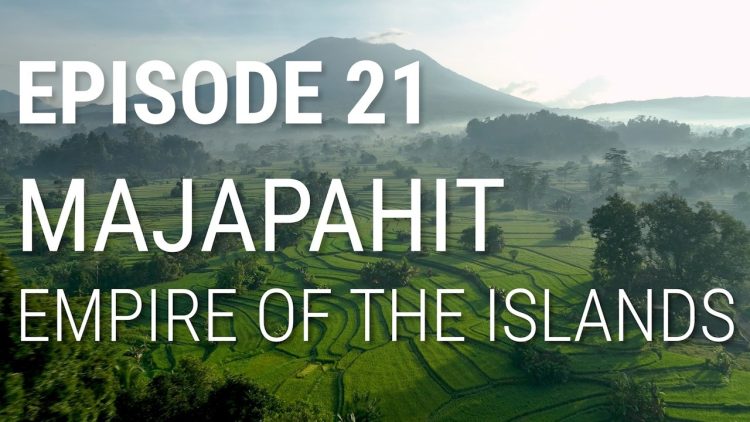
21. Majapahit – Empire of the Islands
Beneath the shade of an Indonesian teak forest, a great brick gateway stands in ruins. It is all that remains of the capital of an empire that once ruled the islands of Southeast Asia. In this episode of Fall of Civilizations, Paul M. Cooper tells the story of the Majapahit Empire of medieval Indonesia: how this empire of the islands grew up on the volcanic island of Java, and how it beat the odds to survive in a world of medieval superpowers.
The story begins in the world Majapahit inherited. Java sits on the Pacific Ring of Fire, a volcanic island in an archipelago of thousands of islands, where kingdoms rose and fell on the spice trade. The great temple of Borobudur, built by the earlier Mataram kingdom in the ninth century, shows what Javanese civilisation could already achieve: a mountain of stone carved with the daily life of its people, and ships in its reliefs that sailed across the Indian Ocean. But by the end of the thirteenth century, the island was in chaos. King Kertanegara of Singhasari had insulted an envoy of the Mongol Yuan dynasty, and in 1293 a Mongol fleet arrived to punish him.
Wijaya played the situation with extraordinary skill. He joined the Mongols to defeat Jayakatwang, then turned on his foreign allies, ambushed them and drove them back to their ships. With the invaders gone, he was crowned on November 10, 1293, as Kertarajasa Jayawardhana, the first king of Majapahit, with his capital at Trowulan in East Java. The empire he founded was a thalassocracy, a sea empire, and its power rested on ships: the great djongs that carried spices from the Maluku islands, rice from the Brantas river valley, and tribute from ports across the archipelago.
The golden age came under King Hayam Wuruk, who reigned from 1350 to 1389, working with Gajah Mada to extend Majapahit’s influence to its widest extent. The court poet Prapanca described it in the Nagarakretagama, written in 1365, which lists 98 tributaries stretching from Sumatra to New Guinea. The capital at Trowulan was a city of brick temples and canals, and the court was a centre of literature, art and Hindu-Buddhist learning. But the film also shows the cost of empire: at the Battle of Bubat in 1357, a Sundanese royal party that had come to marry a princess to Hayam Wuruk was massacred after Gajah Mada demanded she be handed over as a tributary offering. Gajah Mada fell from favour and died around 1364. After Hayam Wuruk’s death in 1389 came a succession crisis and the Regreg War of 1404 to 1406, and the empire’s grip on its overseas vassals began to loosen. The Ming treasure fleets of Admiral Zheng He sailed through Majapahit’s waters, Muslim Malacca rose to dominate the straits, and in 1527 the Sultanate of Demak captured Trowulan. The Hindu-Buddhist elites fled to Bali, and the empire of the islands was over.
What the Film Explores
The film explores how an empire is built on the sea. Majapahit had no great land army and no vast contiguous territory: it had ships, ports and tribute relationships, a mandala of kings rather than a single bordered state.
It also explores the people behind the empire. The film gives full weight to the women who ruled it: Dyah Gayatri, the queen mother, and her daughter Tribhuwana Wijayatunggadewi, who ruled as queen from 1328 to 1350 and under whom Gajah Mada rose to power.
Finally, the film explores why empires fall. Majapahit’s decline was not a single catastrophe but a slow unravelling: a succession crisis, a civil war, the rise of Muslim trading states, the shifting of the spice trade, and finally the march of Raden Patah on the capital. The film’s closing image is the Library of Karangasem and the final poem, the Siwaratri Kalpa, a reminder that what survives an empire is not its armies but its books, its temples and its stories.
Key Themes
- An empire of the islands: Majapahit ruled not by land but by sea, through ships, ports and tribute across the archipelago.
- The Mongol gambit: Raden Wijaya used the Mongol invasion fleet to defeat his rival, then drove the Mongols out and crowned himself in 1293.
- Gajah Mada’s oath: the mahapatih’s Palapa oath of 1336 vowed to unite the Nusantara before he would taste pleasure again.
- The golden age: under Hayam Wuruk (1350-1389), the Nagarakretagama listed 98 tributaries from Sumatra to New Guinea.
- Women at the centre: Queen Tribhuwana Wijayatunggadewi ruled for over two decades, and Dyah Gayatri shaped the court.
- The slow fall: succession crisis, the Regreg War, the rise of Malacca and the Ming fleets loosened the empire’s grip before Demak took Trowulan in 1527.
- What survives: the temples of Trowulan, the poems of Prapanca, and the Hindu-Buddhist culture carried to Bali.
Production and Background
The film is an episode of Fall of Civilizations, the documentary series by historian and author Paul M. Cooper, and it runs for over four and a half hours, the longest episode in the series.
Majapahit is sometimes seen as the precedent for Indonesia’s modern boundaries, and its influence is still visible in the country’s culture, from the national motto, Bhinneka Tunggal Ika, drawn from an Old Javanese poem, to the temples of Bali, where the empire’s Hindu-Buddhist culture survives.
Recommended Companion Viewing
Explore authoritative investigative documentaries on related historical events and investigative subjects.

Hitler's Reich - Diaries of Nazi Supporters, Opponents and Victims (2/4)
Why Botswana Got So Wealthy
17. Carthage - Empire of the Phoenicians
Food History: Enlightenment Dining | Let’s Cook History | Free Documentary History
Frequently Asked Questions
When did the Majapahit Empire exist? From 1293, when Raden Wijaya was crowned after driving out the Mongol invasion fleet, until 1527, when the Sultanate of Demak captured the capital at Trowulan. Its golden age was under King Hayam Wuruk, who reigned from 1350 to 1389.
What was the Palapa oath? It was the vow taken by the prime minister Gajah Mada at his installation in 1336: he swore not to taste palapa, a spice or worldly pleasure, until the realms of the Nusantara, the Indonesian archipelago, were brought under Majapahit. It became the symbol of the empire’s ambition.
Where was Majapahit’s capital? At Trowulan, in East Java, in the Brantas river valley. The site is now an archaeological park of brick temples, canals and gateways, including the great brick gateway that opens the film.
What is the Nagarakretagama? It is a court poem written by the poet Prapanca in 1365, during Hayam Wuruk’s reign. It is the single most important source for Majapahit’s history, listing 98 tributaries and describing the court, the capital and the empire’s geography in detail.
More to watch
- The Complete History Of The Maya Empire: Secrets Of Mesoamerica’s Supercities
- The Complete History Of The Vikings: The Deadliest Warriors Of The Ancient World
- Facts About The Roman Empire
- Soviet Union: Rise & Fall of the Communist Empire
- Lost Books and the Ancient Mysteries They Would Solve
Majapahit was an empire built on the sea; The Complete History Of The Maya Empire: Secrets Of Mesoamerica’s Supercities tells the story of another great civilisation that built its power on a very different landscape.







