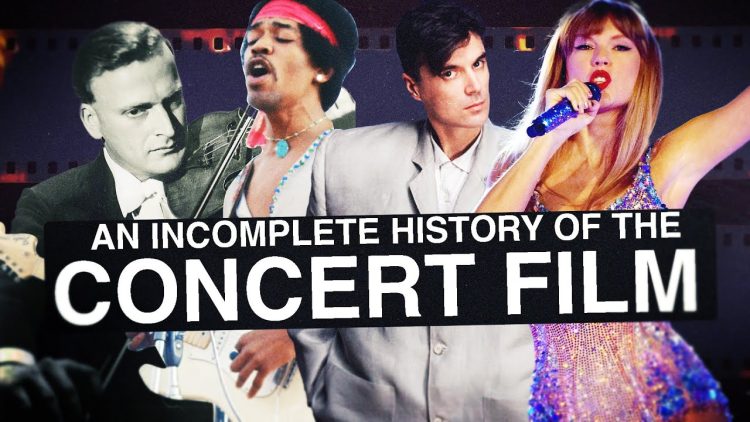
An Incomplete History of the Concert Film
How do you put a live concert on screen? A concert is a room full of people, a wall of sound, a performer and an audience feeding off each other in real time, and none of that is easy to film. In this Polyphonic video essay, Noah Lefevre traces the incomplete history of the concert film — the form that has spent decades trying to answer that question, and in doing so became an art form of its own.
The title gives the game away: the history is incomplete, and that is part of the point. The concert film has never had a single inventor or a single defining moment. It grew up in pieces, as cameras got smaller, sound got better, and musicians and filmmakers realised, separately and then together, that a filmed concert could be something more than a souvenir. Early concert films were often little more than a camera pointed at a stage, a record for the people who were there and a consolation for the people who were not.
The essay’s argument is that the concert film became interesting the moment filmmakers stopped trying to reproduce the concert and started trying to make a film about it. A live show is a shared experience, and a film is a directed one: the camera chooses where to look, the edit chooses what to keep, and the sound mix chooses what to emphasise. The best concert films use those choices to show the audience something they could not have seen from the crowd — the guitarist’s hands, the singer’s face at the quiet moment, the way a band listens to each other — and in doing so they create a new experience rather than a copy of the old one.
That tension, between the show and the film of the show, runs through the whole history. A concert film can bring a performance to people who will never see the band live, and that democratic promise has always been part of its appeal. But it can also flatten a performance, turning a loud, communal, physical event into something watched on a screen. The essay is interested in that trade-off, and in the filmmakers who found ways to make the screen feel like a room full of people rather than a window onto one.
The film also looks at what the concert film does for the music itself. A great performance on film can change how a song is heard, giving a familiar recording a face, a sweat, a mistake and a recovery. It can turn a band’s live reputation into something permanent, and it can introduce an artist to an audience that would never have bought a ticket. The history of the music itself is part of the story, because the concert film has always been a way of writing music history in pictures, preserving performances that would otherwise exist only in memory.
What the Film Explores
The film explores the difference between a record and a work of art. A record says: this happened. A work of art says: this is what it felt like. The concert film lives between those two ambitions, and the essay follows the filmmakers who pushed it from one side to the other, learning to use cameras, editing and sound not to document a show but to interpret it.
It also explores the role of the audience. A concert is not only the band; it is the crowd, and the film asks what happens to the crowd when the show is filmed. Some concert films treat the audience as background, and some treat it as a character, and the essay suggests that the best ones understand that the energy in the room is half the performance. A film that leaves the audience out has left out the reason the show mattered.
The film looks closely at technology, and at how each new tool changed what a concert film could be. Smaller cameras could get closer. Better sound could capture the room rather than just the stage. Streaming and home video could put a concert film in front of millions of people who had never been to a show. Each change expanded the form, and each one raised the same question again: what is a concert film for?
Finally, the film explores why the history is incomplete. The concert film is still being invented, by every artist who films a show and every director who finds a new way to shoot one. Lefevre’s own work points in that direction: alongside the essay, his description points to Lost Concerts of History, a collaborative series with Mercury Studios, and to his book Century of Song, both of which treat music history as something still being written, one performance at a time.
Key Themes
- The concert film, and the problem of putting a live show on screen.
- Why the history is incomplete, and why that matters.
- The difference between recording a concert and making a film about one.
- The camera’s choices, and what they reveal that the crowd cannot see.
- The audience as part of the performance, not just background.
- How new cameras, sound and home video expanded the form.
- How a filmed performance can change the way a song is heard.
- Music history preserved in pictures, one performance at a time.
Production and Background
The film is a Polyphonic video essay by Noah Lefevre, the Ottawa-based music journalist whose channel makes mini-documentaries about the music people love, using research, cultural criticism and motion graphics to tell stories about songs, artists and the way music works. Lefevre’s work has been covered by Film Independent and others for its rigorous, watchable approach to music history, and his book Century of Song and the collaborative series Lost Concerts of History, made with Mercury Studios, extend the same project: treating popular music as a subject worth serious, careful storytelling. The essay runs just under 31 minutes.
Recommended Companion Viewing
Explore authoritative investigative documentaries on related historical events and investigative subjects.

Frequently Asked Questions
What is a concert film? A film of a live musical performance, made either as a record of a show or as a cinematic work in its own right. The essay argues that the best concert films are the second kind.
Why is the history incomplete? Because the form has no single origin and is still being invented. Every generation of filmmakers and musicians adds to it, and Lefevre’s title is a reminder that any history of it is a work in progress.
Who is Noah Lefevre? The creator of Polyphonic, a YouTube channel of music video essays, and the author of the book Century of Song. His essays combine research, criticism and graphic design to explore music history.
What is Lost Concerts of History? A collaborative series by Polyphonic and Mercury Studios, mentioned in the video’s description, about concerts from the past.
Can a film ever capture a live concert? The essay’s answer is that it cannot reproduce one — but it can create something else of value, showing the audience things they could not have seen from the crowd.
More to watch
- The Untold History of Disco
- The global rise of afro house music
- The healing power of music – How does music impact us?
- How these Oscar Winners Changed Movie History