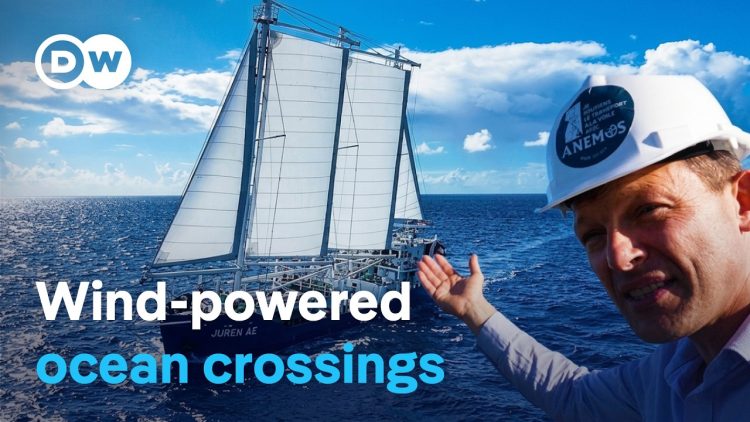
Cargo sailboats: A sea change for shipping?
The shipping industry is facing radical change, with a goal of becoming climate-neutral by 2050. The question this documentary asks is whether cargo sailboats — which harness wind power using yacht-racing technology and digital weather routing — are the solution. It is a question about the future of an industry that most people never think about, and the film’s answer is that the future is already being tested on the world’s oceans.
The shipping industry is under pressure. It is responsible for about three percent of global CO₂ emissions, and it is expected to become climate-neutral by 2050. To achieve that aim, wind power is coming under the spotlight — not as a romantic throwback to the age of sail, but as a modern technology. A remarkable experiment is underway on the world’s oceans, the film says, to find out how to make the best possible use of wind energy. Largely unnoticed by the public, the first modern cargo sailing ship was launched in France in 2020, and the voyage was deemed a success.
Also in France, the 81-metre “Anemos” — currently the world’s largest sail-powered cargo ship — set sail in 2024. And the inter-island freighter “Juren AE”, which operates in the Marshall Islands, was developed by the University of Applied Sciences Emden/Leer, and it too demonstrates the feasibility of emission-free shipping. The film follows these ships as proof that the idea works in practice, not only on paper — three very different vessels, in three very different places, all showing that wind can move cargo.
In technical terms, these ships are modelled after the high-tech racing yachts used by professional sailors such as Isabelle Joschke and Boris Herrmann. Carbon masts, optimised hulls and digital weather routing enable fast, safe and efficient voyages. The film draws an explicit parallel with the automotive industry, where motor racing technologies are incorporated into vehicles on the production line: what is proven at the sharp end of a sport finds its way into everyday use. Cargo sailboats, the documentary argues, are now demonstrating that if shipping is to become climate-neutral, wind power is crucial.
What the film leaves the viewer with is the scale of the change and the modesty of the means. No new fuel has to be invented, no exotic chemistry is required — the wind that filled sails for thousands of years, harnessed with carbon fibre and computers, is being put back to work. The experiment the film documents is still running, but the ships it follows have already shown that the idea is not a fantasy. The question is no longer whether it can be done, but how fast the industry will follow.
What the Film Explores
The film explores the emissions problem first, because the size of the problem sets the scale of the answer. Shipping is responsible for about three percent of global CO₂ emissions — a share large enough to matter, from an industry most people never see. The goal of becoming climate-neutral by 2050 is the pressure that makes the whole story necessary, and the documentary keeps returning to it: whatever replaces today’s ships has to work at the scale of world trade, not only in a laboratory.
A second thread follows the French experiments, where the modern cargo sailing ship was born. The first modern cargo sailing ship was launched in France in 2020, and the voyage was deemed a success — the proof of concept. Then came the “Anemos”, 81 metres long, the world’s largest sail-powered cargo ship, setting sail in 2024. The film treats these two ships as a sequence: the experiment, and then the scale-up.
A third thread follows the “Juren AE”, the inter-island freighter operating in the Marshall Islands and developed by the University of Applied Sciences Emden/Leer. It is a different kind of vessel for a different kind of route — short hops between islands rather than ocean crossings — and the film uses it to show that emission-free shipping is not only for the biggest ships on the longest routes. If it works between small Pacific islands, the idea has a breadth the French ships alone could not prove.
Running through the film is the technology transfer from yacht racing. The ships are modelled after the high-tech racing yachts sailed by professionals such as Isabelle Joschke and Boris Herrmann, and the film shows what that means in practice: carbon masts, optimised hulls, digital weather routing — the same ingredients that make a racing yacht fast, applied to moving cargo. The parallel with motor racing, where track technology ends up in production cars, is the film’s way of saying that this is how industries change: at the sharp end first, and then everywhere.
Key Themes & Topics Examined
- Shipping is responsible for about three percent of global CO₂ emissions
- The goal of climate-neutral shipping by 2050
- The first modern cargo sailing ship, launched in France in 2020
- The “Anemos”: 81 metres, the world’s largest sail-powered cargo ship, sailing since 2024
- The “Juren AE” inter-island freighter in the Marshall Islands
- The University of Applied Sciences Emden/Leer
- Racing yacht technology: Isabelle Joschke and Boris Herrmann
- Carbon masts, optimised hulls and digital weather routing
Production & Background
The documentary is a DW Documentary production about the return of wind power to commercial shipping. Its locations follow the ships themselves: France, where the first modern cargo sailing ship was launched and where the “Anemos” sails, and the Marshall Islands, where the “Juren AE” works between islands.
The film’s structure follows the idea from problem to proof: the emissions and the 2050 goal, the experiments that showed it could work, and the racing technology that makes it possible. It is a film about an industry in the middle of a change that most of the public has not noticed yet.
Recommended Companion Viewing
Explore authoritative investigative documentaries on related historical events and investigative subjects.

Climate change – living on the water
The Global North taken to court - Who pays for the climate catastrophe?
Climate protection from moors
Climate change: Europe's melting glaciers
Frequently Asked Questions
How much CO₂ does shipping produce?
The shipping industry is responsible for about three percent of global CO₂ emissions, according to the film — and it is expected to become climate-neutral by 2050.
What is the “Anemos”?
An 81-metre ship launched in France, currently the world’s largest sail-powered cargo ship. It set sail in 2024, following the first modern cargo sailing ship, launched in France in 2020.
What is the “Juren AE”?
An inter-island freighter operating in the Marshall Islands, developed by the University of Applied Sciences Emden/Leer. It demonstrates the feasibility of emission-free shipping on short island routes.
How do racing yachts help cargo ships?
The cargo sailboats are modelled after high-tech racing yachts sailed by professionals such as Isabelle Joschke and Boris Herrmann. Carbon masts, optimised hulls and digital weather routing — the ingredients of a fast racing yacht — are what make the cargo ships fast, safe and efficient.
Can wind really power modern shipping?
That is the film’s central question, and its answer is that the experiment is already working: the ships it follows have shown that wind power, harnessed with modern technology, can move cargo — and that it will be crucial if shipping is to become climate-neutral.