
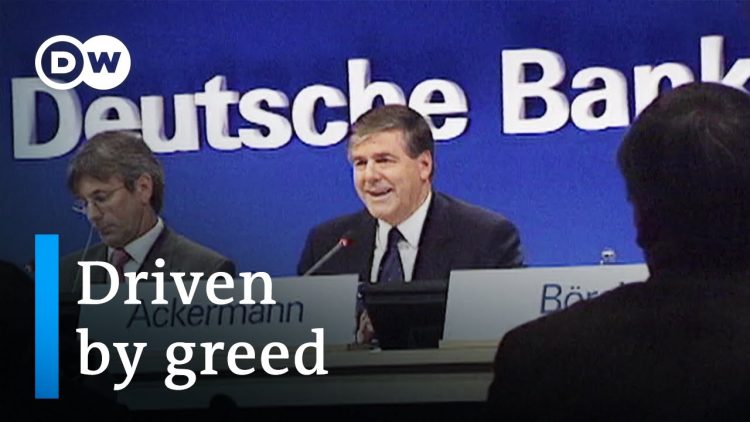
Gambled away in the financial crisis – The Deutsche Bank story | DW Documentary
Deutsche Bank was once the flagship of the German economy, a name that stood for solidity, prudence and trust. By the end of the 2000s, it had fallen from grace, and this DW documentary tells the story of how it happened: how managers driven by greed set the bank on the wrong track, pumped it full of risk in the quest for ever greater profits, and helped cause the financial crisis of 2007 and 2008.
The film’s story begins with ambition. In the 2000s, Deutsche Bank’s managers wanted to make the institution a global player, a bank that could compete with the great American investment banks on their own turf. To do that, they gave their investment bankers a free hand. The bankers were told to grow, to take risks, to bring in profits, and for a while they did exactly that. The profits were enormous, and the bonuses were enormous too.
When the crisis came in 2007 and 2008, Deutsche Bank’s collapse played a key role. The film shows how the bank’s appetite for risk was not a side story to the crisis but one of its main drivers: a major European bank, chasing the same profits as its American rivals, had helped build the house of cards, and when it fell, the damage spread everywhere. The bank survived, but only just, and the price of survival was a long, slow decline.
The victims, the film insists, were not the people who caused the damage. They were Deutsche Bank’s customers and shareholders. The share price tells the story in a single number: it is hovering around 10 euros, where twenty years ago it was around 60 euros. The savers, the pension funds and the small shareholders who trusted the bank’s name watched their investment lose most of its value, while the bank paid out billions in fines for the conduct of its own managers.
The same pattern — private profit, public cost — runs through the banking stories told in The Poor, The Banks & Digital Money, and it is why the Deutsche Bank story still matters.
What the Film Explores
The film explores how a conservative bank became a gambler. Deutsche Bank’s managers did not set out to destroy the institution. They set out to make it bigger, richer and more global, and each step along that road seemed reasonable at the time: hire the best investment bankers, give them room to work, reward them for results. The film follows that logic step by step, showing how a culture of risk-taking grew inside the bank until it was no longer a choice but the way things were done.
It also explores the machinery of the crisis itself. The financial products at the heart of the 2007 and 2008 collapse were complex, and the film takes the time to explain what they were and how they worked, in terms a general audience can follow. The point is not the technical detail. It is that the complexity was the danger: products that few people understood were being bought and sold in enormous volumes, and when the underlying loans began to fail, nobody knew who was holding the losses.
A third strand is the aftermath: the fines, the decline and the long attempt to rebuild. The penalties imposed by supervisory authorities now run into the tens of billions of euros, and each fine is a reminder of conduct that the bank has had to answer for years after the event. The share price, stuck around 10 euros against 60 twenty years earlier, is the market’s verdict on what the bank became.
Key Themes
- Ambition and risk: the drive to make Deutsche Bank a global player led its managers to give investment bankers a free hand, and the bank filled with risk.
- The road to the crisis: the bank’s risk-taking was a major contributing factor in the financial crisis of 2007 and 2008, not a footnote to it.
- Fines in the tens of billions: supervisory authorities are still imposing penalties, and the total now runs into the tens of billions of euros.
- The victims: customers and shareholders paid the price, with the share price falling from around 60 euros to around 10 euros over twenty years.
- Bonuses without consequences: investment bankers received millions in bonuses year after year, keeping the rewards while others bore the costs.
- A flagship fallen: the bank was once the flagship of the German economy, and its decline is a national as well as a corporate story.
Production and Background
The film is a DW Documentary production, made in the broadcaster’s journalistic style, with reporters following the paper trail of fines, share prices and boardroom decisions, and speaking to the people who watched the bank’s transformation from the inside.
The story is still unfolding. The fines continue, the share price has not recovered, and the bank is still working through the consequences of decisions made in the 2000s. The film’s value is in laying out that history clearly, in one place, so that a viewer who remembers the crisis as a blur of headlines can see how one bank, in one country, helped make it happen, and who paid for it.
Recommended Companion Viewing
Explore authoritative investigative documentaries on related historical events and investigative subjects.

How to Lose $35 Billion Dollars Betting on AI
How much influence do the super rich have?
The Rise of India as a Global Economic Power | Bloomberg Originals Marathon
How AI Is Pushing the Semiconductor Supply Chain to the Limit | Bloomberg Primer
Frequently Asked Questions
What did Deutsche Bank do wrong? In the 2000s, its managers gave investment bankers a free hand in the quest for ever greater profits, pumping the bank full of risk. That risk-taking was a major contributing factor in the financial crisis of 2007 and 2008.
How much has the bank paid in fines? Supervisory authorities are still imposing fines, and the penalties now run into the tens of billions of euros.
What happened to the share price? The share price is hovering around 10 euros, where twenty years ago it was around 60 euros — a loss of most of its value for the shareholders who trusted the bank.
Who benefited from the risk-taking? The investment bankers. Many received millions in bonuses year after year, while the customers and shareholders bore the losses.
More to watch
- The Poor, The Banks & Digital Money
- How 3 Million People Got Locked Out of their Bank
- Overworked Underpaid: The Strange Economics of Essential Jobs
- Luxury Living and the Ultra-Rich – When Money is No Object







