
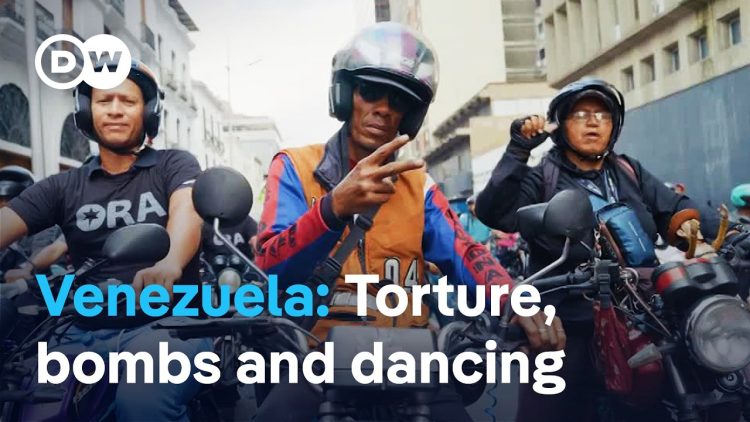
Venezuela in the midst of the US military intervention – Notes from Caracas
In December 2025, documentary filmmaker Anabel Rodríguez Ríos returned home to Venezuela for the saddest of reasons: the death of her stepfather, Nelson. She came to mourn with her mother, in a country that is economically devastated, where the public healthcare system is in crisis, and where medical treatment that might have saved her stepfather’s life was simply too expensive. What she found, when she arrived, was a country at the centre of world events — and a people with no power over any of it. This film is her record of that homecoming, shot in real time and told in the first person.
The backdrop is a gathering confrontation. In the Caribbean Sea, off the coast of Venezuela, the United States is stationing warships. President Donald Trump has threatened Venezuela’s deposed leader, Nicolás Maduro, with war, accusing him of narco-terrorism. In September 2025, the United States began ordering strikes on Venezuelan boats without an international legal mandate, on the claim that the boats belong to drug traffickers. More than 100 people have been killed in these strikes so far. The film does not present this as distant geopolitics. It presents it as the weather over Caracas — the thing everyone is living under, and no one can change.
Then, on the night of 3 January 2026, the filmmaker is awakened by bombs. The United States has launched a strike on Venezuela. Maduro and his wife are captured and taken to the United States, where they are almost immediately indicted. The film’s central sequence is that night and what follows: a capital city caught in a military operation it did not choose, filmed by a woman who is there because her stepfather died, and who is now watching her country become a battlefield.
What makes the film different from a news report is what it shows alongside the war. On New Year’s Eve, the streets of Caracas are filled with music and dancing, even as American aircraft bomb boats in the Caribbean and Venezuela is gripped by uncertainty. At the same time, American corporations are already dividing up Venezuela’s wealth — the oil that the United States is now asserting control over. The film holds these two pictures together: a city celebrating, and a country being carved up.
As she moves through the city, the filmmaker meets the people the headlines miss: human rights activists, relatives of political prisoners, and survivors of torture. They report on enforced disappearances, on beatings and arbitrary arrests, in a system designed to intimidate and silence those who dissent. In her own family, conversations at home reflect a society marked by polarisation, fear and exhaustion. The film closes as an intimate portrait of Venezuela at a turning point — told from the inside, by someone who belongs there, and who knows that the turning point may not turn in her country’s favour.
What the Film Explores
The film explores the personal story first, and it is the story that gives the documentary its shape. A filmmaker comes home to mourn her stepfather, in a country where the healthcare system is in crisis and treatment is too expensive for ordinary people. The documentary treats that private grief as the way into the public story: the economic devastation of Venezuela is not an abstraction in this film, it is the reason a man died, and the reason his family is gathered in mourning.
A second thread follows the military confrontation, and the film is at its most direct here. The warships in the Caribbean, the strikes on boats ordered from September 2025, the more than 100 people killed, the accusation of narco-terrorism, the absence of an international legal mandate — the documentary lays out the sequence of events as they happened, and then shows what they felt like from the ground, in a city where the bombs arrived in the night and the president was taken away by morning.
A third thread follows the people, and it is the film’s heart. Human rights activists, relatives of political prisoners, survivors of torture — the film gives time to the voices that describe enforced disappearances, beatings and arbitrary arrests, and the system built to intimidate and silence dissent. These are not interviews conducted for colour. They are the evidence of what the country has become, told by the people living in it.
Running through the film is the contrast between the ordinary and the geopolitical — the music and dancing on New Year’s Eve, and the corporations already dividing up Venezuela’s oil. The documentary’s argument is that this is what intervention looks like from the inside: not a single event, but a country caught between hope and resignation, where everyday life goes on and the future is decided elsewhere.
Key Themes & Topics Examined
- Anabel Rodríguez Ríos, a filmmaker coming home to mourn
- Venezuela’s economic devastation, and a healthcare system in crisis
- US warships in the Caribbean, and strikes on Venezuelan boats
- The night of 3 January 2026, and the capture of Nicolás Maduro
- Music and dancing in Caracas, while the country is gripped by uncertainty
- American corporations, and the oil the US is asserting control over
- Human rights activists, political prisoners and survivors of torture
- A country caught between hope and resignation
Production & Background
The film is a DW Documentary production, presented as Notes from Caracas. It is shot in real time and told from a first-person perspective, blending personal experience, political power plays and global interests into an intimate portrait of Venezuela at a turning point.
The documentary’s subject is Venezuela in the midst of the United States military intervention, as seen from Caracas by filmmaker Anabel Rodríguez Ríos. Its timeline runs from her return home in December 2025 to the strikes of January 2026, and its sources are the people she meets in the city — activists, families of prisoners, and survivors — as well as her own family, and her own experience of the bombs.
Recommended Companion Viewing
Explore authoritative investigative documentaries on related historical events and investigative subjects.

What Iran’s Top Security Official Said About June 2025 U.S. and Israeli Strikes
Inside the Polarization
North Korea's alliance with China and Russia
The World's Most Impossible Rescues: Survival Against All Odds
Frequently Asked Questions
What is the film about?
Filmmaker Anabel Rodríguez Ríos returns home to Venezuela to mourn her stepfather, and films from Caracas as the United States launches military strikes on the country.
What happened on 3 January 2026?
The filmmaker was awakened by bombs as the United States launched a strike on Venezuela. Nicolás Maduro and his wife were captured and taken to the United States, where they were almost immediately indicted.
Why were the US strikes controversial?
The United States began ordering strikes on Venezuelan boats in September 2025 without an international legal mandate, on the claim that the boats belonged to drug traffickers. More than 100 people had been killed in these strikes.
Who does the filmmaker meet in Caracas?
Human rights activists, relatives of political prisoners, and survivors of torture, who describe enforced disappearances, beatings and arbitrary arrests.
Who made the film?
DW Documentary, as Notes from Caracas — a first-person documentary by Anabel Rodríguez Ríos, shot in real time.







