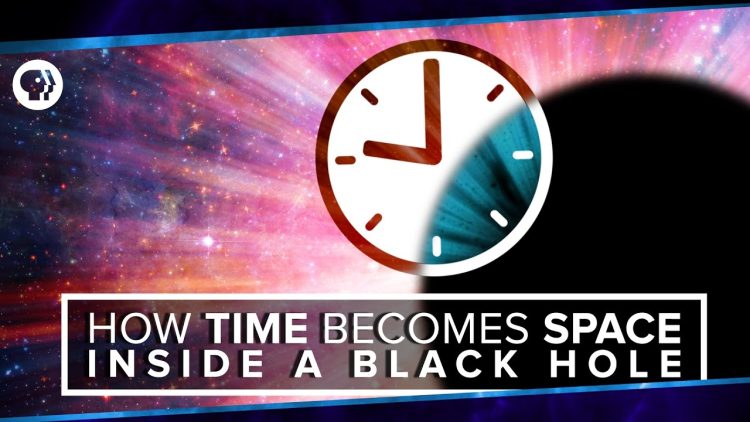
How Time Becomes Space Inside a Black Hole | Space Time
Black holes are strange enough from the outside. They are places where gravity is so strong that nothing, not even light, can escape, and where time slows to a crawl for anyone watching from far away.
The key idea is that a black hole does not simply pull things in hard. It reshapes the geometry of spacetime so thoroughly that the direction towards the centre stops being a direction in space at all. Outside the horizon, you can move left or right, up or down, or stay still, and time carries you forward whether you like it or not. Inside the horizon, the maths of general relativity says that the roles reverse: the inward direction becomes like time, and time becomes like space.
That is why nothing escapes. It is not that the black hole’s gravity is too strong to fight, although it is, but that escape would require moving backwards in time. Every path that leads forward in time inside the horizon leads towards the centre, towards the singularity.
The film builds on earlier Space Time episodes about the event horizon and the geometry of causality, and it is careful about what is known and what is not. Nobody has been inside a black hole and returned to report, and the singularity itself, the point where the equations of general relativity break down, is a sign that our current theories are incomplete rather than a description of a real place. What the episode offers is the clearest picture physics can currently draw of the interior, and it is stranger than any science fiction version.
At just over fifteen minutes, this is one of the shorter films in the batch, but it takes on one of the hardest ideas in modern physics and works through it step by step, using diagrams and plain language rather than equations. It is a good companion to the channel’s longer black hole retrospective, which covers the same physics in much more detail.
What the film explores
The episode starts with the event horizon itself, the boundary around a black hole beyond which nothing returns. For a black hole formed from a collapsed star, the horizon sits at the Schwarzschild radius, a distance set by the black hole’s mass: about three kilometres for a black hole with the mass of the Sun, and millions of kilometres for the supermassive black holes at the centres of galaxies. The film explains that the horizon is not a surface you could touch or see. It is a boundary in spacetime, and crossing it feels like nothing special to the person falling in.
The central section works through the swap of space and time. In ordinary life, space is the set of directions you can move in freely, and time is the direction you are carried along without a choice. Inside a black hole, the mathematics reverses that assignment for the radial direction, the line running from the horizon to the centre. The film shows this with light cones, which tip further and further inward as you approach the horizon and then past it, until all possible futures point towards the singularity. The singularity is not a place in space that you travel to, in this picture, but a moment in time that you arrive at, as unavoidable as next Tuesday.
The episode also touches on why this matters for physics as a whole. Black holes are the places where general relativity, which describes gravity and the large-scale shape of the universe, meets quantum mechanics, which describes the very small, and the two theories do not agree about what happens at the singularity. The film presents the interior as a laboratory for that conflict, and notes that a full theory of quantum gravity is needed before anyone can say what really sits at the centre of a black hole.
Key Themes
- The event horizon as a boundary in spacetime, not a physical surface.
- How light cones tip inward as you cross the horizon.
- The swap of space and time inside a black hole.
- Why escape from a black hole would mean travelling backwards in time.
- The singularity as a moment in time, not a place in space.
- Why the interior is a test case for quantum gravity.
- General relativity’s predictions taken to their extreme.
Production and Background
The episode is from PBS Space Time, the PBS Digital Studios series written and hosted by astrophysicist Matt O’Dowd and produced by Kornhaber Brown, first published in March 2017.
Space Time’s approach is to take one idea from modern physics and work through it carefully, with graphics by Grayson Blackmon and production by Rusty Ward.
Recommended Companion Viewing
Explore authoritative investigative documentaries on related historical events and investigative subjects.

Artemis II Congressional Space Medal of Honor Ceremony
NASA's SpaceX Crew-12 Hatch Close
The Dumbest Ways to Die in Space
NASA's SpaceX Crew-12 Re-Entry & Splashdown
Frequently Asked Questions
What happens if you fall into a black hole? You cross the event horizon without noticing anything special, and then every path forward in time leads towards the centre. The tidal forces, the difference in gravity between your head and your feet, would stretch you apart, an effect physicists call spaghettification, long before you reached the singularity.
Can anything escape from inside a black hole? No. Inside the horizon, all directions that lead forward in time point towards the centre, so escaping would require moving backwards in time. Even light cannot get out.
What is the singularity? In general relativity, the singularity is the point at the centre of a black hole where matter is crushed to infinite density and the equations break down. Physicists take that breakdown as a sign that a better theory, a theory of quantum gravity, is needed.
Does time really stop at the event horizon? From the point of view of a distant observer, a falling object appears to slow down and freeze at the horizon, its light reddened to invisibility. From the falling object’s own point of view, time passes normally and it crosses the horizon in a finite time.
Is the space-time swap a proven fact? It is a prediction of general relativity, which has passed every test so far, but no one can observe the interior of a black hole directly. The picture the episode gives is the best current theoretical description, not a direct observation.
More to watch
- Relativity is so much weirder than we thought…
- I finally saw quantum physics with my own eyes… (It’s spookier than I expected)
- Invisible Forces that Shape Our Reality — How the Universe Works
- What If an Asteroid Hit New York City? | How the Universe Works
- Planetary Defenders: This Is Not an Exercise
For the wider picture of how Einstein’s theory reshaped physics, Relativity is so much weirder than we thought… is a good place to start.