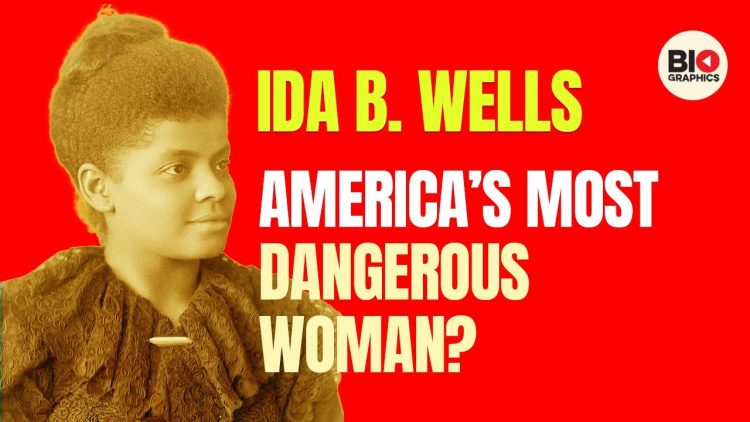
Ida B Wells – Teacher, Protester, Anti-Lynching Crusader
Ida Bell Wells was born enslaved in Holly Springs, Mississippi, on July 16, 1862, in the middle of the American Civil War. She was the eldest of eight children. When she was sixteen, a yellow fever epidemic swept through Holly Springs and killed both her parents and one of her siblings, leaving her to raise her younger brothers and sisters while finishing her own education. She became a teacher in the segregated public schools of Memphis, Tennessee, and began writing about race and politics in the South under the pen name “Iola”.
Her activism began on a train. In 1884, Wells bought a first-class ticket on the Chesapeake and Ohio Railroad and refused to move to the segregated car when the conductor ordered her to. She was forcibly removed from the train, and she sued the railroad. In 1887 a lower court awarded her $500 in damages, but the Tennessee Supreme Court overturned the verdict. The defeat taught her a lesson she never forgot: the courts would not protect Black Americans, so the truth would have to be told in print.
Then, on March 9, 1892, everything changed. Three Black businessmen in Memphis — Thomas Moss, Calvin McDowell and Will Stewart, owners of the People’s Grocery store — were dragged from their jail cells by a white mob and lynched. Their crime was commercial success: their store had drawn customers away from a white-owned rival. Moss was a friend of Wells, and she was godmother to his daughter. Wells wrote furious editorials, travelled the South at great personal risk to gather evidence, and discovered that most lynchings had nothing to do with the crimes the mobs claimed as justification. While she was in New York, a mob destroyed her newspaper office.
Exile made her a national figure. Her pamphlet Southern Horrors: Lynch Law in All Its Phases appeared in 1892, and A Red Record followed in 1895, tabulating the lynchings of 1892, 1893 and 1894 with the names, dates and alleged causes. She took her campaign to Britain, where her lectures embarrassed the American South before an international audience, and in 1898 she presented her case to President William McKinley at the White House. In Chicago she married the lawyer Ferdinand Barnett in 1895 — keeping her own name, one of the first American women to do so — and raised four children while continuing to write and organise. She helped found the National Association for the Advancement of Colored People in 1909, and on January 30, 1913, she founded the Alpha Suffrage Club, the first Black women’s suffrage organisation in Chicago. When its members marched in the 1913 Suffrage Parade in Washington, organisers asked the Black women to march at the back; Wells refused and joined the parade in the middle. She died in Chicago on March 25, 1931. In 2020, nearly ninety years later, she was awarded a posthumous Pulitzer Prize special citation for her courageous reporting on lynching.
What the Film Explores
The film explores how a teacher became a crusader. Wells did not set out to be a national figure: she was a young woman supporting her siblings, teaching in a segregated school and writing on the side. The film follows the chain of events that radicalised her — the train, the lawsuit, the firing, and then the lynching of her friend — and shows how each setback pushed her further into journalism rather than away from it.
It also explores the cost of telling the truth. Wells lost her job, her newspaper, her home city and, for a time, her safety. The film does not soften that price: the mob that destroyed her office would very likely have killed her had she been in Memphis that night.
Finally, the film explores Wells as a suffragist and organiser, a side of her life that is often overshadowed by the anti-lynching campaign. The Alpha Suffrage Club was not a side project: it helped secure the Illinois Equal Suffrage Act of June 25, 1913, and its members’ refusal to march at the back of the 1913 parade was a deliberate act of defiance. Wells fought on two fronts at once, against racism and against sexism, including from within the suffrage movement itself, and the film argues that this double fight is what makes her story still feel modern.
Key Themes
- Born enslaved: Wells was born in Holly Springs, Mississippi, in 1862 and orphaned by yellow fever at sixteen.
- The train: her 1884 refusal to leave a first-class car led to a lawsuit she won, then lost on appeal.
- The People’s Grocery: the lynching of Thomas Moss, Calvin McDowell and Will Stewart on March 9, 1892, changed her life.
- Journalism as evidence: Southern Horrors (1892) and A Red Record (1895) documented lynchings with names, dates and causes.
- Exile: a mob destroyed her newspaper office while she was in New York, and she never returned to Memphis.
- The suffragist: she founded Chicago’s Alpha Suffrage Club in 1913 and refused to march at the back of the Washington parade.
- Late recognition: a posthumous Pulitzer Prize special citation in 2020 honoured reporting done nearly 130 years earlier.
Production and Background
The film is a Biographics production, from the channel’s long-running series of biographical documentaries.
Wells’s reputation has grown steadily since her death. Her home in Chicago is a National Historic Landmark, her papers are studied as a founding text of American investigative journalism, and the 2020 Pulitzer citation finally gave her the national recognition that eluded her in life.
Recommended Companion Viewing
Explore authoritative investigative documentaries on related historical events and investigative subjects.

Boris Yeltsin: The First Russian President
Norm MacDonald: The Comedian On The Outside
Frequently Asked Questions
Who was Ida B. Wells? Ida B. Wells (1862-1931) was an American journalist, suffragist and civil rights activist, born enslaved in Mississippi. She is best known for her investigative reporting that exposed lynching in the American South in the 1890s.
What happened at the People’s Grocery? On March 9, 1892, three Black businessmen in Memphis — Thomas Moss, Calvin McDowell and Will Stewart — were lynched by a white mob after their grocery store drew customers away from a white-owned rival. Moss was a friend of Wells, and the murders turned her into an anti-lynching crusader.
What did Wells write about lynching? Her pamphlet Southern Horrors: Lynch Law in All Its Phases (1892) and her book A Red Record (1895) documented lynchings with names, dates and alleged causes, showing that most had nothing to do with the crimes the mobs claimed as justification.
Why did Wells receive a Pulitzer Prize in 2020? The Pulitzer board awarded her a posthumous special citation “for her outstanding and courageous reporting on the horrific and vicious violence against African Americans during the era of lynching,” nearly ninety years after her death.
More to watch
- Women of the Third Reich: The Other Face of Nazi Germany
- Girls Make a Comeback – What India and China Are Doing About the Women Shortage
- 3,300 Women, Just 20 Guards | Inside the Philippines’ Largest Women’s Prison
- Germany: Violence against women – Causes, consequences and ways forward
- The Untold Story of the Reagan Presidency
Wells fought for the vote as well as for justice, and Girls Make a Comeback – What India and China Are Doing About the Women Shortage shows how the struggle for women’s rights continues in the world’s two most populous countries.