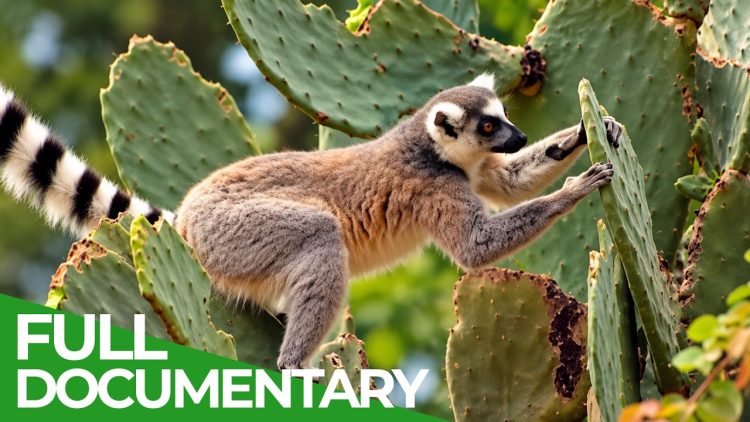
Madagascar’s Legendary Lemurs
Madagascar is an island unlike anywhere else on Earth. It broke away from Africa tens of millions of years ago and drifted alone in the Indian Ocean, and in that long isolation its wildlife evolved into forms found nowhere else. More than ninety percent of the island’s wildlife is endemic, meaning it exists nowhere else on the planet, and the most famous of its animals are the lemurs. This film takes the viewer into the forests of Madagascar to meet them.
The lemurs are primates, relatives of monkeys and of us, but they reached Madagascar long ago, most likely by rafting across the Mozambique Channel on floating vegetation, and they found an island with almost no competition. With no monkeys to compete with, they spread into every available niche, and today more than a hundred species and subspecies are recognised, ranging from the tiny mouse lemur, small enough to fit in the palm of a hand, to the indri, whose haunting calls carry for kilometres through the rainforest.
The film introduces its cast one by one. There are the playful ring-tailed lemurs, the most recognisable of all, with their black-and-white striped tails and their habit of sunbathing in the morning. There are the incredible dancing sifakas, which leap between trees in great bounds and cross open ground in sideways hops on their hind legs, arms outstretched, as if they were dancing. And there are the mysterious creatures that only emerge after dark, the nocturnal lemurs that spend the day hidden and come out when the forest belongs to them.
Between the lemurs, the film shows the island itself: the rainforests of the east, the dry forests of the west, the spiny forests of the south, and the mountains in between. Each of these worlds has its own lemurs, and the film moves between them to show how much variety a single island can hold. It also shows the dangers the lemurs face, from the fossa, the island’s largest predator, to the loss of the forests themselves.
What holds the film together is the sense that Madagascar is a world apart, and that its lemurs are the proof. They exist only here, they evolved only here, and if they are lost, they are lost everywhere. The film is a celebration of that uniqueness, and a quiet warning about how fragile it is.
What the Film Explores
The film explores the ring-tailed lemur first, the species most people picture when they hear the word lemur. Ring-tailed lemurs live in troops of up to thirty animals in the dry south of Madagascar, and they spend more time on the ground than any other lemur. They are highly social, with females leading the group, and they are famous for sunbathing, sitting upright in the morning sun with their arms outstretched. The film shows them in the gallery forests and rocky country of the south, where their black-and-white tails make them easy to spot and hard to forget.
It then turns to the sifakas, the leaping lemurs, and above all to Verreaux’s sifaka, the dancing sifaka of the dry forests. Sifakas move through the trees in an upright posture, leaping from trunk to trunk, and they can clear up to nine or ten metres in a single bound. On the ground they cannot walk normally, and instead they bound sideways on their hind legs, a movement that has earned them the name of dancing lemurs. The film captures those leaps in the open, where the white fur of the sifaka stands out against the dry forest.
The film also explores the night. Madagascar’s nocturnal lemurs include the aye-aye, one of the strangest mammals in the world, a nocturnal animal with a long, thin middle finger that it uses to tap on wood and hook out grubs. The aye-aye is often regarded locally as a bad omen, which has not helped its survival, and it is rarely seen. The film also touches on the mouse lemurs, the smallest primates in the world, some weighing only around thirty grams, which can be found on night walks with a torch.
Finally, the film looks at the threats. Roughly ninety-four percent of known lemur species are threatened with extinction, driven by deforestation, illegal logging and hunting, and the film does not hide that. It shows the fossa, the island’s largest native carnivore, which hunts lemurs in the forests, but it makes clear that the greater danger comes from people: the loss of forest, the pet trade and the hunting of lemurs for food. Parks such as Andasibe-Mantadia, Ranomafana and Masoala protect vital habitat, but the film leaves the viewer in no doubt that the lemurs’ future is uncertain.
Key Themes
- Madagascar’s long isolation, and why more than ninety percent of its wildlife is found nowhere else.
- Ring-tailed lemurs, the social sunbathers of the dry south.
- Dancing sifakas and their extraordinary leaps between trees.
- The aye-aye, a nocturnal lemur with a finger made for finding grubs in wood.
- The indri, the largest living lemur, whose calls carry through the rainforest.
- Mouse lemurs, the smallest primates in the world.
- The fossa, Madagascar’s largest predator, and the hunt for lemurs.
- Extinction, and why almost all lemur species are now threatened.
Production and Background
Madagascar’s Legendary Lemurs was released by Free Documentary Nature and runs for 48 minutes and 3 seconds. It was published in October 2026. The facts it rests on are well established: lemurs are found naturally only in Madagascar, more than a hundred species are now recognised, and the great majority are threatened with extinction. The island’s protected areas, including Andasibe-Mantadia, Ranomafana, Masoala and Berenty, are the places where most visitors go to see lemurs in the wild, and they are also the strongholds on which the animals’ survival depends.
Recommended Companion Viewing
Explore authoritative investigative documentaries on related historical events and investigative subjects.

Will renewables stop the climate crisis?
Growing Up Wild
Raja Ampat: Life in the Coral Kingdom
Nature's Social Network
Frequently Asked Questions
Where do lemurs live?
Lemurs are found naturally only in Madagascar, an island off the south-east coast of Africa. Every species is Malagasy.
Why do sifakas look like they are dancing?
Sifakas leap through the trees upright, and on the ground they cannot walk normally, so they bound sideways on their hind legs with their arms outstretched, which looks like dancing.
What is an aye-aye?
The aye-aye is a nocturnal lemur with an elongated middle finger that it uses to tap on wood and hook out insect larvae. It is one of the most unusual mammals in the world.
What is the largest lemur?
The indri is the largest living lemur, a black-and-white animal whose wailing calls carry for kilometres through the rainforests of the east.
Are lemurs endangered?
Yes. Roughly ninety-four percent of known lemur species are threatened with extinction, mainly because of deforestation, illegal logging and hunting.