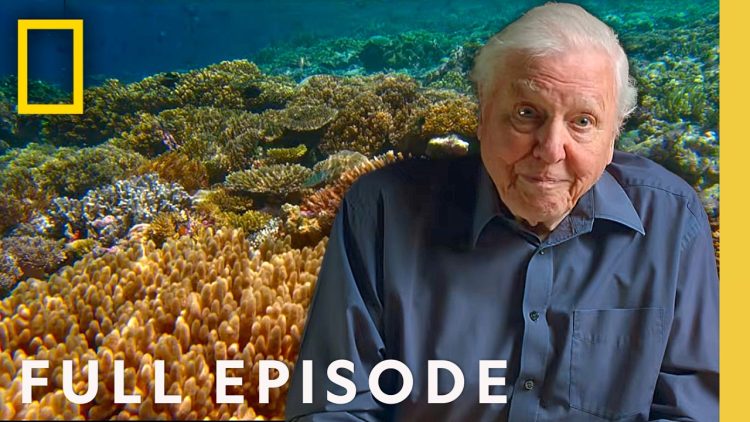
Ocean with David Attenborough (Full Documentary) | World Ocean Day Special | National Geographic
David Attenborough has spent a lifetime showing us the natural world. In Ocean with David Attenborough, released in cinemas on his ninety-ninth birthday, May 8, 2025, he turns to the place where his career began and where, he argues, the fate of the planet will be decided: the sea. The ocean covers more than seventy percent of the Earth’s surface, produces around half of the oxygen we breathe, and absorbs around thirty percent of the carbon dioxide humanity emits.
The film is structured in five chapters. It opens on the final frontier, the open ocean, a realm of seamounts and deep currents that science is only beginning to map. Then it moves to the coastal seas, where giant kelp forests and coral reefs shelter a quarter of all marine life in a fraction of the ocean’s area. These are the film’s most beautiful passages: kelp swaying in the current, coral spawning in synchrony, and the sheer abundance of a healthy sea.
The middle of the film is its hardest passage. The chapter on overfishing contains the most detailed, cinematic footage of bottom trawling ever captured: weighted nets dragged across the seafloor, ripping up everything in their path, leaving a trail of devastation and a catch in which much of what is killed is thrown back dead as bycatch. The footage, filmed in early 2024 in partnership with scientific studies, shocked audiences when it was first shown, because bottom trawling had remained hidden from view for hundreds of years.
Then comes the turn. The chapter on ocean conservation shows what happens when the nets stop: marine protected areas, where fish return, reefs recover, and the sea rebuilds itself with a speed that surprises even the scientists. The film’s argument is that the ocean is not dying but damaged, and that damage can be undone. The target is the global commitment to protect thirty percent of the ocean by 2030, and the film ends with Attenborough’s own final thoughts: a ninety-nine-year-old naturalist telling his audience that if we save the sea, we save our world.
What the Film Explores
The film explores the ocean as a single, connected system. Attenborough’s great theme, across a career of seventy years, has been connection: the idea that no habitat stands alone. Here he applies it to the sea, showing how the coastal shallows and the open ocean depend on each other, how the plankton that make our oxygen depend on the nutrients the deep currents bring up, and how a decision made in one fishery ripples across an entire ocean.
It also explores the economics of destruction. Bottom trawling is not a mystery: it is an industrial method that catches fish efficiently by destroying the habitat the fish need, and the film shows why it persists — because it is profitable, because it is invisible, and because the damage it does is underwater, where voters cannot see it.
Finally, the film explores recovery as a fact, not a hope. The marine protected areas it visits are not sanctuaries in the abstract: they are places where the fishing stopped and the sea came back, with more fish, more species, and more resilience to warming water. The film’s closing argument is that conservation is not a sacrifice but a bargain — that a protected ocean gives back more than it costs — and that the choice is ours, and still open.
Key Themes
- The final frontier: the open ocean, its seamounts and deep currents, is the least explored place on Earth.
- Coastal seas: kelp forests and coral reefs shelter a quarter of marine life in a fraction of the ocean’s area.
- Overfishing: the film shows bottom trawling in unprecedented detail — weighted nets ripping up the seafloor, with vast bycatch thrown back dead.
- Ocean conservation: marine protected areas show the sea rebuilding itself once the nets stop.
- A connected system: the ocean produces around half our oxygen and absorbs around thirty percent of our carbon dioxide.
- The 30×30 target: the global commitment to protect thirty percent of the ocean by 2030.
- Attenborough at 99: his most urgent film, released on his ninety-ninth birthday, is also his most hopeful.
Production and Background
The film is a Silverback Films and Open Planet Studios co-production, directed by Toby Nowlan, Keith Scholey and Colin Butfield, and it marks the first collaboration between Sir David Attenborough and National Geographic. It was filmed over two years in the Azores, California, Indonesia, the United Kingdom, Liberia, Antarctica, the Mediterranean and Hawaii, with the bottom trawling sequences filmed in early 2024. It premiered at the Royal Festival Hall in London on May 6, 2025, played in cinemas from May 8, premiered on National Geographic on June 7, and streamed on Disney+ and Hulu on World Oceans Day, June 8.
The film has been honoured widely since its release, winning two Critics Choice Awards in 2025, for Best Science/Nature Documentary and Best Cinematography, and two Creative Arts Emmy Awards in 2026, for cinematography and sound editing.
Recommended Companion Viewing
Explore authoritative investigative documentaries on related historical events and investigative subjects.

Our Planet | Coastal Seas | FULL EPISODE | Netflix
Raja Ampat: Life in the Coral Kingdom
Wonder Shore: Africa's Wild Paradise
Oceans Odysseys: Incredible Animal Journeys (Full Episode) | National Geographic
Frequently Asked Questions
When was Ocean with David Attenborough released? The film played in cinemas from May 8, 2025, Attenborough’s ninety-ninth birthday, premiered on National Geographic on June 7, 2025, and streamed on Disney+ and Hulu on World Oceans Day, June 8, 2025.
What is bottom trawling? Bottom trawling is an industrial fishing method in which weighted nets are dragged across the seafloor, catching fish but also destroying the habitat and killing large amounts of unintended catch, known as bycatch, which is thrown back dead.
Can the ocean recover? The film argues that it can, and shows the evidence: in marine protected areas where fishing has stopped, fish return, reefs recover, and the sea rebuilds itself faster than scientists expected.
What is the 30×30 target? It is the global commitment, agreed in 2022, to protect thirty percent of the world’s ocean by 2030 through marine protected areas. The film presents it as the most important conservation goal of the decade.
More to watch
- Forgotten Islands: The Last Coral Paradise
- Raja Ampat: Life in the Coral Kingdom
- High-Tech Shark Deterrence – Australia’s New Strategy for Safe Beaches
- Backbreaking Work: Deep-Sea Fishing in the Arctic Ocean
- Rivers at risk – Water crisis on four continents
The film’s hardest scenes are about industrial fishing, and Backbreaking Work: Deep-Sea Fishing in the Arctic Ocean shows the human side of that industry.