
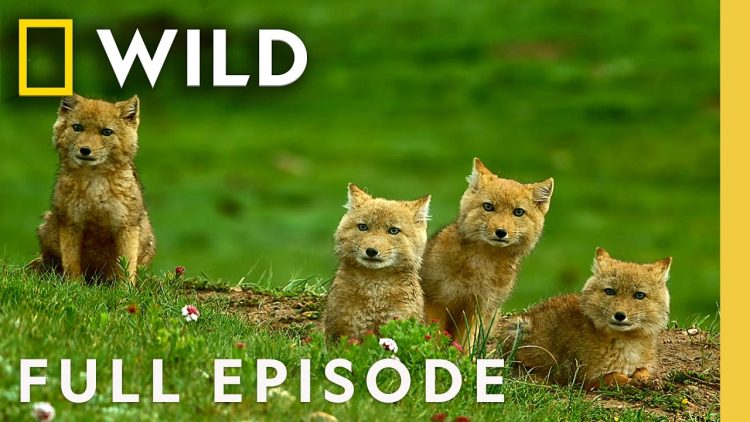
Rare Wildlife of China’s Mountains (Full Episode) | The Hidden Kingdoms of China | Nat Geo Animals
Who are the ghosts of China’s mountains? That is the question this full episode of The Hidden Kingdoms of China sets out to answer, and the ghosts turn out to be real animals, perfectly camouflaged and fiercely determined, living at altitudes where the air is thin and the weather can turn in minutes. The episode is set in Qinghai, in western China, on the Tibetan Plateau, a region often called the Third Pole because it holds more ice than anywhere on Earth outside the Arctic and Antarctica.
The star of the film is a female snow leopard and her yearling cub. Snow leopards are the top carnivores of these mountains, and they are almost impossible to see: their smoky grey coats break up against the rock, and they hunt alone, by ambush, across territories that can stretch for nearly 400 square miles. The film follows the mother as she teaches her cub to climb, to play and, above all, to hunt. Because prey is so scarce at this altitude, a mother leopard must make a kill roughly every eight to ten days to feed herself and her cub, and every hunt is a gamble.
The film is not only about the leopard. The Himalayan marmot spends about eight months of the year in hibernation, its heart slowing to just a few beats a minute, and it must rebuild its fat reserves in a short summer before the cold returns. A large pack of Tibetan wolves works together across the high grasslands, a species that has lived at extreme altitude for more than 20,000 years, with thick coats and hearts that work efficiently in thin air. And then there is the Pallas’s cat, one of the world’s smallest wild cats, a flat-faced, round-bodied hunter that stalks pikas across the open ground and retreats to burrows when larger predators appear.
What holds the episode together is the landscape itself. The Tibetan Plateau is the highest plateau on Earth, averaging around 4,000 metres above sea level, and it is the source of three of Asia’s great rivers, the Yangtze, the Yellow and the Mekong. The film’s mountain kingdom sits in Qinghai province, in the Sanjiangyuan region, which holds the largest concentration of wild animals in any high-altitude region in the world. The rivers that begin here water the lives of hundreds of millions of people downstream, which is why the plateau’s wildlife matters far beyond its own remote valleys.
The snow leopard is the measure of that health. Found across twelve countries from Afghanistan to Mongolia, it is a keystone species: where leopards thrive, the whole mountain ecosystem is working, from the blue sheep and pikas at the bottom of the food chain to the wolves and cats that share the top. The episode never preaches about conservation, but its message is there in every frame.
What the film explores
The first part of the film establishes the setting: a high, dry world of steep-sided mountains and valleys with almost no cover, where the animals that live there are defined by the cold and the altitude. The film explains how the plateau was built and why it is so extreme, and it introduces the idea that runs through the whole episode, that survival here depends on specialisation. Nothing in this landscape is a generalist. Every species has one way of making a living, and it does it well.
The middle of the episode follows the snow leopard mother and her cub, and the film uses their story to show how a solitary hunter works. The mother scent-marks her territory, patrols its edges and teaches the cub the skills he will need when he leaves her: how to move silently across scree, how to judge a leap across a gap, how to wait. The cub’s play is practice, and the film makes the point gently, that a young leopard who does not learn to hunt will not survive his first winter alone.
The film then widens its view to the rest of the kingdom. The marmots are shown emerging from hibernation and feeding frantically through the short summer, the wolf pack is shown working as a team to run down prey on the open grassland, and the Pallas’s cat is shown hunting pikas, the small rabbit-like animals that are the main food of most of the plateau’s predators. The blue sheep, the leopard’s main prey, get their own section, and the film explains the arms race between predator and prey: the sheep’s climbing against the leopard’s ambush.
The final section steps back to the scale of the whole plateau. The rivers that start here, the Yangtze, the Yellow and the Mekong, are named, and the film notes that the health of this remote mountain world reaches far beyond its borders. The snow leopard’s future, and the future of the animals that share its mountains, depends on a landscape that is still largely intact, and the episode ends on the animal that has come to stand for it: the ghost of the mountains, slipping away across the rocks.
Key Themes
- The Tibetan Plateau as the Third Pole, the highest plateau on Earth.
- The snow leopard, ghost of the mountains and apex predator of Qinghai.
- A mother leopard teaching her yearling cub to hunt.
- Blue sheep, the cliff-climbing prey that sustains the leopards.
- Himalayan marmots and eight months of hibernation.
- Tibetan wolves, hunting as a pack at extreme altitude.
Production and Background
The film is the first episode of The Hidden Kingdoms of China, a National Geographic series, listed as season one, episode one, and titled within the series “Ghosts of the Mountain”.
The Hidden Kingdoms of China was made to show a side of China that few viewers outside the country ever see: not the cities or the farmland, but the high, empty mountain country of the west, where the wildlife is as remarkable as anywhere on Earth and far less filmed.
Recommended Companion Viewing
Explore authoritative investigative documentaries on related historical events and investigative subjects.

Madagascar's Legendary Lemurs
Eat Or Be Eaten: Reef Predators
A Wolf's Journey: The Wolf With Golden Eyes
Nature's Social Network
Frequently Asked Questions
Where is the film set? In the mountains of Qinghai province in western China, on the Tibetan Plateau.
Why is the snow leopard called the ghost of the mountains? Because it is so hard to see. Its smoky grey coat blends perfectly with the rock, it is solitary, it hunts mostly at dawn and dusk, and it ranges across territories of hundreds of square miles.
What do snow leopards eat? Mostly blue sheep, which share their cliffs, along with ibex, marmots and pikas.
What is the Pallas’s cat? A small wild cat, about the size of a domestic cat but much stockier, with a flat face and round pupils.
Why is the Tibetan Plateau called the Third Pole? Because it holds more ice than anywhere on Earth outside the Arctic and Antarctica.
More to watch
- A Wolf’s Journey: The Wolf With Golden Eyes
- Masai Mara: African Wildlife Stories
- Mission in the Alps: The Mountain Rescuers
- The Complete History Of Tibetan Buddhism: 2,500 Years Of Ancient Secrets
- China’s plan to never run out of food
For another wolf story from the wild, A Wolf’s Journey: The Wolf With Golden Eyes follows a lone wolf across very different country.







