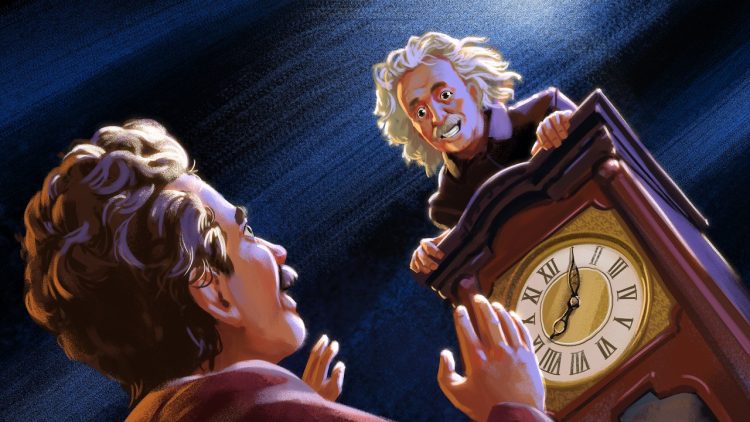
Relativity is so much weirder than we thought…
Can atomic clocks prove Einstein wrong? That is the question this film sets out to answer, and it is one of the deepest questions in modern physics. Einstein’s general theory of relativity describes gravity as the bending of space and time, and it has passed every test ever put to it. But it does not fit with quantum mechanics, the theory that describes the world at the smallest scales, and somewhere in that mismatch there must be new physics. This film goes looking for it with the most precise instruments ever built.
The instruments are optical atomic clocks, and they are extraordinary machines. An atomic clock keeps time by counting the oscillations of atoms, and the optical versions are so accurate that they would lose less than a second over the age of the universe. The film explains how they work: lasers cool the atoms down to almost absolute zero, holding them still enough to be measured, and then more lasers probe the atoms’ energy levels with a precision that was unthinkable a generation ago. The film’s guides are the scientists at NIST, the National Institute of Standards and Technology in the United States.
The film’s central experiment is beautifully simple in concept and enormously difficult in practice. Einstein’s theory says that time runs more slowly in stronger gravity, so a clock at the top of a mountain should tick faster than one at the bottom. The film follows researchers as they drive an atomic clock up a mountain to test exactly that, and as they link atomic clocks across 80 kilometres to compare their ticking in real time. Then it goes further: the team flies an atomic clock in a helicopter, taking the most precise timekeeping ever built into the air to see whether Einstein’s predictions still hold.
The cast of the film is a roll call of the people doing this work. Professor Jonathan Oppenheim of University College London, who has proposed a theory in which gravity is not quantum at all, appears alongside Greg Hoth, Dr Andrew Ludlow and Dr Laura Sinclair of NIST, and the team at the University of Western Australia, including Lilani Toms-Hardman, Professor Sascha Schediwy, Dr Sabrina Slimani and Dr Benjamin Dix-Matthews. The film also draws on the work of Professor Hidetoshi Katori and his colleagues at RIKEN and the University of Tokyo.
By the end, the film has taken the viewer from the foundations of relativity to the edge of what is known, and it ends where it began: with the question of whether Einstein is still right. The clocks have not yet caught him out. But the film’s point is that the test itself is the achievement. Every time an atomic clock is driven up a mountain or flown in a helicopter, physics is pushed a little further.
What the Film Explores
The film explores the atomic clock first, and it is the documentary’s foundation. How does an atomic clock work, and why are the optical versions so accurate? The film answers with lasers: lasers that cool atoms down, lasers that trap them, and lasers that probe them. The chapters on cooling and on the optical frequency comb, the device that lets scientists measure the frequency of light itself, are the film’s most technical material.
A second thread follows the mountain experiment, and it is the film’s most vivid sequence. Driving an atomic clock up a mountain sounds like a stunt, and in a sense it is, but it is a stunt with a serious purpose: to measure the difference in the rate of time between two heights, exactly as Einstein predicted. The film shows the practical difficulty of the work, because the effect being measured is tiny and the clock is extraordinarily sensitive.
A third thread follows the linking of clocks across distance, and the helicopter flight. Linking atomic clocks across 80 kilometres, and then flying one in a helicopter, turns a laboratory instrument into a field instrument, and the film treats that as a turning point: once clocks can be moved, they can be used to map gravity itself. The film’s argument is that this is not just a test of Einstein, but the beginning of a new kind of measurement.
Running through the film is the question in its title, and the film takes it seriously. Is Einstein still right? The evidence so far says yes, and the film does not pretend otherwise. But it also shows why the question matters: general relativity and quantum mechanics cannot both be complete, and the atomic clock is one of the few instruments precise enough to find where they disagree. The film closes on that open frontier, with the clocks still ticking and the question still unanswered.
Key Themes & Topics Examined
- Atomic clocks: the most precise instruments ever built
- Lasers that cool atoms down to almost absolute zero
- Driving an atomic clock up a mountain to test Einstein
- Linking atomic clocks across 80 kilometres
- Flying an atomic clock in a helicopter
- Optical frequency combs, and measuring the frequency of light
- NIST, the University of Western Australia, RIKEN and the University of Tokyo
- General relativity against quantum mechanics: is Einstein still right?
Production & Background
The film is a Veritasium production, written by Sarah Houlton, Gregor Cavlovic and Emilia Gyles, produced and directed by Sarah Houlton, presented by Gregor Cavlovic and Emilia Gyles, and edited by Peter Nelson, with additional editing by James Stuart and Trenton Oliver. The executive producers are Gregor Cavlovic, Emilia Gyles and Derek Muller. The film was made with the help of NIST, the University of Denver and the Meyer-Womble Observatory, the University of Western Australia and the International Centre for Radio Astronomy Research, and RIKEN and the University of Tokyo.
The documentary’s subject is the use of optical atomic clocks to test Einstein’s theory of general relativity, and its framing is the one the description gives: whether gravity obeys the rules of quantum mechanics, and whether the most precise clocks ever built can find the place where Einstein’s theory breaks. Its research was reviewed by Professor David Kaiser of MIT, Professor Scott Diddams of the University of Colorado Boulder, Professor Claudia de Rham of Imperial College London, Professor Steven Cundiff of the University of Michigan and Dr Derek van Westrum of NOAA.
Recommended Companion Viewing
Explore authoritative investigative documentaries on related historical events and investigative subjects.

The Science Behind Fire and Explosions
Can Humans Sense Magnetic Fields?
You've (Likely) Been Playing The Game Of Life Wrong
Frequently Asked Questions
What is the film about?
Whether optical atomic clocks can prove Einstein wrong, by testing general relativity against the predictions of quantum mechanics.
How does an atomic clock work?
It keeps time by counting the oscillations of atoms, cooled by lasers to almost absolute zero and probed with extraordinary precision.
What experiment does the film follow?
Researchers drive an atomic clock up a mountain, link clocks across 80 kilometres, and fly a clock in a helicopter, to measure how gravity changes the rate of time.
Who made the film?
Veritasium, with the help of NIST, the University of Western Australia, RIKEN and the University of Tokyo.
Has Einstein been proved wrong?
Not yet: the clocks have confirmed his predictions so far, but the film shows why the test matters, since relativity and quantum mechanics cannot both be complete.