
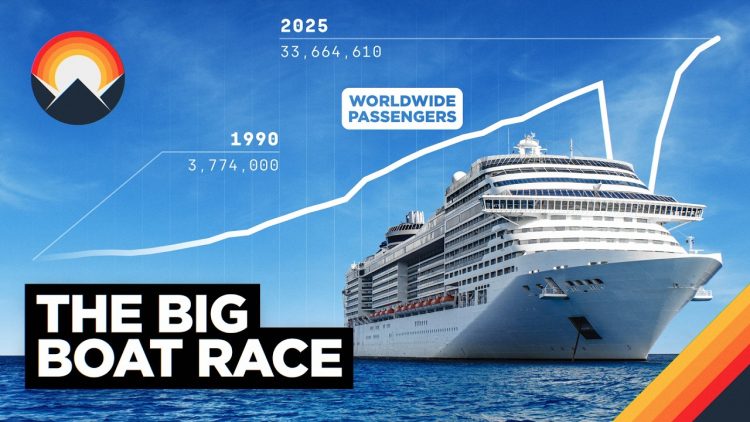
The Cruise Industry’s Arms Race
The race to build the world’s biggest cruise ship is one of maritime history’s most fascinating ongoing competitions, and in 2026 that race belongs decisively to one company. Royal Caribbean International builds nine of the sixteen largest ships afloat, and the three largest are identical sisters at 248,663 gross tons each. This film is the story of how the cruise industry got here, and why the ships keep getting bigger.
The current record holders are the Icon class. Icon of the Seas debuted in January 2024 as the largest cruise ship ever built, sailing from Miami. Star of the Seas, her sister, joined the fleet in August 2025 and sails year-round from Port Canaveral in Florida. Legend of the Seas, the third sister, was delivered in June 2026 and spent her first season in the western Mediterranean, sailing from Barcelona and Rome, before moving to Fort Lauderdale for Caribbean cruises. Each Icon class ship is about 365 metres long and can carry 7,600 guests, which is more than five times the tonnage of the Titanic.
Before the Icon class arrived, Royal Caribbean’s Oasis class held the world record. Wonder of the Seas, at 236,857 gross tons, Utopia of the Seas at 236,860, and Symphony of the Seas at 228,081 are still among the largest vessels afloat, and the film traces how each generation of ships raised the bar on the last. The pattern is unmistakable: every time a record is set, a rival, and usually Royal Caribbean itself, sets out to beat it.
The rivals are not standing still. MSC World America, at 216,638 gross tons, debuted in April 2025 and sails Caribbean itineraries from Port Miami, and it is the largest ship from any line other than Royal Caribbean. Disney Adventure, at 208,108 gross tons and based year-round in Singapore, is the largest ship ever operated by Disney Cruise Line. A fourth Icon class ship, Hero of the Seas, is due in 2027, with more ships of the class planned up to 2030, and Carnival and Norwegian have bigger ships on order, though none of them will be as large as the Icon class.
By the end, the film has become a story about what a cruise ship actually is. These are no longer ships that take you somewhere: they are floating cities, packed with waterparks, Broadway theatres, dozens of restaurants, seven pools and eight distinct neighbourhoods, designed to be destinations in their own right. The arms race, the film shows, is not really about size for its own sake. It is about who can offer the most extraordinary holiday at sea, and the answer, for now, keeps getting bigger.
What the Film Explores
The film explores the record holders first, and the Icon class is the documentary’s centrepiece. Three identical sisters, each at 248,663 gross tons, each 365 metres long, each carrying up to 7,600 guests: the film lays out the numbers because the numbers are the story. Gross tonnage measures enclosed internal volume, not weight, and it is the industry’s standard measure of size. By that measure, the Icon class ships are the biggest cruise ships ever built.
A second thread follows the history of the race, and the film is at its most interesting here. The Oasis class held the record before Icon, and the film traces the step-by-step escalation from one generation to the next: each new ship a little bigger, a little more ambitious, a little harder to beat. The race is not new, but it has accelerated, and the film’s argument is that the acceleration has a logic. Bigger ships carry more passengers, and more passengers spread the cost of the ship, the crew and the fuel across more fares.
A third thread follows the rivals, and the film gives them their due. MSC’s World America, Disney’s Adventure, and the bigger ships Carnival and Norwegian have on order all show that the race is not a one-company affair, even if Royal Caribbean currently owns the nine biggest ships afloat. The film treats the competition as the engine of the whole industry: each line watches the others, and each new launch resets what passengers expect from a cruise.
Running through the film is the question of where the race ends. A fourth Icon class ship is due in 2027, with more planned up to 2030, and the film’s closing argument is that there is no obvious ceiling. Ships are limited by the ports they can enter, the canals they can pass through and the shipyards that can build them, but within those limits the industry has shown no sign of stopping. The documentary closes on the open question: how big can a cruise ship get before the race runs out of road.
Key Themes & Topics Examined
- The Icon class: Icon, Star and Legend of the Seas at 248,663 gross tons
- 365 metres long, 7,600 guests, 2,350 crew: the scale of a floating city
- The Oasis class, and the record the Icon class broke
- MSC World America, the largest ship from any other line
- Disney Adventure, the largest ship Disney has ever operated
- Gross tonnage, and how the industry measures size
- Hero of the Seas, due in 2027, and the ships on order
- Why bigger: more passengers, more fares, more of everything
Production & Background
The film is a Wendover Productions production, written by Tristan Purdy and Sam Denby, edited by Alexander Williard, with animation by Sara Stoltman, Gabriel Ferreras, Austin Glass and Kate Ermolenkko, sound by Manni Simon and Dony Bullen and thumbnail by Simon Buckmaster. Wendover Productions is the channel of Sam Denby, known for explainers that take a single logistical or technological question and follow it through the systems underneath.
The documentary’s subject is the competition between cruise lines to build ever larger ships, as it stood in 2026. Its framing is the one the film itself sets out: a race in which Royal Caribbean’s Icon class currently holds the record, with three identical sisters at 248,663 gross tons each, and in which MSC, Disney, Carnival and Norwegian are all building bigger ships of their own. The figures cited come from cruise industry tonnage trackers and fleet specifications, cross-checked across multiple sources.
Recommended Companion Viewing
Explore authoritative investigative documentaries on related historical events and investigative subjects.

North Korea's alliance with China and Russia
The World's Most Impossible Rescues: Survival Against All Odds
Turkey: How Artists Challenge(d) Erdoğan with Gezi Protests
Deceptively Real and Life-Threatening - On the Trail of Product Counterfeiters
Frequently Asked Questions
What is the film about?
The competition between cruise lines to build ever larger ships, and how Royal Caribbean’s Icon class came to hold the record.
What is the biggest cruise ship in the world?
A three-way tie: Royal Caribbean’s Icon of the Seas, Star of the Seas and Legend of the Seas, each at 248,663 gross tons, about 365 metres long, with room for up to 7,600 guests.
When did the Icon class ships debut?
Icon of the Seas in January 2024, Star of the Seas in August 2025, and Legend of the Seas in summer 2026.
What is the biggest ship from another cruise line?
MSC World America, at 216,638 gross tons, which debuted in April 2025 and sails from Port Miami.
Is the race over?
No: a fourth Icon class ship, Hero of the Seas, is due in 2027, with more ships of the class planned up to 2030, and Carnival and Norwegian have bigger ships on order.







