
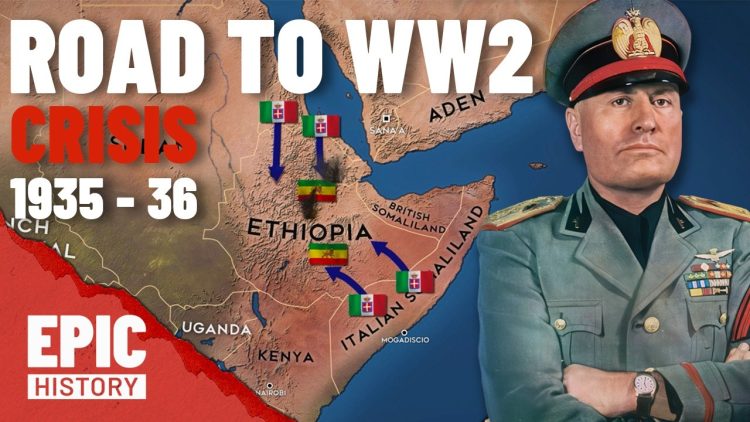
Road to WW2: 1935 – 36
In 1935, the established powers are failing to stem a tide of militarism and extremism. That is where this episode of Epic History TV’s Road to WW2 begins, with a world that can see the danger coming and cannot agree on what to do about it. Hitler wields unchecked power in Germany, using it to unravel the Treaty of Versailles and enforce Nazi racial ideology. In China, Nationalist and Communist factions are under pressure to unite against the Japanese invasion before it is too late. And in Africa, Mussolini looks to expand his new Italian empire through war in Ethiopia.
The film follows the years 1935 and 1936, two years in which the order built after the First World War came apart. In Germany, Hitler had become Chancellor in 1933, and by 1935 he was openly defying the Treaty of Versailles, reintroducing conscription and announcing the existence of the Luftwaffe, while the Nuremberg Laws of September 1935 stripped German Jews of their citizenship and laid the legal basis for persecution. In March 1936 he sent German troops into the Rhineland, the demilitarised zone on the French border, in a gamble that the French and British would not respond. They did not, and the gamble paid off.
Meanwhile, the economic stresses of the 1930s continued to drive political division across Europe. The Great Depression had shattered confidence in democratic governments, and in country after country voters turned to extremes, to communists on the left and to fascists on the right. It does not only look at Europe. In China, the Nationalists under Chiang Kai-shek and the Communists under Mao Zedong were still fighting each other, even as Japan pressed further into Chinese territory, having seized Manchuria in 1931 and now threatening the north. In Africa, Mussolini’s Italy invaded Ethiopia in October 1935, in a war of colonial conquest that the League of Nations proved powerless to stop. The League of Nations, the body created after the First World War to keep the peace, had failed in Ethiopia, failed in Manchuria and failed in the Rhineland, and the powers that might have stopped Hitler, Mussolini and Japan had chosen not to. The road to the Second World War, the film argues, was not a single decision but a series of failures, and 1935 and 1936 were the years when those failures became irreversible.
What the Film Explores
The film explores Germany first, and Hitler’s unravelling of the Treaty of Versailles. The treaty had limited the German army to 100,000 men, forbidden an air force and demilitarised the Rhineland, and by 1936 Hitler had broken all three of those limits. The film shows how each breach was met with protests and nothing more, and how each success emboldened him to go further. The Nuremberg Laws, passed in September 1935, are covered as part of the same story: the enforcement of Nazi racial ideology at home, alongside the rebuilding of German military power abroad.
It then turns to Italy and Ethiopia, and to the failure of the League of Nations. Mussolini invaded Ethiopia in October 1935, in a war that used poison gas and modern weapons against an African kingdom, and the League imposed sanctions that were too weak and too late to matter. The film treats Ethiopia as the test that the League failed, and as the moment when it became clear that the international order had no answer to aggression.
The film also explores China, and the pressure on its two factions to unite. The Nationalists and the Communists had been fighting a civil war since the late 1920s, and the Long March of 1934 to 1935 had taken the Communists across China to a new base in the north-west. But Japan’s advance made the civil war look like a luxury, and the film shows the first pressures, from within China and from abroad, for a united front against the invader, a front that would eventually be formed in 1937.
Finally, the film looks at Spain, where the polarisation of the 1930s exploded into war. In July 1936, a military uprising led by General Franco against the elected Republican government became a full-scale civil war, and it drew in volunteers and weapons from across Europe: German and Italian support for Franco, Soviet support for the Republic, and the International Brigades of volunteers from dozens of countries. The film treats Spain as the moment when the conflicts of the decade stopped being separate crises and became a single, European-wide confrontation.
Key Themes
- Hitler’s Germany, and the unravelling of the Treaty of Versailles in 1935 and 1936.
- The Nuremberg Laws of 1935, and the legal enforcement of Nazi racial ideology.
- The remilitarisation of the Rhineland in March 1936, and the failure of France and Britain to respond.
- Mussolini’s invasion of Ethiopia in 1935, and the failure of the League of Nations.
- China, and the pressure on Nationalists and Communists to unite against Japan.
- The Spanish Civil War, which began in July 1936 and became a rehearsal for the wider war.
- The Great Depression, and how economic stress drove political division across Europe.
- The League of Nations, and a global order that chose self-interest over collective action.
Production and Background
Road to WW2: 1935 – 36 was released by Epic History TV and runs for 28 minutes and 35 seconds. It was published in December 2025, as part of the channel’s Road to WW2 series, which follows the years leading up to the Second World War in sequence. The series’ historical consultant is Professor Richard Overy of the University of Exeter, the author of The Inter-War Crisis, Why The Allies Won and Blood And Ruins, and the episode draws on his work on the period. The film is presented in the channel’s signature style, with detailed animated maps and narration that follows events step by step.
Recommended Companion Viewing
Explore authoritative investigative documentaries on related historical events and investigative subjects.

Rise of China
Retold - History's Forgotten Stories: The Deadly Air
Frequently Asked Questions
What did Hitler do in 1935 and 1936?
He reintroduced conscription, announced the Luftwaffe, passed the Nuremberg Laws stripping German Jews of citizenship, and in March 1936 sent troops into the demilitarised Rhineland, breaking the Treaty of Versailles.
Why did the League of Nations fail over Ethiopia?
Mussolini invaded Ethiopia in October 1935, and the League imposed sanctions that were too weak and too late to stop him, showing that the international order had no effective answer to aggression.
What was happening in China in 1935 and 1936?
Nationalists and Communists were still fighting a civil war, even as Japan pressed further into Chinese territory, and pressure was growing for the two sides to unite against the invader.
When did the Spanish Civil War start?
It began in July 1936, when a military uprising against the elected Republican government became a full-scale civil war that drew in volunteers and weapons from across Europe.
Who is the series’ historical consultant?
Professor Richard Overy of the University of Exeter, the author of The Inter-War Crisis and Blood And Ruins, advises the Road to WW2 series.







