
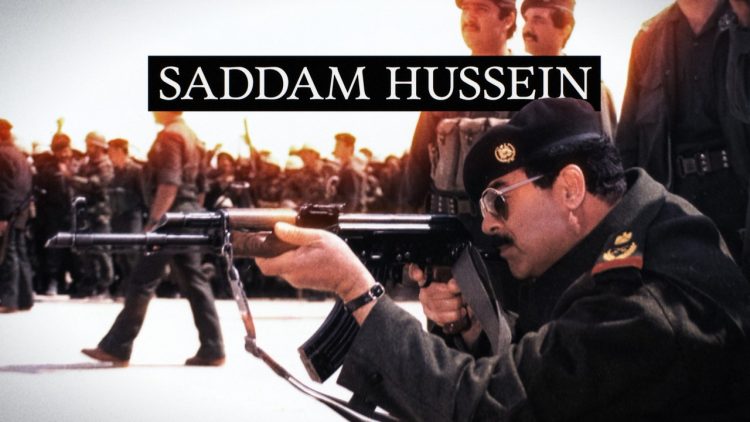
Saddam Hussein: Rise and Fall of the Iraqi Dictator (Full Documentary)
Saddam Hussein was one of the most notorious dictators of the second half of the twentieth century. His rule of Iraq came at a time when the Middle East became a focal point of geopolitics, and in his ruthless ambition he started several wars, used weapons of mass destruction on his own population, and held Iraq in an iron grip until 2003. This film from Real Time History, running for more than three hours, tells the whole of that story, from his road to power to the occupation that followed his fall.
The film is divided into five parts, and its structure is the story of a rise and a fall. The first part follows Saddam’s road to power, from his origins in Tikrit, through his rise in the Ba’ath Party, to his seizure of the presidency in 1979. The second covers the Iran-Iraq War of 1980 to 1988, the third the Gulf War of 1990 to 1991, the fourth the invasion of 2003, and the fifth the occupation of Iraq from 2003 to 2005. Together they trace a single arc: a man who built his power on fear, spent it on war, and lost it to invasion.
What the film does well is to show how each war followed from the one before. The war with Iran, launched in 1980 in the hope of a quick victory, became an eight-year stalemate that cost hundreds of thousands of lives, and it was during that war, in 1988, that Saddam’s forces used chemical weapons against the Kurdish town of Halabja, killing thousands of civilians. The invasion of Kuwait in 1990, driven by debt and ambition, brought a coalition of dozens of countries against him, and the defeat that followed left him weakened but still in power. And the invasion of 2003, launched by the United States and Britain on the claim that Iraq held weapons of mass destruction, ended his rule in a matter of weeks.
The film is built from authentic historical footage, maps and the research of its writers, Jesse Alexander and Mark Newton, and it draws on a shelf of serious histories, from Steve Coll’s The Achilles Trap to Carter Malkasian’s Illusions of Victory. The man who had held Iraq in an iron grip was found hiding in a hole near Tikrit in December 2003, and he was tried by an Iraqi court and executed in December 2006. The country he left behind descended into an insurgency and a sectarian war, and the film closes on the thought that removing a dictator did not, by itself, build a state.
What the Film Explores
The film explores Saddam’s road to power first, and the way he built it. Born in Tikrit in 1937, he joined the Ba’ath Party as a young man, took part in an attempt to assassinate the Iraqi leader in 1959, and rose through the party’s ranks after it seized power in 1968. He became president in 1979, and within months he had purged the party of his rivals, in a televised meeting in which hundreds of officials were denounced and led away. The war became one of the longest and bloodiest of the twentieth century, fought in trenches and with chemical weapons, and it ended in 1988 in a stalemate that left both countries devastated. The film covers the war’s most notorious episode, the chemical attack on Halabja in March 1988, in which thousands of Kurdish civilians were killed, and it shows how the war’s cost drove Saddam to his next gamble.
The third part covers the Gulf War. In August 1990, Saddam invaded Kuwait, and the United States assembled a coalition of dozens of countries to drive him out. Operation Desert Storm, in January and February 1991, destroyed the Iraqi army in a matter of weeks, and Kuwait was liberated. But Saddam remained in power, and the film explores the decade of sanctions and confrontation that followed, in which Iraq was contained but its people suffered, and in which the regime survived by repression.
The film then follows the invasion of 2003, and the occupation that followed it. American and British forces invaded in March 2003, and Baghdad fell within weeks. Saddam was captured in December 2003, and the film shows the occupation’s early failures, the disbanding of the army and the rise of the insurgency, and it closes on the Iraq of 2005, a country in the grip of a war that would last for years after its dictator was gone.
Key Themes
- Saddam’s road to power, from Tikrit to the presidency in 1979, and the purge that secured it.
- The Iran-Iraq War of 1980 to 1988, and the eight-year stalemate it became.
- Halabja in 1988, and the use of chemical weapons against Iraq’s own Kurdish population.
- The invasion of Kuwait in 1990, and the Gulf War that drove Iraq out of it.
- A decade of sanctions and containment, and the regime’s survival through repression.
- The invasion of 2003, and the fall of Baghdad in a matter of weeks.
- The capture of Saddam in December 2003, his trial and his execution in 2006.
- The occupation that followed, and the insurgency that filled the vacuum his fall left behind.
Production and Background
Saddam Hussein: Rise and Fall of the Iraqi Dictator was produced by Real Time History, the channel presented by Jesse Alexander, and it runs for three hours, twenty-one minutes and 31 seconds. It was published in November 2026. The film is written by Jesse Alexander, directed and edited by Toni Steller and Philipp Appelt, and researched by Mark Newton and Jesse Alexander. Its sources include Steve Coll’s The Achilles Trap, Efraim Karsh’s Saddam Hussein: A Political Biography, and Michael Newton and Michael Scharf’s Enemy of the State, on the trial and execution of Saddam Hussein, and like all of the channel’s work it uses only authentic historical footage.
Recommended Companion Viewing
Explore authoritative investigative documentaries on related historical events and investigative subjects.

The Real Story Of Henry VIII: Inside The Mind Of A Tudor Tyrant
Wolf children in Lithuania - The forgotten orphans of World War Two
Amarna: The Site of Ancient Egypt’s Heretical Revolution
Frequently Asked Questions
How did Saddam Hussein come to power?
He rose through the Ba’ath Party after it seized power in 1968, and became president in 1979, securing his position by purging the party of his rivals in a televised meeting.
What was the Iran-Iraq War?
It was the war Saddam launched against Iran in September 1980, which lasted eight years and cost hundreds of thousands of lives, ending in a stalemate in 1988.
What happened at Halabja?
In March 1988, during the Iran-Iraq War, Iraqi forces attacked the Kurdish town of Halabja with chemical weapons, killing thousands of civilians.
Why did the Gulf War happen?
Saddam invaded Kuwait in August 1990, and a coalition led by the United States drove Iraqi forces out of Kuwait in January and February 1991, in Operation Desert Storm.
What happened to Saddam after 2003?
He was captured by American forces in December 2003, near Tikrit, tried by an Iraqi court, and executed in December 2006.







