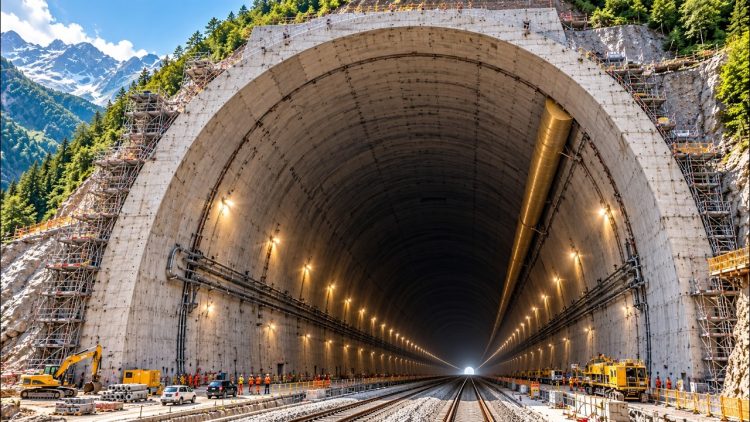
How Do They Build a €14.7 Billion Railway Tunnel Through the Alps? Mega Construction Projects
How do engineers build and rebuild giant railway tunnels while trains keep running? This film goes inside some of Europe’s toughest tunnel construction projects, where crews blast rock beside active tracks, protect rail traffic running every eight minutes, and dig beneath more than 2,000 metres of mountain. It follows the work from Germany and Switzerland to the France-Italy rail corridor: 12,000-horsepower tunnel boring machines, the underground manoeuvre of a 1,300-tonne boring machine, deep ventilation shafts, unstable fault zones, giant rock conveyors, concrete tunnel linings and precision railway track installation.
The benchmark is the Gotthard Base Tunnel in Switzerland, the world’s longest railway tunnel at 57.09 kilometres, running between Erstfeld and Bodio under the Alps. It opened in June 2016 after 17 years of construction, cost about CHF 12.2 billion, and at its deepest point lies under roughly 2,300 metres of rock. It is part of Switzerland’s New Trans-Alpine Railways programme, built to give freight a flat, high-capacity route between northern Europe and Italy, and it cut the Zurich-Milan journey by around 40 minutes. Its twin single-track tubes carry up to 260 freight trains a day, and a passenger train takes just under 20 minutes to pass through.
The project still being built is the Brenner Base Tunnel, linking Innsbruck in Austria with Fortezza in Italy under the Brenner Pass, the historic trade route between southern Germany and northern Italy. Its two main tubes run about 55 kilometres, or 64 kilometres counting the Innsbruck bypass, and the project is budgeted at roughly EUR 10.5 billion. Both main tubes broke through on 28 July 2025, with service planned for around 2032. Like Gotthard it is a flat base tunnel, designed to replace a steep mountain crossing with a fast, level route, and like Gotthard it has taken far longer than first planned: work began in 1999, when it was expected to open in 2015.
The film’s real subject is not any one tunnel but the problem all of them share: building underground while the railway above keeps running. Its chapters move through the hardest parts of the job in order — blasting rock while busy trains run, replacing tunnel tracks beside passing trains, exploring unstable mountains before the main excavation, building deep shafts to lower the boring machines in, breaking rock with the machines themselves, surviving fault zones and reinforcing the walls, digging ventilation shafts five hundred metres deep, the breakthrough moment when a boring machine finally reaches daylight, and restoring the highways above the new tunnel. The closing chapter is the trade-off the whole film is about: keeping the railways running costs time and money and forces compromises, but closing them would cost far more.
What the Film Explores
The film explores the engineering of building under a mountain that is still in use.
It also explores the machines themselves. A modern tunnel boring machine is a moving factory: a cutting head driven by motors totalling around 12,000 horsepower, followed by conveyors that carry the excavated rock away, and by equipment that installs the concrete lining segments as the machine advances.
Finally, the film explores why Europe is spending tens of billions of euros on these tunnels at all. The Alps are a wall across the middle of the continent’s freight routes, and the old mountain railways, with their steep gradients and tight curves, cannot carry the traffic that northern Europe sends to Italy and the Mediterranean. The base tunnels are flat, fast and high-capacity, and they are meant to move freight off the roads and onto rail.
Key Themes
- The Gotthard benchmark: 57.09 kilometres, opened June 2016, CHF 12.2 billion, the world’s longest and deepest railway tunnel, under up to 2,300 metres of rock.
- The Brenner crossing: 55 kilometres of main tunnel between Innsbruck and Fortezza, about EUR 10.5 billion, main tubes broken through in July 2025, service planned around 2032.
- Tunnel boring machines: 12,000-horsepower cutting heads, 1,300-tonne machines manoeuvred underground, conveyors carrying rock away as the lining goes in.
- Fault zones: crushed, unstable rock that can collapse without warning, forcing crews to reinforce the tunnel walls metre by metre.
- Ventilation shafts: shafts five hundred metres deep that bring air to the crews and, later, to the trains running through the tunnel.
- Working beside live traffic: blasting and replacing track while trains pass every eight minutes, with safety systems protecting both crews and passengers.
Production and Background
The film comes from YouCanDo TV, a small channel, and it is a compilation-style megaproject video rather than a documentary about a single tunnel. Its description is candid about its sources: it notes that it uses images and content under fair-use provisions, and its chapters range across Germany, Switzerland and the France-Italy corridor.
That said, the engineering the film shows is real, and the projects it draws on are among the largest civil engineering works in European history. The Gotthard Base Tunnel took 17 years and excavated about 28 million tonnes of rock; the Brenner Base Tunnel has been under construction since 1999 and will not carry trains until around 2032; the Mont-Cenis base tunnel on the Lyon-Turin line, at 57.5 kilometres, will be longer still when it opens.
Recommended Companion Viewing
Explore authoritative investigative documentaries on related historical events and investigative subjects.

Gothic architecture - When cathedrals reached up to the heavens
City of the Future: Singapore – Full Episode | National Geographic
The Lincoln Memorial: A Nation's Reflection
Copenhagen - The world's greenest capital city?
Frequently Asked Questions
What is the longest railway tunnel in the world? The Gotthard Base Tunnel in Switzerland, at 57.09 kilometres.
What is the Brenner Base Tunnel? A rail tunnel under construction between Innsbruck in Austria and Fortezza in Italy, with two main tubes of about 55 kilometres.
How does a tunnel boring machine work? A rotating cutting head grinds away the rock face, conveyors carry the spoil out behind the machine, and the machine installs precast concrete lining segments as it advances, so the tunnel is built as it is dug.
Why build base tunnels instead of going over the mountains? The old Alpine railways are steep and slow, which limits freight.
More to watch
- How the Channel Tunnel Works
- The rise and fall of Germany’s maglev supertrain
- World’s Toughest Trains: Surviving the Most Extreme Railways on Earth
- How this tiny country became the best at night trains in Europe
- Galloping Gertie: The Turbulent Life and Death of the Tacoma Narrows Bridge
The Alps are not the only place engineers have bored under water and rock: How the Channel Tunnel Works shows how Britain and France were joined beneath the sea.