
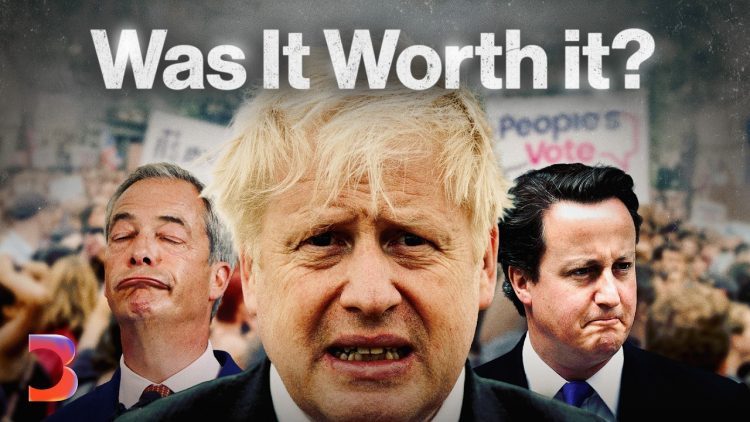
This Is What Brexit Cost the World
In June 2016, the United Kingdom voted to leave the European Union. Ten years later, Bloomberg Originals unpacks the economic cost of Brexit and the political forces it unleashed. The referendum was won by Leave with 51.9 percent of the vote, and the result set off a decade of upheaval that is still shaping British politics.
The vote itself was the easy part. What followed was years of parliamentary deadlock that crippled a series of prime ministers. David Cameron, who had called the referendum, resigned the morning after the result. Theresa May spent three years trying to pass a withdrawal deal and failed. Boris Johnson got Brexit done, then lost his premiership to scandal. Liz Truss lasted 49 days. Rishi Sunak steadied the government but lost the 2024 election to Keir Starmer.
At the heart of the film is the maths. The conventional wisdom has always been that Britain’s exit would be a financial calamity, and the film tests that claim with Bloomberg Economics modelling. The official forecaster, the Office for Budget Responsibility, has estimated since 2020 that leaving the EU will leave Britain’s long-run GDP about 4 percent lower than it would otherwise have been, with imports and exports both about 15 percent lower in the long run. Bloomberg Economics’ own analysis, published in 2023, put the cost at around £100 billion a year in lost output, roughly 4 percent of GDP. Other estimates run higher: the National Institute of Economic and Social Research puts the long-run hit at 5 to 6 percent.
But the film’s argument goes beyond the economy. The Brexit vote sparked a surge in populism and triggered a politics of anger that spread well beyond Britain, and the film traces how the same forces that drove Leave — distrust of elites, anger at immigration, a sense that the system was rigged — reshaped politics in the United States and across Europe. Far from settling the issue for a generation, Brexit continues to loom large over British politics. Successive prime ministers have sought closer alignment with Brussels, some recent polling suggests a growing majority of the British public would now vote to rejoin the bloc, and one of the foremost architects of Brexit, Reform UK leader Nigel Farage, is now a favourite to become the country’s next prime minister. Meanwhile, with the United States under Donald Trump retreating from old alliances, Britain and its European allies are confronting their most challenging geopolitical moment since the end of the Cold War.
What the Film Explores
The film explores the factors that drove the Leave vote. It does not present Brexit as a single-issue decision: the campaign mixed sovereignty, immigration, economics and identity, and different voters backed Leave for different reasons.
It also explores the economic argument in detail, using Bloomberg Economics modelling to test whether the conventional wisdom holds up. The film walks through the modelling step by step: what leaving the single market and customs union did to trade, how much of the damage came from uncertainty itself, and whether there was an economic upside to be found anywhere.
Finally, the film explores the political legacy. Brexit did not settle the argument; it institutionalised it. The film shows how the referendum’s aftermath — the deadlock, the churn of prime ministers, the rise of Reform UK — created a politics in which the question of Britain’s relationship with Europe can never quite be closed, and how that unresolved question now collides with a world in which old alliances are fraying. The lesson it draws is a sobering one: referendums are easy to call and very hard to live with.
Key Themes
- The vote: on June 23, 2016, Britain voted 51.9 percent to leave the EU, and the result stunned the political establishment.
- The deadlock: years of parliamentary gridlock crippled a series of prime ministers, from May to Truss.
- The maths: the OBR puts the long-run GDP cost at about 4 percent; Bloomberg Economics put lost output at around £100 billion a year.
- Populism: the vote sparked a surge in populist politics that spread beyond Britain, to the United States and across Europe.
- Immigration: the debate over who could come to Britain was central to the campaign and remains unresolved.
- Unfinished business: polling suggests a growing majority would now vote to rejoin, while Nigel Farage’s Reform UK has become a leading political force.
Production and Background
The film is a Bloomberg Originals production, released in June 2026 to mark ten years since the referendum. Bloomberg Originals makes data-led, cinematic documentaries about business and politics, and this film follows that method: expert hosts, original modelling from Bloomberg Economics, and interviews that place the numbers in their political context.
The film arrived at a moment when the question it asks had become live again. With Britain seeking closer alignment with Brussels, the United States retreating from old alliances, and Reform UK leading in some polls, the tenth anniversary of the referendum was not a moment of closure but a moment of reckoning.
Recommended Companion Viewing
Explore authoritative investigative documentaries on related historical events and investigative subjects.

North Korea - Propaganda and the next generation
Behind the Polarization
Greater Israel: How Christian Zionism became policy
The World's Most Impossible Rescues: Survival Against All Odds
Frequently Asked Questions
When did the UK vote to leave the EU? On June 23, 2016. Leave won with 51.9 percent of the vote. The UK formally left the EU on January 31, 2020, and the Trade and Cooperation Agreement governing the new relationship came into force on January 1, 2021.
What has Brexit cost the UK economy? The Office for Budget Responsibility estimates that leaving the EU will leave long-run GDP about 4 percent lower than it would otherwise have been. Bloomberg Economics put the cost at around £100 billion a year in lost output, and the National Institute of Economic and Social Research estimates 5 to 6 percent.
Why did Brexit cause so much political instability? The referendum result had to be implemented by a Parliament that had mostly campaigned to remain, and by prime ministers who disagreed about what Leave meant. The result was years of deadlock, and a rapid churn of leaders: Cameron, May, Johnson, Truss, Sunak and Starmer in under a decade.
Could Britain rejoin the EU? Some recent polling suggests a growing majority of the public would now vote to rejoin, and successive prime ministers have sought closer alignment with Brussels. Any attempt to rejoin would face fierce resistance, including from Reform UK leader Nigel Farage, one of Brexit’s foremost architects.
More to watch
- Trump’s America – Is US democracy in danger?
- Inside the AfD – How Germany’s Far-Right Populist Party Operates
- Behind the Polarization
- Immigration Under President Trump’s First Term: Kids Caught in the Crackdown
- Why Dictators Are Afraid of Literature
The populist surge Brexit helped unleash is not confined to Britain: Inside the AfD – How Germany’s Far-Right Populist Party Operates shows how a similar movement grew in Germany.







