
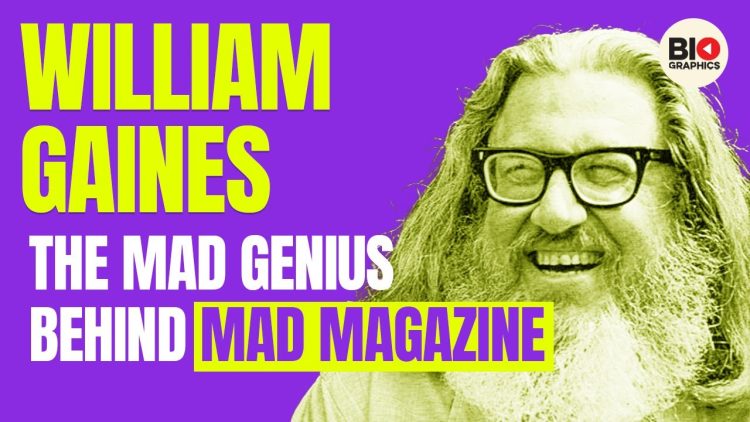
William Gaines: MAD MAGAZINE’S Leading Man
William Maxwell Gaines was born in New York City on March 1, 1922, into a family that had already helped invent the comic book. His father, Max Gaines, had tested the idea of packaging and selling comics on newsstands in 1933, and as publisher of the All-American Comics division of DC Comics he had accepted William Moulton Marston’s proposal for the first successful female superhero, Wonder Woman, in 1941. Young Bill Gaines seemed headed for a very different life: he studied chemistry, intending to become a teacher.
EC was struggling, and Gaines remade it. Working with writer and artist Al Feldstein, he dropped the educational titles and turned the company towards the genres that sold: horror, science fiction and war. In 1950 the new line began with Tales from the Crypt and The Vault of Horror, two of the first horror comics ever published, followed by Weird Science, Shock SuspenStories and Two-Fisted Tales. The stories were better written and better drawn than most of their rivals, and Gaines treated his artists as selling points, profiling them in full-page biographies and letting them sign their work, a rarity in the industry at the time.
Then came the backlash. In 1954, Fredric Wertham’s book Seduction of the Innocent blamed comic books for juvenile delinquency, and a Senate subcommittee held hearings on the subject. Gaines himself testified, defending his comics in a famous exchange. The industry responded by adopting the Comics Code Authority, a set of standards that banned the bloodthirsty material on which EC’s horror line depended. Gaines suspended his horror comics.
That decision made Gaines’s fortune and his reputation. Mad, edited by Al Feldstein from 1955 to 1986, became the great American satirical magazine, mocking movies, advertising, celebrities, politicians and comic books themselves with a gang of regular contributors that included Wally Wood, Jack Davis, Will Elder, Mort Drucker and Sergio Aragonés. Its gap-toothed mascot, Alfred E. Neuman, with his catchphrase “What, me worry?”, became one of the most recognisable faces in American popular culture. In 1961 Gaines sold Mad to Premier Industries, a maker of venetian blinds, but he remained publisher until the day he died, acting as a buffer between the magazine and its corporate owners. He died in his sleep at his home in New York on June 3, 1992, aged 70, having published Mad for over forty years.
What the Film Explores
The film explores how a reluctant publisher became one of the most important figures in comics history by accident. Gaines did not set out to revolutionise anything: he inherited a faltering company while finishing his studies, and his first instinct was to follow the market.
It also explores the 1954 crisis as a turning point in American culture. The Senate hearings and the Comics Code were not just a business problem for Gaines; they were a test of whether a popular art form could survive being blamed for society’s problems. Gaines’s answer was not to fight the Code head-on but to sidestep it, turning Mad into a magazine.
Finally, the film explores what Mad meant. For generations of American teenagers, Mad was a first lesson in scepticism: a magazine that taught its readers to distrust advertising, to laugh at authority, and to spot the gap between what institutions said and what they did. Gaines himself was famous among his staff as a generous gourmand who loved practical jokes and good-natured abuse, and the film argues that the magazine’s tone came directly from him. He published satire for over forty years because he enjoyed it, and the readers could tell.
Key Themes
- An accidental publisher: Gaines inherited EC in 1947 after his father’s death, abandoning plans to become a chemistry teacher.
- The horror revolution: with Al Feldstein, he turned EC into the home of Tales from the Crypt, The Vault of Horror and Weird Science.
- The 1954 crisis: Wertham’s Seduction of the Innocent and the Senate hearings led to the Comics Code, which killed EC’s horror line.
- The magazine gambit: converting Mad to a black-and-white magazine in 1955 put it beyond the Code and kept Harvey Kurtzman on board.
- Forty years of satire: under Feldstein, Mad mocked movies, advertising and politicians, with Alfred E. Neuman as its mascot.
- The buffer: after selling Mad in 1961, Gaines stayed on as publisher, shielding the magazine from its corporate owners until his death in 1992.
Production and Background
The film is a Biographics production, from the channel’s long-running series of biographical documentaries about notable lives. It follows the channel’s usual approach: a clear, chronological telling of the life, built around the work rather than the gossip, and drawing on the standard histories of the period, including Frank Jacobs’s biography The Mad World of William M. Gaines (1972) and Maria Reidelbach’s Completely Mad: A History of the Comic Book and Magazine (1991).
Gaines’s reputation has only grown since his death. He was posthumously inducted into the Will Eisner Comic Book Hall of Fame in 1993 and the Jack Kirby Hall of Fame in 1997, and Mad’s influence runs through American comedy, from the satirical magazines and television shows that copied it to the generations of readers who learned to laugh at authority from its pages.
Recommended Companion Viewing
Explore authoritative investigative documentaries on related historical events and investigative subjects.

Frequently Asked Questions
Who was William Gaines? William Maxwell Gaines (1922-1992) was an American publisher who inherited EC Comics in 1947 and published the satirical magazine Mad for over forty years, after first making EC famous for horror comics such as Tales from the Crypt.
How did Mad magazine start? Mad was launched in 1952 as a ten-cent comic book, created by Harvey Kurtzman with Gaines’s backing. In 1955 Gaines converted it into a black-and-white magazine, which put it outside the Comics Code Authority’s reach and let it satirise anything.
What happened to EC Comics in 1954? After Fredric Wertham’s Seduction of the Innocent and Senate hearings on juvenile delinquency, the comics industry adopted the Comics Code Authority, whose standards banned the horror material EC depended on. Gaines suspended his horror comics and bet everything on Mad.
When did William Gaines die? He died in his sleep at his home in New York on June 3, 1992, aged 70. He was still the publisher of Mad at the time, a role he had held since 1952.
More to watch
- Superpower laughter – How humor makes us strong
- JOHNNY CARSON: The King of Late Night TV
- John Ritter: From Three’s Company to Obscurity?
- Alan Rickman: Cinema’s Greatest Silver Tongued Devil
- Bob Saget: America’s Greatest and Most Controversial TV Dad and Stand Up Comedian
Gaines built his career on the power of a joke, and Superpower laughter – How humor makes us strong looks at why humour itself can be a form of strength.







