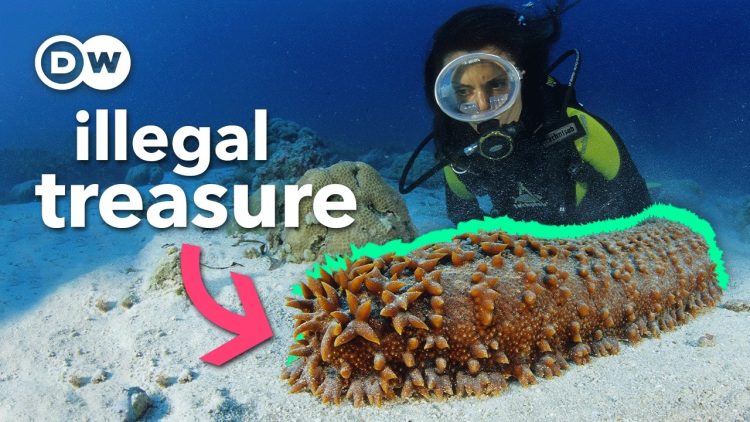
The $200 million black market you never heard of
There is a huge transnational illegal trade going almost undetected in the Indian Ocean, and it is not drugs and it is not guns. It is sea cucumbers. They have become the most trafficked marine species in India, and the trade is growing globally too. This film dives into the murky depths of how that came to be, following a creature most people have never thought about into a black market worth around 200 million dollars.
The sea cucumber is an unlikely criminal commodity. It is a soft-bodied marine animal that lives on the sea floor, and it is prized as food and traditional medicine, sold dried as beche-de-mer, above all in markets in Hong Kong and across East Asia. That demand has put a price on an animal that plays a quiet but vital role in the ocean, cleaning the sea floor and recycling nutrients. When the price rises high enough, the poachers follow, and the film shows how a humble sea creature became the centre of an international smuggling network.
The film’s reporting is centred on the Andaman and Nicobar Islands, the Indian archipelago where the trade is at its most intense. Regional reporting cited by the film describes foreign poachers repeatedly targeting the islands for sea cucumbers, and research by TRAFFIC and WWF-India highlights the scale of the threat. A comprehensive study of sea cucumber crime in India and Sri Lanka, and research on dried sea cucumbers in Hong Kong markets, both feed into the film’s picture of a trade that runs from remote island reefs to distant city markets.
What makes the film more than a wildlife story is the people it meets along the chain. There are the fishers, naturalists and inhabitants of the islands who live with the trade every day, the enforcement officers trying to catch poachers at sea, and the government officials whose stance the film examines in its own chapter. And then there is the poacher himself, who speaks on camera about how the trade works from the inside, in a sequence the film builds toward across its fifteen minutes.
By the end, the film has become a story about how a market can hollow out an ocean without anyone noticing. Sea cucumbers are listed under CITES, the international convention on trade in endangered species, and the film points to the convention’s documents as part of the legal framework meant to control the trade. But the film’s closing question is whether the rules can keep up with the money. The way forward, it suggests, will need more than seizures at sea: it will need the demand itself to change.
What the Film Explores
The film explores the animal first, and it wants the viewer to understand what is being lost. The sea cucumber is not a charismatic species, and that is part of the problem: a creature that spends its life on the sea floor, out of sight, can be stripped from a reef without the kind of public outcry that follows the poaching of a tiger or an elephant. The film’s opening chapter introduces the animal on its own terms, before the price of being tasty turns it into a target.
A second thread follows the money, and the film is at its most forensic here. The trade runs from poachers working the reefs of the Andaman and Nicobar Islands, through middlemen and smuggling routes, to dried-product markets in Hong Kong, where beche-de-mer commands high prices. The film draws on research by TRAFFIC and WWF-India and on a comprehensive paper on sea cucumber crime in India and Sri Lanka, building a picture of a supply chain that is organised, transnational and very hard to police.
A third thread follows the enforcement, and the film gives it a full chapter of its own. Catching a poacher at sea is difficult work: the ocean is vast, the islands are remote, and the boats are small and fast. The film looks at how enforcement actually happens, what the government’s stance is, and where the gaps are that the smugglers exploit. The poacher who speaks on camera describes the trade from the other side of that cat-and-mouse game, and his account is the film’s most revealing material.
Running through the film is the question of what can be done. The film’s final chapters look at the way forward, and at the reflections of the people who live with the trade. The answers it points to are not simple: stronger enforcement at sea, tighter controls on the dried-product markets, and international cooperation under CITES. But the film’s closing argument is that none of that works without addressing demand, because as long as a sea cucumber is worth more dead and dried than alive on the reef, someone will go and get it.
Key Themes & Topics Examined
- The sea cucumber: the most trafficked marine species in India
- A 200 million dollar black market hiding in plain sight
- The Andaman and Nicobar Islands, and the foreign poachers targeting them
- Beche-de-mer: the dried product sold in Hong Kong markets
- TRAFFIC and WWF-India research on the scale of the threat
- Catching a poacher at sea, and the government’s stance
- A poacher speaks: the trade from the inside
- CITES, and the search for a way forward
Production & Background
The film is a DW Planet A production, reported by Aditi Rajagopal, with camera work by Dheeraj Aithal, line production by Anaka Kaundinya and editing by Andreas Hyronimus, supervised by Kiyo Dorrer and Adam Baheej Adada, with fact checking by Aitziber Romero Bengoetxea. The report was supported by the Pulitzer Center. Planet A is DW’s series on the shift toward an environmentally friendly world.
The documentary’s subject is the illegal trade in sea cucumbers in the Indian Ocean, and its framing is the one the description gives: a huge transnational trade going almost undetected, centred on the Andaman and Nicobar Islands, and growing globally. Its background interviews included Manish Chandy, Pankaj Sekhsaria, Sanjib Kumar Roy, Teale Phelps Bondaroff, Dr PS Asha and Dr Arivazhagan, with the Dakshin Foundation and the fishers, naturalists and inhabitants of the islands.
Recommended Companion Viewing
Explore authoritative investigative documentaries on related historical events and investigative subjects.

Frequently Asked Questions
What is the film about?
The illegal trade in sea cucumbers in the Indian Ocean, now the most trafficked marine species in India, in a black market worth around 200 million dollars.
Why are sea cucumbers trafficked?
They are prized as food and traditional medicine, sold dried as beche-de-mer, above all in markets in Hong Kong and across East Asia.
Where is the trade centred?
The Andaman and Nicobar Islands, the Indian archipelago where foreign poachers repeatedly target the reefs for sea cucumbers.
Who made the film?
DW Planet A, reported by Aditi Rajagopal, with support from the Pulitzer Center.
What law governs the trade?
Sea cucumbers are listed under CITES, the international convention on trade in endangered species, which the film points to as part of the legal framework.