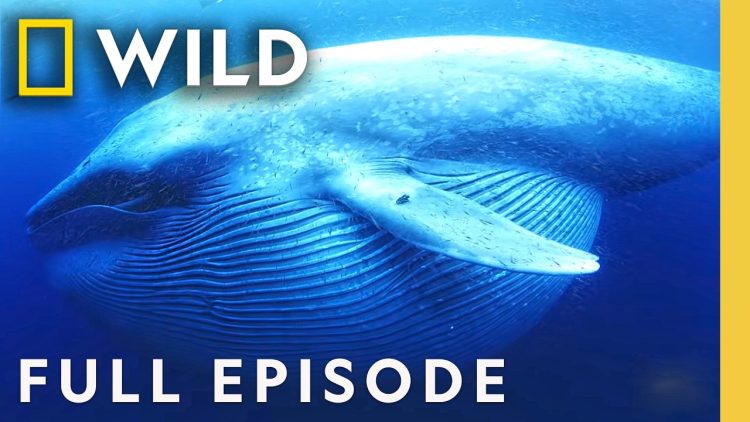
Whales: Giants of the Deep Blue Oceans (Full Episode) | Documentary Special | Nat Geo Animals
How long have whales lived in Earth’s oceans? That is the question this National Geographic special opens with, and the answer is a story of one of the most extraordinary transformations in evolution. Whales are the descendants of land mammals that returned to the sea around fifty million years ago, and they have since become the largest animals that have ever lived on Earth, larger than any dinosaur.
The film’s centrepiece is the blue whale, and the numbers are hard to believe. A large adult reaches around thirty metres in length, and the heaviest reliably recorded weighed about 190 tonnes, making it the largest animal known to have ever existed. Its heart alone weighs around 180 kilograms, roughly the size of a small car, and its tongue can weigh as much as an elephant. A blue whale’s call is so low and so powerful that it can be heard hundreds of kilometres away through the water, and the animal feeds almost entirely on krill, tiny shrimp-like creatures it sieves from the sea with plates of baleen, a filter made of keratin, the same protein as human hair and fingernails.
But the film is not only about size. It is about the social lives of whales, and nowhere is that clearer than in the humpback, whose males sing the longest and most complex songs of any animal. A humpback song can last ten to thirty minutes, repeated for hours, and the song slowly changes every year, with all the males in an ocean basin learning the new version, a form of cultural transmission that has no real parallel outside our own species. Sperm whales, meanwhile, live in family groups led by older females, and they communicate with rhythmic click patterns called codas, which work like dialects, different groups using different patterns.
The film also shows how whales hunt. The toothed whales, including sperm whales, killer whales and dolphins, hunt one animal at a time, using echolocation, a biological sonar, to find prey in the dark. Sperm whales dive to depths of more than a kilometre to hunt squid, holding their breath for over an hour. The baleen whales feed differently, lunging through clouds of krill with their mouths open, or, in the case of humpbacks, working together in bubble-net feeding, where a group of whales blows a ring of bubbles to trap a school of fish and then lunges up through the centre. The bowhead whale, the longest-lived mammal on Earth, can live for more than two hundred years, carrying in its blubber the harpoon points of hunts from the nineteenth century.
The final part of the film turns to the threats whales face, and to what can be done. Commercial whaling brought blue whales to the edge of extinction before the International Whaling Commission protected them in 1966, and their numbers are still far below what they once were. Today the dangers are different: ships strike whales, fishing gear entangles them, ocean noise drowns out their calls, and plastic and chemical pollution build up in their bodies. The film’s argument is that whales are not only magnificent animals but engineers of the ocean: their feeding and their waste move nutrients through the water, supporting the plankton that produce much of the oxygen we breathe. Keeping the oceans full of whales, the film suggests, is not only about saving whales. It is about keeping the ocean itself alive.
What the film explores
The first part of the film is the deep history of whales: land mammals that returned to the sea, lost their legs, grew enormous, and became the largest animals in the history of life. The film explains the two great groups, the baleen whales, which filter-feed on krill and small fish, and the toothed whales, which hunt with echolocation, and it shows how each group solved the problem of living, feeding and raising young in an ocean that is dark, cold and vast.
The second part is the social world of whales. The film follows humpback songs as they spread across an ocean basin, it shows sperm whale families and their codas, and it explains how whales learn from each other, passing songs and hunting techniques from one generation to the next. The point is that whales are not solitary giants. They are social animals with cultures of their own, and the film treats that as one of the most remarkable things about them.
The third part is hunting, from the sperm whale’s deep dives for squid to the humpback’s cooperative bubble-net feeding. The film shows the physics of echolocation, the power of a lunge feed, and the patience of a blue whale sifting krill. The final section is the future: the threats from ships, nets, noise and pollution, the history of whaling and the slow recovery since protection, and the practical steps, quieter ships, safer fishing gear, protected areas, that can keep the giants in the sea.
Key Themes
- The blue whale, the largest animal that has ever lived, at around 30 metres.
- Baleen whales and toothed whales, two ways of making a living in the sea.
- Humpback songs, the longest and most complex in the animal kingdom.
- Sperm whales: the largest brain on Earth and the loudest sound of any animal.
- Bubble-net feeding and the deep dives of the sperm whale.
- The bowhead whale, the longest-lived mammal, at over 200 years.
Production and Background
The film is a National Geographic special, Giants of the Deep Blue, published on the Nat Geo Animals channel in June 2026 as a full episode.
The special belongs to a long tradition of National Geographic whale films, and it draws on decades of research into whale behaviour, from the discovery of humpback song in the 1970s to the modern tracking of sperm whale codas and the satellite monitoring of blue whale migration.
Recommended Companion Viewing
Explore authoritative investigative documentaries on related historical events and investigative subjects.

Raja Ampat: Life in the Coral Kingdom
Wonder Shore: Africa's Wild Paradise
Wonder Shore: Africa's Most Spectacular Coastline
Eat Or Be Eaten: Ocean Predators
Frequently Asked Questions
What is the largest whale? The blue whale, at around 30 metres long and up to about 190 tonnes for the heaviest reliably recorded animal.
How do whales communicate? In many ways. Humpback males sing songs of 10 to 30 minutes that evolve year by year and spread across whole ocean basins. Sperm whales use rhythmic click patterns called codas, which act like dialects.
How deep can a sperm whale dive? Sperm whales regularly dive to depths of more than a kilometre to hunt squid, holding their breath for over an hour.
How long do whales live? It varies widely.
Are whales still in danger? Yes, although commercial whaling has largely ended. The main threats today are ship strikes, entanglement in fishing gear, ocean noise that interferes with communication, and pollution.
More to watch
- Forgotten Islands: The Last Coral Paradise
- Raja Ampat: Life in the Coral Kingdom
- High-Tech Shark Deterrence – Australia’s New Strategy for Safe Beaches
- Backbreaking Work: Deep-Sea Fishing in the Arctic Ocean
- Eat Or Be Eaten: Ocean Predators
For another reef world the whales pass through, Raja Ampat: Life in the Coral Kingdom visits the most diverse reefs on Earth.