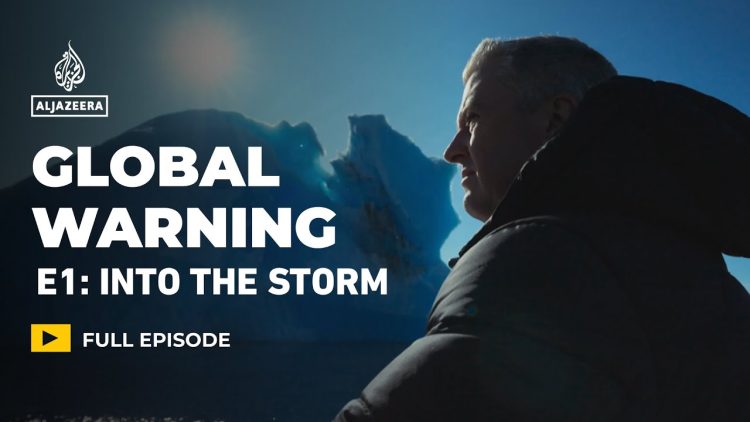
Inside the planet’s most urgent climate warning | Global Warning E1 | Featured Documentary
This decisive decade demands unprecedented action to address humanity’s greatest challenge. That is the opening line of Global Warning, Al Jazeera’s three-part series on the real consequences of climate change for our civilisation, through the rest of the 21st century and beyond.
The episode opens in Ireland, where extreme weather events are becoming increasingly common, and then moves to Greenland, where the story is at its starkest. The Greenland ice sheet is losing, on average, more than 200 billion tonnes of ice a year since 2003, and in the record year of 2019 it lost around 532 billion tonnes in a single year. Since systematic satellite monitoring began in the early 1990s, Greenland has lost roughly 5,900 billion tonnes of ice, enough water to cover the entire United States in a layer more than seven metres deep. The film shows the glaciers retreating and the meltwater pouring off the ice, and it explains why that matters far beyond Greenland: the meltwater flows into the North Atlantic, where it threatens the Atlantic Meridional Overturning Circulation, the AMOC, the system of currents that carries warm water north and keeps northern Europe far milder than its latitude would suggest.
From Greenland the film moves to the other side of the crisis. In Malawi, in sub-Saharan Africa, it shows the weather extremes that are already destroying harvests and driving people from their homes. In Bangladesh, it shows the flooding of agricultural land, a country where millions of people live on ground that is barely above sea level and where a rising sea and stronger storms threaten the food supply of a whole nation. In Siberia, it shows the thaw of the permafrost, the frozen ground that holds vast stores of carbon, and the damage that thaw does to the land and the people who live on it. The film’s point is that these are not separate stories.
The series does not end in despair. Alongside the damage, it looks at a positive vision for reimagining economies, landscapes and infrastructure, and at practical solutions, ways of mobilising collective resolve, and the challenge of making humanity a transformative force, harnessing innovation to safeguard the future of civilisation. The film is clear about the scale of what is needed, and it is equally clear that the decade we are in is the one that will decide it.
What the film explores
The first part of the episode is Ireland and Greenland. It opens with the extreme weather that is becoming normal in Ireland, and then moves to the Greenland ice sheet, where the film shows the scale of the melting and explains the physics behind it: warmer air, darker ice that absorbs more sunlight, and a feedback loop that accelerates the loss. The AMOC is introduced here, and the film explains why a current in the Atlantic matters to a farmer in Ireland or a fisherman in Norway.
The second part is the human cost, in Malawi, Bangladesh and Siberia. The film shows the droughts and floods that are already hitting sub-Saharan Africa, the rising water that is flooding Bangladesh’s farmland, and the thawing permafrost of Siberia, which is damaging infrastructure and releasing carbon that has been locked away for thousands of years. The witnesses in each place describe the same thing in different words: a climate that no longer behaves the way it did when they were young.
The third part is the science and the solutions. The film looks at the new climate science, at the tipping points that scientists warn about, and at the collapsing ecosystems, marine die-offs and escalating extreme weather that are already visible. It then turns to the other side of the story: the reimagining of economies and infrastructure, the practical solutions that exist, and the collective resolve that would be needed to use them. The episode ends with the challenge it opened with: this decade demands unprecedented action, and the time to act is now.
Key Themes
- Greenland’s ice sheet, losing more than 200 billion tonnes a year.
- The AMOC, the Atlantic current that keeps Europe mild, at its weakest in 1,600 years.
- Ireland and the extreme weather that is becoming normal.
- Malawi and the weather extremes of sub-Saharan Africa.
- Bangladesh and the flooding of agricultural land.
- Siberia and the thaw of the permafrost.
- Tipping points, collapsing ecosystems and marine die-offs.
- Solutions: reimagining economies, landscapes and infrastructure.
Production and Background
The film is the first episode of Global Warning, a three-part series from Al Jazeera English, published on the Featured Documentary channel in October 2025.
The series was made as a response to the growing urgency of the climate crisis, and it is deliberately framed around the idea of the decisive decade: the 2020s as the period in which the world will either act at the scale required or lock in consequences that will last for centuries.
Recommended Companion Viewing
Explore authoritative investigative documentaries on related historical events and investigative subjects.

Will renewables stop the climate crisis?
Climate change: Europe's melting glaciers
How heatwaves impact our lives
Cargo sailboats: A sea change for shipping?
Frequently Asked Questions
What is the AMOC? The Atlantic Meridional Overturning Circulation is the system of ocean currents that carries warm, salty water north across the Atlantic, where it cools, sinks and returns south at depth. It is what keeps northern Europe 5 to 10 degrees warmer than other places at the same latitude. It is currently at its weakest in 1,600 years.
How fast is Greenland losing ice? On average, the Greenland ice sheet has lost more than 200 billion tonnes of ice a year since 2003, with a record loss of around 532 billion tonnes in 2019. Since the early 1990s it has lost roughly 5,900 billion tonnes in total.
Why does Greenland’s melting matter to the AMOC? Because the meltwater is fresh, and fresh water is less dense than salt water. When it flows into the North Atlantic it sits on the surface and prevents the warm water beneath from cooling, becoming dense and sinking, which is what drives the circulation. More meltwater means a weaker AMOC.
What is permafrost, and why does its thaw matter? Permafrost is ground that has been frozen for at least two years, and in Siberia it has been frozen for thousands. It holds vast stores of carbon, and when it thaws, that carbon is released as carbon dioxide and methane, which accelerates the warming that caused the thaw in the first place.
Is there anything that can still be done? The film argues yes, but only with action at a scale that matches the problem: cutting emissions, reimagining economies and infrastructure, and mobilising collective resolve. Its central claim is that the 2020s are the decisive decade, and that the choices made now will shape the rest of the century.
More to watch
- Climate change: Europe’s melting glaciers
- Will renewables stop the climate crisis?
- Climate change – living on the water
- Climate protection from moors
- The Global North taken to court – Who pays for the climate catastrophe?
For the same story closer to home, Climate change: Europe’s melting glaciers shows what is happening to the ice on this continent.