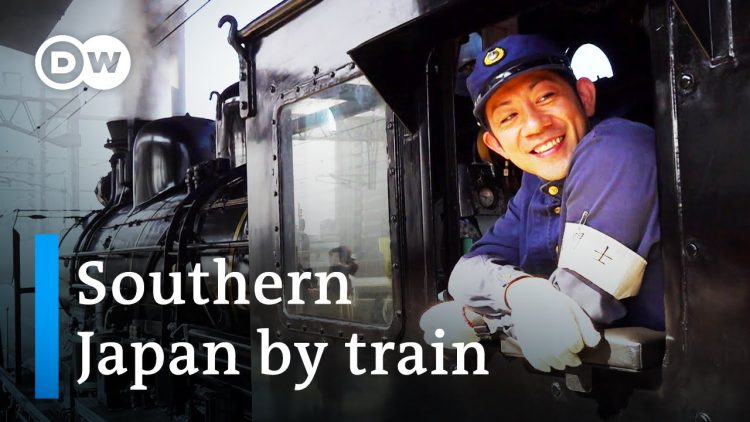
A train ride into Japan’s past | DW Documentary
Kyushu is said to be the wellspring of Japanese civilisation, yet few tourists visit the southernmost of Japan’s main islands. This DW documentary sets out to change that, by train. The rail journey begins in Fukuoka, a city with a metro population of 2.5 million, and ends at the southern tip of the island, in the city of Ibusuki.
The film’s method is simple and effective. The train is the thread, and the stops along the way are the story. From the window, the viewer sees spectacular landscapes: green, mountainous country, rice fields, coastlines and the steam of hot springs. At each stop, the film steps off the train and into the life of the place: the markets, the temples, the workshops and the homes where traditions that are centuries old are still part of daily life.
That history runs deep. The family of the emperor, or Tenno, comes from Kyushu, and this is also where the dynasties of the proud warrior class, the samurai, have their roots. The film treats that history not as a museum exhibit but as a living presence: the castles and shrines are still used, the festivals are still held, and the crafts are still practised by people who learned them from their parents. The train journey becomes a journey through the layers of Japanese history, from the island where the civilisation began to the present day, and the film’s quiet argument is that the past is not behind Japan.
Kyushu is also a volcanic island, and the film does not let the viewer forget it. There are a number of active volcanoes on the island, and one of the most famous is Mount Aso. Its caldera, the cauldron-like hollow at the top, has a circumference of about 120 kilometres, one of the largest in the world, and the film shows it as the island’s great landmark: a reminder that the land itself is still being made.
The journey is a reminder that the best way to see a country is often the slowest one, as World’s Toughest Trains: Surviving the Most Extreme Railways on Earth shows on railways far harsher than this one.
What the Film Explores
The film explores the contrast between modern and traditional Japan. Fukuoka, where the journey begins, is a city of 2.5 million people, with all the energy and speed of a modern metropolis. As the train moves south, the cities give way to countryside, and the film shows a Japan that moves at a different pace: small towns, farming villages, temples and workshops where the old crafts are still practised. The film’s point is not that one Japan is real and the other is not.
It also explores the island’s role as the wellspring of Japanese civilisation. Kyushu is where the imperial family comes from, and where the samurai dynasties have their roots, and the film visits the places where that history is still visible: the shrines, the castles, the old towns.
A third strand is the volcanic landscape. Mount Aso’s caldera, some 120 kilometres around, dominates the centre of the island, and the film shows how the volcanoes have shaped everything: the soil, the farming, the hot springs, the towns that grew up around them. The hot springs are not a tourist attraction in the film’s telling.
Key Themes
- The wellspring of Japan: Kyushu is where Japanese civilisation began, home to the imperial family and the roots of the samurai dynasties.
- Modern and traditional side by side: the journey moves from the modern city of Fukuoka to the traditional countryside, showing both Japans at once.
- A journey through time: the train travels through history as well as landscape, from ancient shrines to working towns.
- Volcanoes and hot springs: Mount Aso’s caldera, about 120 kilometres around, shapes the island, and its hot springs run through daily life to Ibusuki.
- The lesser-known island: Kyushu is one of Japan’s least-visited regions for Western tourists, and the film treats that as an invitation.
- Cultures meeting: cafes named Wolfgang and Bavaria show how Japan borrows from Europe, and how the island has always been a meeting place.
Production and Background
The film is a DW Documentary production, part of the broadcaster’s long-running series of travel documentaries that use a single journey — a train, a river, a road — to open up a country. The format suits Kyushu: the island is long and narrow, running from north to south, and a train line runs its length, so the journey from Fukuoka to Ibusuki is a natural spine for the story.
Kyushu’s claim to be the wellspring of Japanese civilisation is an old one, rooted in the island’s mythology and in the archaeological record, which places some of Japan’s earliest settlements there. The imperial family’s origins on the island are part of Japan’s founding stories, and the samurai dynasties that ruled Japan for centuries trace their roots to Kyushu’s warrior families. The film does not argue the archaeology.
Recommended Companion Viewing
Explore authoritative investigative documentaries on related historical events and investigative subjects.

The billion-dollar waste business
The Technology We Build- A
Resistance through no sex: The 4B movement in South Korea
Inside Iran's secret security state - Two defectors break their silence
Frequently Asked Questions
Where is Kyushu? Kyushu is the southernmost of Japan’s four main islands, a green, mountainous island that is mostly a holiday destination for the Japanese and little visited by Western tourists.
Where does the train journey go? It begins in Fukuoka, a city with a metro population of 2.5 million, and ends at the southern tip of the island in the city of Ibusuki, famous for its hot sand baths.
What is Mount Aso? Mount Aso is one of Kyushu’s active volcanoes, and its caldera — the cauldron-like hollow at the top — has a circumference of about 120 kilometres, one of the largest in the world.
Why is Kyushu called the wellspring of Japanese civilisation? The imperial family comes from Kyushu, and the samurai dynasties have their roots there, making the island the traditional birthplace of Japanese culture and power.
More to watch
- World’s Toughest Trains: Surviving the Most Extreme Railways on Earth
- Through Kazakhstan by Train
- How this tiny country became the best at night trains in Europe
- The rise and fall of Germany’s maglev supertrain