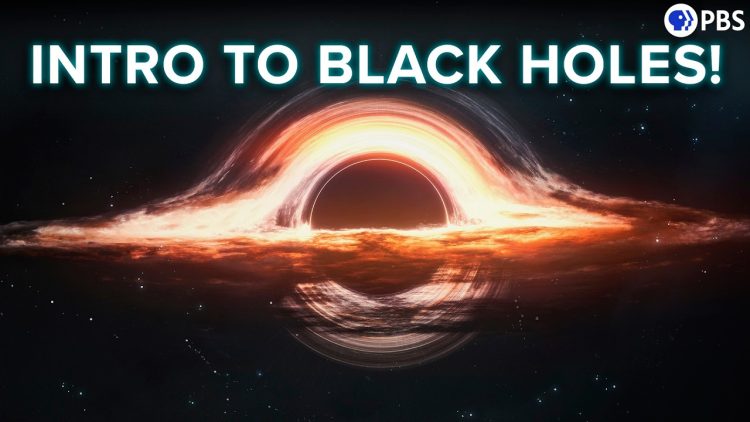
Black Holes. Explained. For 1.5 Hours.
Black holes are not just the strangest objects in the universe, they are the sharpest test we have of how reality actually works. That is the starting point for this PBS Space Time special, a ninety-eight minute retrospective in which host Matt O’Dowd looks back through a decade of the channel’s content to explain how black holes form, what happens at their edges, and why they force general relativity and quantum physics into direct confrontation.
The film begins with formation. A black hole is what is left when a massive star dies: the star’s core collapses under its own gravity, and if the core is heavy enough, nothing can stop the collapse. The result is a region of spacetime so curved that nothing inside it can escape, bounded by the event horizon.
From there the film works outwards, through the strange physics of the horizon itself. Time slows near a black hole, so that a clock falling towards the horizon appears to slow down and freeze from the point of view of a distant observer, while the falling clock itself ticks normally. Light climbing out of the gravitational field loses energy and reddens, and light that falls in is blue-shifted.
The middle of the film is about what black holes do to our theories. At the centre of a black hole, general relativity predicts a singularity, a point of infinite density where the equations break down. Quantum mechanics, which describes the very small, says that such a point cannot be the whole story. The film explains the most famous consequence of that conflict: Hawking radiation, Stephen Hawking’s 1974 prediction that black holes are not entirely black, but slowly leak energy and evaporate over unimaginable stretches of time. It also explains the information paradox, the question of what happens to the information about the matter that fell in, which has driven theoretical physics for fifty years.
The final part of the film is about seeing black holes for real. For decades they were inferred, never observed directly, but that changed in April 2019, when the Event Horizon Telescope, a planet-wide network of radio observatories, released the first image of a black hole’s shadow, the glowing ring around the supermassive black hole in the galaxy M87. In May 2022 the same collaboration imaged Sagittarius A*. The film also covers the other great confirmation: the detection of gravitational waves by LIGO in September 2015, ripples in spacetime from two colliding black holes, which opened a new way of listening to the universe. Black holes have gone from a mathematical curiosity to something we can photograph, and the film shows how that happened.
What the film explores
The first section is a tour of the black hole zoo. Stellar-mass black holes, formed from dying stars, weigh a few times as much as the Sun. Supermassive black holes, millions or billions of times the Sun’s mass, sit at the centres of galaxies and shape them. Between them are the intermediate-mass black holes, which astronomers are still hunting for, and the film explains how each type is found, from X-ray binaries to the motion of stars around the galactic centre.
The second section is about the event horizon and the singularity, and the film uses the spacetime diagrams that have become the channel’s signature to show how they work. It explains why the horizon is a point of no return, why the singularity is best thought of as a moment in time rather than a place in space, and why the interior of a black hole is the one place in the universe where our two great theories of physics openly contradict each other.
The third section turns to the evidence. The film walks through the observations that turned black holes from theory into fact: the X-ray glow of infalling gas, the orbits of stars around Sagittarius A* that won the 2020 Nobel Prize in Physics, the gravitational wave detections that now arrive regularly, and the Event Horizon Telescope images that let us see the shadow of a black hole with our own eyes. It ends by looking forward, to the questions still open, and to the hope that black holes will be the place where a theory of quantum gravity is finally found.
Key Themes
- How massive stars collapse into black holes.
- The Schwarzschild radius and the event horizon.
- Time dilation and the slowing of clocks near a black hole.
- Accretion discs and the X-ray glow of infalling gas.
- The singularity and the breakdown of general relativity.
- Hawking radiation and the slow evaporation of black holes.
Production and Background
The film is a PBS Space Time special, published in December 2025 and hosted and written by Matt O’Dowd, with post-production by Leonardo Scholzer and direction by Andrew Kornhaber.
At ninety-eight minutes it is the longest single film in this batch, and it is designed to be watched as a whole, with each section building on the last.
Recommended Companion Viewing
Explore authoritative investigative documentaries on related historical events and investigative subjects.

Nancy Grace Roman Space Telescope Postlaunch News Conference
NASA's SpaceX Crew-12 Hatch Close
Artemis II Congressional Space Medal of Honor Ceremony
The Dumbest Ways to Die in Space
Frequently Asked Questions
What is a black hole? A region of spacetime where gravity is so strong that nothing, not even light, can escape. It forms when a massive star collapses, and it is bounded by the event horizon, the boundary beyond which there is no way back.
How big is a black hole? It depends on its mass. A black hole with the mass of the Sun would have a horizon about three kilometres across. The black hole at the centre of the Milky Way, Sagittarius A*, has about four million times the Sun’s mass and a horizon some 24 million kilometres across. The largest known black holes are billions of times the Sun’s mass.
What is Hawking radiation? A prediction made by Stephen Hawking in 1974 that black holes slowly emit radiation and lose mass, evaporating over time. For a stellar-mass black hole the process is unimaginably slow, taking far longer than the current age of the universe, but it means black holes are not entirely black.
Have black holes ever been photographed? Yes. In April 2019 the Event Horizon Telescope released the first image of a black hole, the glowing ring around the supermassive black hole in the galaxy M87. In May 2022 the collaboration released an image of Sagittarius A*, the black hole at the centre of our own galaxy.
What happens if you fall into a black hole? You would cross the event horizon without noticing, and then every path forward in time would lead to the singularity at the centre. The difference in gravity between your head and your feet would stretch you apart, an effect called spaghettification, and nothing you did could change the outcome.
More to watch
- Relativity is so much weirder than we thought…
- I finally saw quantum physics with my own eyes… (It’s spookier than I expected)
- Invisible Forces that Shape Our Reality — How the Universe Works
- What If an Asteroid Hit New York City? | How the Universe Works
- The Mystery of Water: Nature’s Strangest Liquid
For more on the theory behind all of this, Relativity is so much weirder than we thought… explains how Einstein’s ideas reshaped physics.