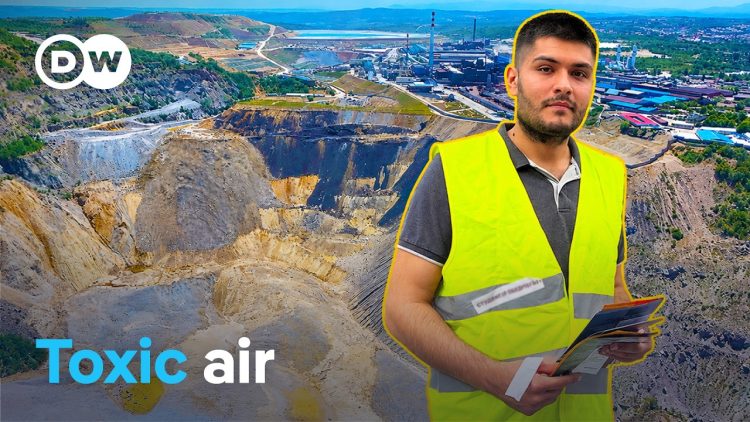
In the shadow of copper – The price of mining in Serbia
The small Serbian town of Bor lives from copper mining. The mine is the town’s livelihood, and it is also, many residents say, what is making them sick. High levels of pollution from the mine, which has been majority-owned by a Chinese corporation since 2018, are blamed by residents for illness in the town — and this documentary sets out to show the price of the copper that Bor produces.
Resistance is growing in the town of Bor in eastern Serbia. Lazar Milutinovic and Marko Andrejevic are members of the student movement that has been driving social change in Serbia for more than two years, and the film follows them as they carry that movement into the fight over the mine. Meanwhile, others point to the high levels of heavy metal contamination measured in the area, the high incidence of cancer and the low life expectancy — figures that the film presents as the other side of the town’s livelihood.
Environmental engineer Snezana Serbula has spent her entire professional career investigating the mine’s impact on Bor. One of Serbia’s most prominent critics of mining, she has published numerous scientific studies on the effects of heavy metal emissions on the environment and on human health. The film treats her work as the evidence base for the story: decades of measurement and study, set against the daily experience of the people who live with the mine.
In this report, workers say they were not adequately informed about the possible long-term consequences of mining. Meanwhile, local residents accuse the authorities and the company of a lack of transparency. Lazar and Marko have founded an opposition movement in the town, calling for greater oversight and stricter environmental regulations. The film shows a community that is not asking for the mine to vanish overnight, but for someone to be watching it — and for the rules to be enforced.
Jasna Tomic lives in the village of Krivelj near Bor. She could soon lose her home: the village, which has been inhabited by the Vlach ethnic minority for centuries, is expected to make way for the mine. Many of her neighbors have already left. Jasna fears she, too, will soon have to relocate. She is fighting to ensure that the village community can at least find a new home together. Her story is the film’s most personal one — a centuries-old village, and a community trying to stay a community even as the ground beneath it is taken away.
What the Film Explores
The film explores the town of Bor first, and the bargain at its heart. Bor lives from copper mining — the mine is the employer, the reason the town exists in its present form. But many residents say the pollution from the mine is making them sick, and the film’s subject is the cost of that bargain: what a town gives up in health for the work that sustains it, and who decides whether the price is acceptable.
A second thread follows the evidence. Environmental engineer Snezana Serbula has spent her whole career investigating the mine’s impact on Bor, and her published studies on heavy metal emissions and their effects on the environment and on human health are the film’s backbone. Around her work, the film gathers the other measures of the problem: the high levels of heavy metal contamination in the area, the high incidence of cancer, the low life expectancy. The documentary’s argument is built on measurement, not only on testimony.
A third thread follows the resistance. Lazar Milutinovic and Marko Andrejevic, members of a student movement that has been driving social change in Serbia for more than two years, have founded an opposition movement in Bor, calling for greater oversight and stricter environmental regulations. The film also records the workers who say they were not adequately informed about the long-term consequences of mining, and the residents who accuse the authorities and the company of a lack of transparency. The resistance, the film shows, is as much about information as about pollution.
Running through the film is Krivelj and Jasna Tomic. The village near Bor has been inhabited by the Vlach ethnic minority for centuries, and it is expected to make way for the mine. Many of her neighbors have already left; Jasna fears she will soon have to relocate too, and she is fighting for the village community to find a new home together. Her story turns the film’s question from an environmental one into a human one: what happens to a community when the ground it has lived on for centuries is needed for something else?
Key Themes & Topics Examined
- Bor, the small Serbian town that lives from copper mining
- A Chinese corporation the majority owner of the mine since 2018
- High levels of heavy metal contamination in the area
- High incidence of cancer and low life expectancy
- Snezana Serbula, environmental engineer and prominent critic of mining
- The student movement and the opposition in Bor
- Workers not informed about the long-term consequences of mining
- Krivelj and the Vlach ethnic minority facing relocation
Production & Background
The documentary is a DW Documentary production filmed in Bor and Krivelj in eastern Serbia. It is a film by Eberhard Rühle, Nikolaus Tarouquella and Natalija Miletić, built around the residents, the workers, the students and the scientist who have spent years living with — and measuring — the mine.
The film’s structure moves from the town to the evidence to the resistance, and ends in Krivelj, where the future of a centuries-old village is being decided. It is a film about the price of a single industry, and about the people who are paying it.
Recommended Companion Viewing
Explore authoritative investigative documentaries on related historical events and investigative subjects.

Frequently Asked Questions
Where is Bor?
A small town in eastern Serbia that lives from copper mining. The mine has been majority-owned by a Chinese corporation since 2018.
Who owns the mine?
It has been majority-owned by a Chinese corporation since 2018, according to the film.
What do residents say about their health?
Many residents say the high levels of pollution from the mine are making them sick. Others point to high levels of heavy metal contamination, a high incidence of cancer and low life expectancy in the area.
Who is Snezana Serbula?
An environmental engineer who has spent her entire professional career investigating the mine’s impact on Bor. One of Serbia’s most prominent critics of mining, she has published numerous scientific studies on the effects of heavy metal emissions on the environment and on human health.
What will happen to Krivelj?
The village near Bor, inhabited by the Vlach ethnic minority for centuries, is expected to make way for the mine. Many residents have already left. Jasna Tomic, who still lives there, fears she will soon have to relocate, and is fighting for the village community to find a new home together.