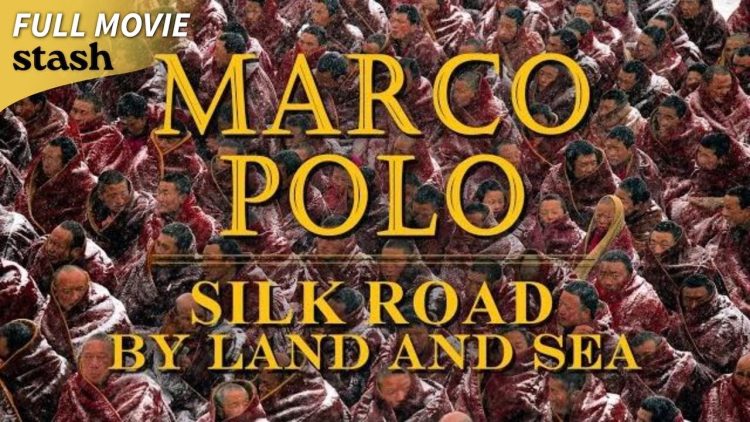
Marco Polo: Silk Road by Land & Sea | Travel Documentary | Full Movie | Michael Yamashita
Travelling to new lands, exploring new cultures and sharing discoveries with the world: that pursuit is what unites the two men at the heart of this film. One is Marco Polo, the Venetian merchant who crossed Asia in the thirteenth century and spent seventeen years at the court of the Mongol ruler Kublai Khan. The other is Michael Yamashita, the National Geographic photographer who retraced Polo’s route along the Silk Road, by land and by sea, to see what remains of the world Polo described.
Marco Polo was born around 1254 in Venice, a wealthy trading republic. His father Niccolo and his uncle Maffeo were merchants who had already travelled to Asia and met Kublai Khan before Marco was born; they returned to Venice in 1269, when Marco was about fifteen and meeting his father for the first time. In 1271 the three set out again, this time taking Marco, then seventeen, carrying letters from the newly elected Pope Gregory X. They sailed to Acre and travelled overland through Persia and Afghanistan, over the Pamir mountains and across the Gobi Desert, a journey of about three and a half years, until they reached Kublai’s summer palace at Shangdu — the Xanadu of later legend — around 1275.
By his own account Marco won the khan’s favour, learned several languages, and was sent on missions across China and to lands to the south. He stayed about seventeen years, describing cities, trade, salt production and paper money in detail, along with the great capital at Khanbaliq, on the site of modern Beijing, the imperial postal relay system, and the port cities of southern China such as Hangzhou, which he called Quinsay and described as the finest city in the world, and Quanzhou, which he called Zaiton. Around 1291 the Polos were finally allowed to leave, escorting a Mongol princess, Kokochin, who was to marry the ruler of Persia. The fleet sailed by way of Sumatra and southern India, and only a handful of the hundreds of passengers survived the voyage.
Venice was then at war with Genoa, and Marco was captured and imprisoned. In prison he dictated his story to a fellow captive, the romance writer Rustichello da Pisa, and the book that resulted — The Travels of Marco Polo, or The Description of the World — gave medieval Europeans their fullest picture of China and the wider East. Its claims were so grand that Marco was mocked as “Il Milione”, the teller of a million tall tales, yet the book shaped maps and explorers for centuries: Columbus carried a copy on his voyages, hoping to reach the gold-roofed island of Zipangu, Japan, that Polo had described. Yamashita’s retracing of the route, camera in hand, is the film’s way of testing that book against the ground it describes, from the deserts of Central Asia to the ports of the South China Sea.
What the Film Explores
The film explores what happens when a book becomes a map. Polo’s Travels was not a guidebook but a story told in prison, and for centuries Europeans argued about whether any of it was true.
It also explores the meeting of two worlds.
Finally, the film explores why Polo’s journey still matters. The route he travelled is now crossed by railways, pipelines and highways, and the cities he described are among the largest on Earth. But the questions his book raised — how do strangers understand each other, what do we believe about places we have never seen, and how does a story change the world — are as current as ever.
Key Themes
- The journey out: in 1271, aged seventeen, Marco Polo left Venice with his father and uncle and spent three and a half years crossing Asia to Kublai Khan’s court.
- Seventeen years in China: Polo served the khan as an envoy, travelling on missions across China and describing paper money, coal and the postal relay system.
- Shangdu, the Xanadu: Kublai’s summer palace, where the Polos arrived around 1275, became one of the most famous places in European literature.
- The return by sea: in 1291 the Polos sailed home escorting a Mongol princess, a voyage on which most of the party died, reaching Venice in 1295.
- The book: dictated in a Genoese prison around 1298 to Rustichello da Pisa, The Travels gave Europe its fullest picture of China.
- Yamashita’s retracing: the National Geographic photographer follows Polo’s route by land and sea, testing the book against the ground.
Production and Background
The film is a National Geographic production, following the broadcaster’s tradition of pairing a historical journey with a modern expedition. It stars Michael Yamashita, the National Geographic photographer whose retracing of Polo’s route is the film’s present-day thread, and it was created by Farland Chang.
Marco Polo died in Venice in 1324, and his book outlived every empire it described. The Mongol Yuan dynasty fell within a century of his visit, the Silk Road routes were redrawn by sea trade, and Venice itself faded as a great power. What survived was the idea his book planted: that the world was one connected place, and that a curious traveller could cross it.
Recommended Companion Viewing
Explore authoritative investigative documentaries on related historical events and investigative subjects.

The Lost Home Movies of Nazi Germany
U-Boat Wargamers: The Mastermind
Beyond Stonewall: Exploring LGBTQ+ History Through the Smithsonian Archives
The Mysterious Lost Buddhas Of Afghanistan | Inside Afghanistan
Frequently Asked Questions
Who was Marco Polo? Marco Polo (c. 1254-1324) was a Venetian merchant who travelled overland to China in 1271 with his father and uncle, spent about seventeen years in the service of the Mongol ruler Kublai Khan, and returned to Venice in 1295.
How long did Marco Polo’s journey take? The outward journey took about three and a half years, from 1271 to around 1275.
What is the Silk Road? The Silk Road was not a single road but a network of trade routes linking Europe, the Middle East, Central Asia and China, carrying silk, spices, ideas and technologies.
Did Marco Polo really go to China? Some modern scholars have questioned details of his account, noting that no independent Chinese record mentions him by name.
More to watch
- Rise of China
- Mao’s China: Against the World
- China’s plan to never run out of food
- The Imperial History Behind Beijing’s 600-Year-Old Central Axis
- Mongolia’s Deadly Winter: Two Teenagers Fight to Save an Ancient Tradition
Polo’s destination was an empire whose capital still carries its history in stone: The Imperial History Behind Beijing’s 600-Year-Old Central Axis traces the heart of the city he called Khanbaliq.