
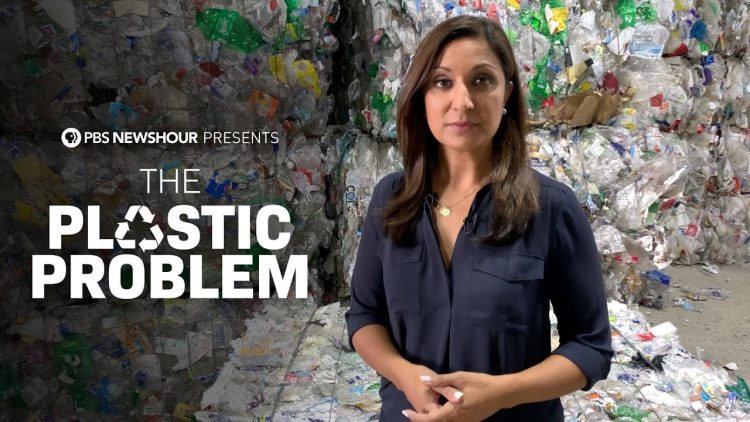
The Plastic Problem – A PBS NewsHour Documentary
By 2050 there will be more plastic than fish in the oceans. That is the warning this PBS NewsHour documentary opens with, and it is an environmental crisis that has been in the making for nearly seventy years.
The scale is hard to take in. More than nine billion metric tons of plastic have been produced since 1950, a weight equivalent to some 27,000 Empire State Buildings, or more than a billion elephants. Spread out evenly, as researcher Roland Geyer of the University of California, Santa Barbara, puts it in the film, that much plastic could cover an area the size of Argentina or California six times over.
The film begins at home, in the United States, with the question of where plastic comes from and why we use so much of it. Plastic is cheap, light and durable, and those same qualities are the problem: a bottle used for minutes can last for hundreds of years in the environment, breaking down only into smaller and smaller particles. Only about nine per cent of all plastic ever made has been recycled.
From there the programme goes global. In Costa Rica, correspondent John Yang reports on leatherback turtles, already endangered, whose nesting beaches and feeding grounds are filling with plastic. On Easter Island, in the middle of the Pacific, the longtime mayor of Hanga Roa, Pedro Edmunds Paoa, describes how plastic from all over the world washes up on his island’s shores, more every year, with nowhere for it to go. The film also shows the other side of the trade: ghost fishing gear, lost and abandoned nets and lines, estimated at 640,000 tonnes floating in the ocean, about ten per cent of all known ocean plastic, still catching fish long after the fishermen have gone.
The final part of the film looks for answers. It examines recycling, which the film shows to be far less effective than most people assume, and the alternatives: bioplastics, refill systems, bans on single-use items and, above all, making less plastic in the first place. The tone is sober rather than hopeless. The film’s argument is that plastic is not an unavoidable part of modern life but a material we chose, and that the same choice can be made differently.
What the film explores
The first section of the film is a history of the material itself. Plastic went from a novelty to a necessity in a single lifetime, and the film traces that change through the post-war boom in consumer goods, the rise of disposable packaging and the spread of plastic into every part of daily life, from food wrapping to clothing to medicine. The point is that the plastic problem is not a litter problem. It is the result of a production system that makes vast quantities of a near-indestructible material for single use.
The second section is a journey through the damage. The film shows plastic in the stomachs of seabirds, in the nests of turtles, in the bodies of fish and in the water we drink and the air we breathe. In 2019 a whale washed ashore in the Philippines with some forty kilograms of plastic in its stomach, and the film uses that case, and others like it, to show that the problem is not abstract. It also looks at microplastics, the tiny fragments that result when larger pieces break down, which have been found from the deepest ocean trenches to the Arctic ice.
The third section asks what works. Recycling, the film shows, handles only a small fraction of the waste stream, and much of what is collected is not actually recycled. The film gives time to the people working on alternatives, from researchers developing genuinely compostable materials to communities organising refill and reuse systems, and to the policy changes, such as bans on plastic bags and straws, that have started to appear around the world. The question the film leaves open is whether those efforts can grow fast enough to match the scale of production.
Key Themes
- More than nine billion tonnes of plastic produced since 1950.
- Eight million tonnes leaking into the ocean every year.
- The prediction that plastic will outweigh fish by 2050.
- Wildlife harmed by plastic, from turtles in Costa Rica to a whale in the Philippines.
- Easter Island, where the world’s plastic washes ashore.
- Ghost fishing gear, about ten per cent of all ocean plastic.
- Why recycling alone cannot solve the problem.
- Alternatives: bioplastics, reuse systems and making less plastic.
Production and Background
The film is a PBS NewsHour Presents special, first broadcast on 28 November 2019 and presented by Amna Nawaz, with reporting from John Yang in Costa Rica and the NewsHour team in Boston, Seattle and Easter Island.
The film’s central figures, the 2050 prediction and the eight-million-tonne annual flow, come from the 2016 report The New Plastics Economy by the World Economic Forum and the Ellen MacArthur Foundation, which drew on around two hundred studies and interviews with 180 experts.
Recommended Companion Viewing
Explore authoritative investigative documentaries on related historical events and investigative subjects.

The overconsumption trap nobody is talking about
Who owns water? | DW Documentary
Frequently Asked Questions
How much plastic is in the ocean? Researchers estimate more than 150 million tonnes of plastic are already in the ocean, and at least eight million tonnes more arrive every year. If current trends continue, a 2016 report predicted that by 2050 the ocean will contain more plastic than fish, by weight.
How much plastic has ever been made? More than nine billion metric tons since 1950, according to a 2017 study by Roland Geyer and colleagues. Only about nine per cent of it has been recycled, about twelve per cent has been incinerated, and the rest has gone to landfill or into the environment.
Does plastic harm wildlife? Yes. Seabirds, turtles, whales and fish eat plastic or become entangled in it. In 2019 a whale washed ashore in the Philippines with some forty kilograms of plastic bags and other debris in its stomach, and ghost fishing gear continues to catch marine life long after it is lost.
What are microplastics? Tiny fragments of plastic, less than five millimetres across, formed when larger pieces break down, or manufactured small for use in products. They have been found in seawater, drinking water, seafood, soil and even the air, and scientists are still studying their health effects.
Can recycling fix the plastic problem? Not on its own. Recycling handles only a small share of plastic waste, and many types of plastic cannot be recycled economically. The film argues that the main solutions are making less plastic, reusing more, and redesigning packaging and products.
More to watch
- Bioplastics and Other Innovations Against Climate Change
- The billion-dollar waste business
- Displaced on Java – A village battling rising sea levels
- Backbreaking Work: Deep-Sea Fishing in the Arctic Ocean
- Pollution in Tocopilla due to generation of electrical energy
Stopping the flow starts with alternatives, and Bioplastics and Other Innovations Against Climate Change looks at the materials that could replace plastic in the first place.







