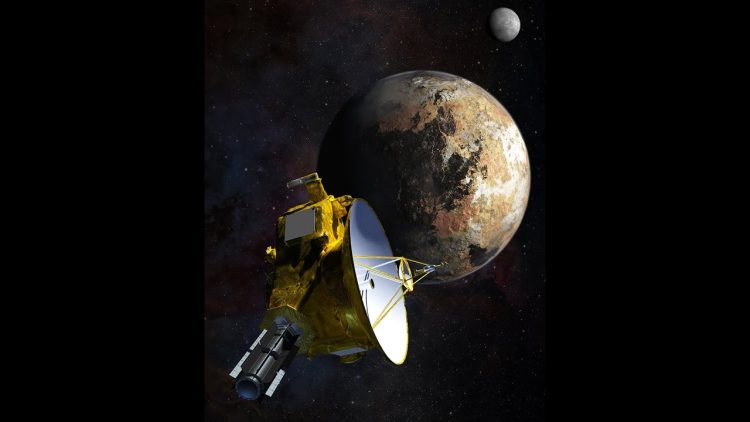
The Year of Pluto – New Horizons Documentary Brings Humanity Closer to the Edge of the Solar System
For eighty-five years, Pluto was a dot in a telescope. It was discovered in 1930, demoted to a dwarf planet in 2006, and for all that time nobody had ever seen its surface. Then, on 14 July 2015, NASA’s New Horizons spacecraft swept past it and showed the world something nobody had expected: not a dead ball of ice, but a living world of glaciers, mountains, volcanoes and a great heart-shaped plain.
New Horizons is the first mission to the Kuiper Belt, a gigantic zone of icy bodies and mysterious small objects orbiting beyond Neptune, a region the film calls the third zone of our Solar System, beyond the inner rocky planets and the outer gas giants. The spacecraft itself is about the size of a grand piano, and it was designed, built and operated by the Johns Hopkins University Applied Physics Laboratory in Maryland, which manages the mission for NASA’s Science Mission Directorate. It is part of NASA’s New Frontiers Program, managed by the Marshall Space Flight Center in Huntsville, Alabama.
The journey took almost ten years and more than five billion kilometres. New Horizons launched in January 2006 and flew past Jupiter in 2007, using the giant planet’s gravity to pick up speed, then crossed the Solar System in silence for eight years. On 14 July 2015 it reached its closest point to Pluto, about 12,500 kilometres from the surface, and it flew past at more than 50,000 kilometres an hour, too fast to stop or to orbit.
What it found rewrote the textbooks. Pluto’s most famous feature is its heart, a region roughly 1,600 kilometres wide, formally called Tombaugh Regio after Clyde Tombaugh, the astronomer who discovered Pluto. Its western lobe, Sputnik Planitia, is a nitrogen glacier sitting on top of an ancient impact basin, an ice sheet at least four kilometres thick that is slowly overturning, like oatmeal boiling on a stove. The heart is so massive that it literally tipped the dwarf planet, forcing it to reorient itself so the basin faces away from Charon. Around it are ice mountains up to 3,500 metres high, nitrogen ice glaciers flowing downhill, and volcanoes of water ice that may have erupted relatively recently. Pluto’s atmosphere, mostly nitrogen with smaller amounts of methane and carbon monoxide, is hazed with solid particles formed by sunlight, and its surface is far younger and more active than anyone had predicted.
The film tells this story through the scientists who made it happen, including Dr. James Green, John Spencer, Fran Bagenal and Mark Showalter, who explain what the mission had to do and what it found. Their point is that Pluto was not a footnote. It was the first world of the Kuiper Belt ever visited, and it showed that the outer Solar System is not a frozen graveyard but a place of geology, weather and change. The mission did not stop at Pluto. On 1 January 2019, New Horizons flew past Arrokoth, a small Kuiper Belt object more than six billion kilometres from Earth, at a distance of about 3,500 kilometres, the farthest flyby ever made. The mission has been extended through 2029, and it is still sending back data from the edge of the Solar System.
What the film explores
The first part of the film is the mission itself: why go to Pluto, how do you build a spacecraft that can survive a ten-year journey to the edge of the Solar System, and how do you hit a target the size of a city from five billion kilometres away. The film explains the launch, the Jupiter gravity assist and the long silent cruise, and it shows the team at the Applied Physics Laboratory waiting for the signal that the flyby had worked.
The second part is the flyby and what it revealed. The film walks through the images as they arrived: the heart, the glaciers, the mountains and the haze, and it explains what each one means. The heart is the centrepiece, and the film explains how a nitrogen glacier four kilometres thick could be heavy enough to tip a whole world, and why that suggests there may be a liquid ocean beneath the ice.
The third part is the wider meaning. The film sets Pluto in its context as the first world of the Kuiper Belt, a region of icy bodies that are the leftover building blocks of the Solar System, and it explains why visiting one of them matters for understanding how planets form. It ends with the mission’s next step, the flyby of Arrokoth, and with the thought that New Horizons is still out there, still flying, still sending back news from a place no spacecraft had ever been.
Key Themes
- New Horizons, the first mission to the Kuiper Belt.
- The ten-year, five-billion-kilometre journey to Pluto.
- The flyby of 14 July 2015, at about 12,500 kilometres.
- Pluto’s heart, Tombaugh Regio, and the Sputnik Planitia glacier.
- Ice mountains, nitrogen glaciers and volcanoes of water ice.
- Alan Stern and the team at Johns Hopkins Applied Physics Laboratory.
Production and Background
The Year of Pluto is a NASA documentary, about an hour long, made to explain the New Horizons mission and its results. It was produced with the team that built and flew the spacecraft, and it features interviews with the scientists who planned the mission and interpreted its data, including Dr.
New Horizons launched on 19 January 2006 and flew past Pluto on 14 July 2015, completing the initial reconnaissance of the planets that had begun with Mariner 2 more than fifty years earlier. The spacecraft then flew on to Arrokoth, a contact binary of two lobes joined by a narrow neck, on 1 January 2019, and its mission has been extended through 2029.
Recommended Companion Viewing
Explore authoritative investigative documentaries on related historical events and investigative subjects.

How Time Becomes Space Inside a Black Hole | Space Time
NASA's SpaceX Crew-13 Launch
Space Station Operations Update
Black Holes. Explained. For 1.5 Hours.
Frequently Asked Questions
When did New Horizons reach Pluto? On 14 July 2015, after a journey of almost ten years and more than five billion kilometres.
What is Pluto’s heart? A heart-shaped region about 1,600 kilometres wide, formally called Tombaugh Regio. Its western lobe, Sputnik Planitia, is a nitrogen glacier at least four kilometres thick, sitting in an ancient impact basin.
Is Pluto geologically active? Yes, far more than anyone expected.
Who built New Horizons? The Johns Hopkins University Applied Physics Laboratory designed, built and operates the spacecraft, and manages the mission for NASA.
What happened after Pluto? On 1 January 2019, New Horizons flew past Arrokoth, a small Kuiper Belt object more than six billion kilometres from Earth, at a distance of about 3,500 kilometres.
More to watch
- The Insane Engineering of James Webb Telescope
- What If Space And Time Are NOT Real?
- How Time Becomes Space Inside a Black Hole | Space Time
- Black Holes. Explained. For 1.5 Hours.
- Mars – Life on the Red Planet?
For the rocket that made deep-space missions possible, Saturn V: How NASA Built the Most Powerful Rocket Ever tells the story of the machine that first carried humans beyond Earth.