The Insane Engineering of James Webb Telescope
How do you build a telescope with a mirror six and a half metres across, fold it up like origami, launch it on a rocket, and then unfold it, a million and a half kilometres from Earth, with no one there to fix it if anything goes wrong?
The Webb was launched on Christmas Day 2021, 25 December, on an Ariane 5 rocket from the Guiana Space Centre in Kourou, French Guiana, and it travelled for a month to its destination, a halo orbit around the Sun-Earth L2 Lagrange point, about 1.5 million kilometres from Earth, where it arrived on 24 January 2022. The reason for that strange address is that Webb sees in infrared, in heat, and to see the faint heat of the first galaxies it has to be extraordinarily cold, and extraordinarily shielded from the heat of the Sun, the Earth and the Moon.
The shield is the film’s first engineering marvel. It is a five-layer sunshield made of Kapton, a plastic film coated in aluminium, each layer about a tenth of a millimetre thick, and when fully deployed it is 21.2 metres by 14.2 metres, about the size of a tennis court. The shield drops the temperature by almost 600 degrees Fahrenheit across its five layers, from about 85 degrees Celsius on the hot side, facing the Sun, to about minus 233 degrees on the cold side, where the telescope sits.
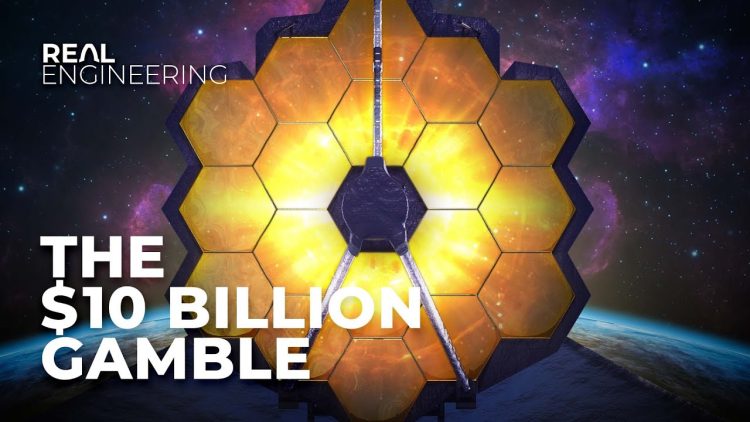
The mirror is the second marvel. Webb’s primary mirror is 6.5 metres across, made of 18 hexagonal segments of beryllium, a metal chosen because it is both strong and light, coated with a layer of gold only 100 nanometres thick, about 48 grams of gold in total, roughly the mass of a golf ball. Beryllium was chosen because it barely changes shape as it cools, which matters when the mirror has to hold its shape to within a fraction of a wavelength of light at minus 233 degrees. The 18 segments can each be moved independently, by tiny actuators, so that the mirror can be aligned in space to a precision no telescope has ever needed before. Hubble, by comparison, has a single mirror 2.4 metres across, and it orbits only 560 kilometres above the Earth, close enough for astronauts to have visited it five times. Webb, at 1.5 million kilometres, can never be repaired. It had to work first time.
The film’s climax is the deployment, and the numbers are terrifying. The unfolding involved more than 300 single-point failures, steps where a single failure would have ended the mission, and it took two weeks to complete. The sunshield unfurled on 28 December, the mirror wings swung into place, and by the end of January the telescope was at L2 and cooling down. The first full-colour images were released on 12 July 2022, and they showed the deepest view of the universe ever taken. The film’s point is that Webb is not only a telescope. It is a test of whether human engineering can do something that has never been done before, and do it perfectly, a million miles from home, with no second chance.
What the film explores
The first part of the film is the problem: why build a telescope in infrared, why put it at L2, and why it has to be so cold. The film explains that the light from the first galaxies has been stretched by the expansion of the universe into the infrared, and that to see it a telescope must be cold enough not to be blinded by its own heat. That single requirement, the film shows, drives everything else about the design.
The second part is the sunshield, the largest and most delicate part of the spacecraft. The film explains the five layers, the Kapton, the angles that let heat escape sideways, and the folding that let a tennis-court-sized shield fit inside a rocket fairing. It also explains the cryocooler, the refrigeration system that cools the mid-infrared instrument even further, to about 7 kelvin, colder than the cold side of the shield.
The third part is the mirror and the deployment. The film explains why beryllium, why gold, why 18 segments, and why each segment needs its own actuators. It then walks through the deployment sequence, step by step, and explains what was at stake at each one. The film ends with the first images, and with the science that Webb was built to do: seeing the first galaxies, studying the atmospheres of exoplanets, and looking further back in time than any telescope before it.
Key Themes
- Launched 25 December 2021 on an Ariane 5 from French Guiana.
- L2, a million and a half kilometres from Earth, reached 24 January 2022.
- The five-layer Kapton sunshield, the size of a tennis court.
- From 85 degrees Celsius to minus 233 across five layers.
- The 6.5-metre mirror: 18 hexagonal segments of gold-coated beryllium.
- Only 48 grams of gold, about the mass of a golf ball.
Production and Background
The film is a Real Engineering video, written and narrated by Brian McManus, with animation by Mike Ridolfi and editing by Dylan Hennessy, published in December 2021, just before the launch.
The Webb telescope was the result of more than twenty years of planning and development, and its cost, around 9.7 billion dollars, made it one of the most expensive scientific instruments ever built. The film was made before the launch, and it is a measure of how well its engineering was understood that everything it describes, the folding, the unfolding, the cooling, happened as planned.
Recommended Companion Viewing
Explore authoritative investigative documentaries on related historical events and investigative subjects.

Nancy Grace Roman Space Telescope Science Overview News Conference
Progress 96 Cargo Ship Launch
Blackholes, Aliens, and the Sun! How the Universe Works
NASA's SpaceX Crew-12 Undocking
Frequently Asked Questions
Why is the Webb telescope at L2? Because it sees in infrared, in heat, and it needs to be cold and shielded from the Sun, the Earth and the Moon.
How big is Webb’s mirror? 6.5 metres across, made of 18 hexagonal segments of beryllium coated with gold.
Why is the mirror made of beryllium and gold? Beryllium is strong and light, and it barely changes shape as it cools, which matters at minus 233 degrees.
Could Webb be repaired if something went wrong? No. Hubble orbits 560 kilometres above the Earth and was visited by astronauts five times. Webb is 1.5 million kilometres away, and no spacecraft can reach it.
What has Webb seen so far? Its first full-colour images, released on 12 July 2022, included the deepest view of the universe ever taken.
More to watch
- Relativity is so much weirder than we thought…
- What If an Asteroid Hit New York City? | How the Universe Works
- Invisible Forces that Shape Our Reality — How the Universe Works
- NASA’s SpaceX Crew-12 Re-Entry & Splashdown
- The Complete History Of The Colosseum: 2,000-Year-Old Engineering Marvel
For the theory behind the telescope’s view of the universe, Relativity is so much weirder than we thought… explains the physics Webb was built to explore.