
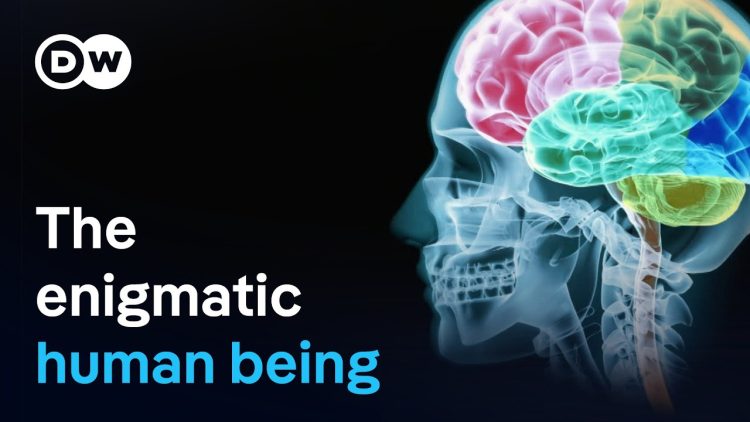
What distinguishes humans from animals? | DW Documentary
What made our ancestors evolve in such an extraordinary way? That is the question this DW Documentary sets out to answer, and it begins by putting humans in their place. Some animals see, hear or smell better than humans. Others can find their way in the dark much better than we can. Some can fly. All animals communicate, some have excellent memories, and others build complex structures and have highly developed social skills. So what sets humans apart? Why have humans evolved such highly developed cognitive abilities in comparison to animals?
The film’s answer starts with the brain, and with the scale of the change. Our species, Homo sapiens, appeared in Africa around 300,000 years ago, with the oldest known fossils coming from Jebel Irhoud in Morocco. The modern human brain averages around 1,350 cubic centimetres, roughly triple the volume of the earliest members of our genus. Homo habilis, who lived some 2.4 million years ago and made the first stone tools, had a brain of about 650 cubic centimetres. Homo erectus, who appeared around two million years ago and was the first of our relatives to leave Africa, averaged around 950. The growth was not steady and it was not inevitable.
But the film is careful to say that brain size alone is not the answer. Neanderthals had brains as large as ours, around 1,400 cubic centimetres, and they did not build civilisations. What sets humans apart, the film argues, is not the size of the brain but what it does: above all, language and cumulative culture. Other animals communicate, but no other species passes on knowledge that accumulates over generations, so that each generation starts where the last one left off. A chimpanzee can learn to use a stick to fish for termites, but it does not improve on the stick, teach the improvement to its young, and see the improvement spread across a whole population.
The film also looks at the other side of the story, the shadow side. The same abilities that made humans successful, planning, cooperation, tool use, the capacity to imagine the future, also gave us the power to destroy the world we live in. We are the only species that can wipe out other species on a planetary scale, change the climate of the whole Earth, and build weapons that could end our own civilisation. The film asks whether our extraordinary abilities will ultimately lead to self-destruction, and it does not offer a comforting answer. It suggests that the question is not whether we are clever enough to survive, but whether we are wise enough to use our cleverness well.
The documentary’s strength is that it does not present a single theory as settled. It presents the latest scientific theories, from the archaeologists who study stone tools to the neuroscientists who study the brain, and it lets them disagree. What emerges is a picture of a species that is not separate from the rest of nature, but a part of it, one that happened to evolve a particular set of abilities, and that now has to live with the consequences of having them.
What the film explores
The first part of the film is the comparison. It shows what animals can do that humans cannot: the eagle’s eyesight, the dog’s sense of smell, the bat’s echolocation, the bird’s ability to navigate by the stars. The point is to strip away the idea that humans are simply better at everything. We are not. We are better at one thing, and the film spends the rest of its time trying to say what that thing is.
The second part is the fossil record and the brain. The film traces the growth of the brain from Homo habilis to Homo erectus to Homo sapiens, and it explains the theories for why it grew: the demands of hunting, the demands of social life in large groups, and the demands of language. It also explains why brain size is not the whole story, using the Neanderthals as the key example of a large-brained relative that did not develop cumulative culture in the same way.
The third part is language and culture. The film argues that the decisive human ability is not intelligence in the abstract but the capacity to share knowledge and build on it, generation after generation. It shows how that ability turned a species of African apes into a species that lives on every continent, and it ends with the shadow side: the power that same ability gives us to destroy the world, and ourselves, and the open question of whether we will.
Key Themes
- Animals that see, hear, smell and navigate better than humans.
- Homo sapiens, around 300,000 years old, from Africa.
- The brain, from 650 cubic centimetres in Homo habilis to 1,350 in us.
- Homo erectus and the first stone tools, around 3.3 million years ago.
- Neanderthals, large brains, but no cumulative culture.
- Language and the ratchet effect of shared knowledge.
Production and Background
The film is a DW Documentary, published on the DW Documentary channel in February 2026.
The film’s subject, what makes humans unique, is one of the oldest questions in science, and it is one that has been transformed in recent decades by new fossil discoveries, including the Jebel Irhoud fossils that pushed the origin of our species back to around 300,000 years ago, and by new genetic evidence about our relationship with Neanderthals and other extinct relatives.
Recommended Companion Viewing
Explore authoritative investigative documentaries on related historical events and investigative subjects.

Testosterone — new discoveries about the male hormone
Why Does Every Mammal Get 1 Billion Heartbeats in Their Life?
Is Spider Web Really Stronger Than Steel?
Bigfoot Caught on Camera?
Frequently Asked Questions
When did Homo sapiens appear? Around 300,000 years ago, in Africa.
How big is the human brain compared to our ancestors? The modern human brain averages around 1,350 cubic centimetres. Homo habilis, about 2.4 million years ago, had a brain of around 650 cubic centimetres, and Homo erectus, about two million years ago, averaged around 950.
What really sets humans apart from other animals? The film argues that it is not brain size alone, since Neanderthals had brains as large as ours, but language and cumulative culture: the ability to share knowledge and build on it, generation after generation, so that each generation starts where the last one left off.
Do other animals have culture? Yes, in a limited sense. Chimpanzees pass on tool use, whales pass on songs, and many animals learn from each other.
Could our abilities lead to self-destruction? The film leaves the question open. Our cognitive abilities have given us the power to change the planet’s climate, drive other species to extinction and build weapons of mass destruction.
More to watch
- Homo Sapiens: How Humans Conquered the Planet
- The History of Humanity: From Deep Time Until Today
- Our Body as a High-Performance Machine – How Resilient Are We?
- Can Humans Sense Magnetic Fields?
- A Wolf’s Journey: The Wolf With Golden Eyes
For the full story of our species, Homo Sapiens: How Humans Conquered the Planet follows the journey from Africa to every corner of the Earth.







