
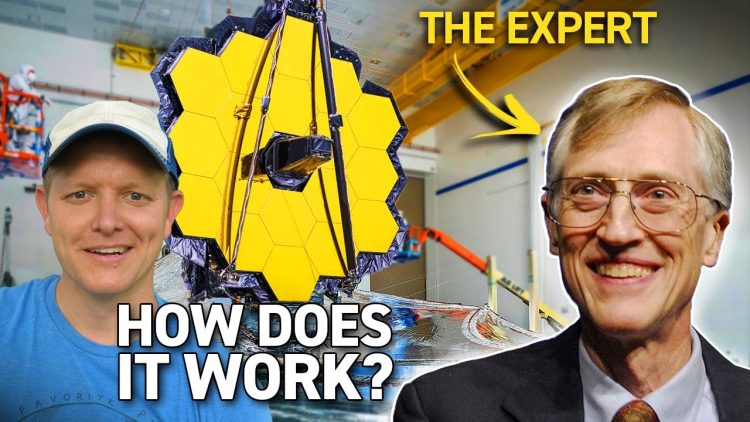
How Does The James Webb Space Telescope Work? – Smarter Every Day 262
Before the James Webb Space Telescope launched, Destin Sandlin of Smarter Every Day sat down with the one person who could explain it best. Dr. John Mather is an astrophysicist and a cosmologist, and he won the Nobel Prize in Physics in 2006, with George Smoot, for his work on the Cosmic Background Explorer satellite, which measured the afterglow of the Big Bang. He is also the senior project scientist for the James Webb Space Telescope, which means he represents the interests of science to the project managers. If you could pick any human in history to explain the telescope to you, as Destin puts it, you would pick Dr. John Mather.
The interview was filmed in 2017, at NASA’s Goddard Space Flight Center in Maryland, where the telescope was designed and tested, and the video was published in October 2021, just weeks before the launch. That timing matters, because the film is a conversation about a machine that had not yet flown. Mather explains it as a scientist explains something he has spent decades building: patiently, clearly, and with the excitement of someone who knows what is at stake. The first thing he explains is the problem.
The reason for all of that is infrared light. Webb sees in heat, and the light from the first stars and galaxies has been stretched by the expansion of the universe into the infrared, so a telescope that wants to see the beginning of the universe has to see in infrared. That single requirement drives everything about the design. The telescope has to be cold, because a warm telescope would be blinded by its own heat, and it has to be shielded from the Sun, the Earth and the Moon.
The mirror is the part Mather calls the most difficult to engineer. It is 6.5 metres across, made of eighteen hexagonal segments of beryllium, a metal chosen because it is strong and light and barely changes shape as it cools, coated with a layer of gold only a hundred nanometres thick. The eighteen segments can each be moved independently, so the mirror can be aligned in space to a precision no telescope has ever needed before. The telescope itself is a three-mirror design, a Cassegrain telescope with three mirrors, which gives it a good image over a large piece of sky, and it sees infrared light from 0.6 to 28 microns, far beyond what the human eye can see and far beyond what Hubble can see.
The film ends with Mather’s own attitude to the launch. He is famously calm about it, and Destin asks him how he can be so relaxed about a machine that took more than twenty years to build, cost around ten billion dollars, involved more than ten thousand people in fourteen countries, and could never be repaired if anything went wrong. Mather’s answer is that you make your plans, you test everything you can, and then you let go. The telescope launched on Christmas Day 2021, 25 December, on an Ariane 5 rocket from French Guiana, and everything Mather describes in this film, the folding, the unfolding, the cooling, happened as planned. The first full-colour images were released on 12 July 2022.
What the film explores
The first part of the film is the problem: why build a telescope in infrared, why put it at L2, and why it has to be so cold. Mather explains that the light from the first galaxies has been stretched by the expansion of the universe, and that to see it a telescope must be cold enough not to be blinded by its own heat. That single requirement, the film shows, drives everything else about the design.
The second part is the design itself. The film explains the three-mirror system, the eighteen beryllium segments, the gold coating and the sunshield, and it shows why each part is built the way it is. Mather explains the testing, too: every component was shaken, frozen and heated in giant chambers at Goddard, because once the telescope was in space, there would be no one there to fix it.
The third part is the launch and what comes after. The film was made before the launch, and Mather talks about what the telescope will do once it is working: see the first stars and galaxies, study the atmospheres of planets around other stars, and look further back in time than any telescope before it. The film ends with Mather’s advice, which Destin takes to heart: make your plans, do the work, and then let go of the worry.
Key Themes
- Dr. John Mather, Nobel laureate and senior project scientist for Webb.
- The interview, filmed at NASA Goddard in 2017.
- Why Webb sees in infrared, and why it has to be so cold.
- The 6.5-metre mirror: eighteen segments of gold-coated beryllium.
- The five-layer Kapton sunshield, the size of a tennis court.
- The L2 orbit, a million and a half kilometres from Earth.
Production and Background
The film is Smarter Every Day episode 262, published in October 2021 by Destin Sandlin, and it is one of the channel’s most watched science films.
Dr. John Mather won the Nobel Prize in Physics in 2006, with George Smoot, for the Cosmic Background Explorer satellite, which measured the spectrum of the cosmic background radiation and found the hot and cold spots that led to the existence of galaxies. He was tapped in 1995 to work on the next great space telescope after Hubble, and he has been its senior project scientist ever since.
Recommended Companion Viewing
Explore authoritative investigative documentaries on related historical events and investigative subjects.

Nancy Grace Roman Space Telescope Prelaunch News Conference
U.S. Spacewalk 97
Progress 96 Cargo Ship Launch
Frequently Asked Questions
Who is Dr. John Mather? An astrophysicist and cosmologist at NASA’s Goddard Space Flight Center.
Why does Webb see in infrared? Because the light from the first stars and galaxies has been stretched by the expansion of the universe into the infrared.
How big is Webb’s mirror? 6.5 metres across, made of eighteen hexagonal segments of beryllium coated with gold.
What is the sunshield? A five-layer shield made of Kapton, about the size of a tennis court, that blocks the heat of the Sun, the Earth and the Moon.
When did Webb launch? On 25 December 2021, on an Ariane 5 rocket from French Guiana.
More to watch
- The Insane Engineering of James Webb Telescope
- What If Space And Time Are NOT Real?
- There Is Something Faster Than Light
- How Time Becomes Space Inside a Black Hole | Space Time
- The Big Bang Special How the Universe Works
For another mission to the edge of the Solar System, Mars – Life on the Red Planet? asks whether our nearest neighbour ever held life.







