
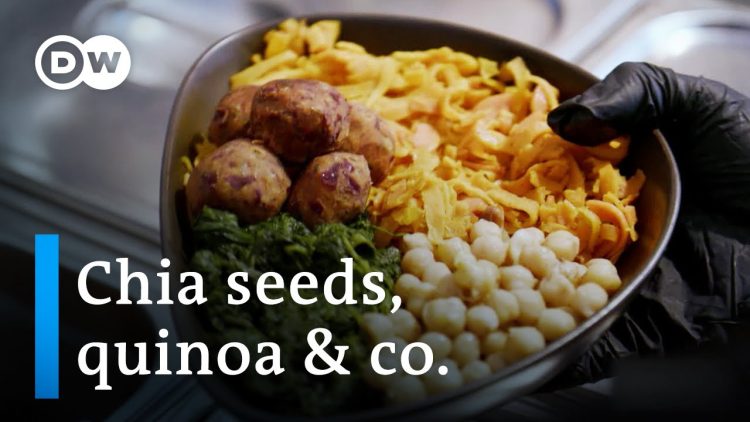
Superfoods – is healthy eating just hype? | DW Documentary
Are superfoods all that they are cracked up to be? There is plenty of worldwide hype about eating chia seeds, goji berries and quinoa, but what benefits do they really bring? This DW Documentary looks at what superfoods do for people, and at what the healthy eating boom is doing to agriculture and business on the other side of the world.
The film begins in Germany, where the superfood boom is visible on every high street. There are more and more restaurants serving superfoods, and in Bochum, in the Ruhr region, Florian Klar opened the first superfood bistro there about a year before the film was made. He buys in all types of food, using local suppliers when he can, but he also uses exotic superfoods in his meals, and his bistro is a small picture of a much larger change: foods that were once obscure health-store items are now mainstream, and the food industry has noticed.
Quinoa, goji berries and chia seeds can now all be found in supermarkets, and the film shows how the industry has changed its product selection accordingly. Selling these products is lucrative, and the shelves have followed the money. But the film also asks the question the marketing never does: what is a superfood, actually? The answer, as nutritionist Matthias Riedl explains, is simpler than the packaging suggests. A superfood is simply a foodstuff that contains a high amount of nutrients, and every country has its own. Blueberries, flax seed, blackcurrants and kale are all superfoods native to Germany, and they offer much of what the exotic imports do, without the air miles.
The film then travels to Bolivia, a key quinoa exporter, to see how the hype has influenced farming there. Exports of the so-called Inca corn quadrupled between 2007 and 2013, and the rising price of quinoa on global markets led Andean farmers to increase the size of their fields. But the boom has a cost that the price does not show. After just two straight years of quinoa harvests, the soil is already exhausted and barren, and the farmers who grew rich on the boom are left with land that will not grow anything at all.
That contrast is the heart of the film. In Germany, superfoods are sold as a route to health and virtue. In Bolivia, the same foods are a cash crop that is wearing out the land that grows them. The film does not argue that superfoods are worthless — quinoa, chia and goji berries are genuinely nutritious foods — but it asks whether the hype is honest, and whether a food can really be called healthy when the way it is grown damages the people and the soil that produce it.
What the Film Explores
The film explores the gap between marketing and nutrition. Superfoods are sold with the promise of extraordinary benefits, but the film shows that their real advantage is ordinary: they are nutrient-dense foods, and many of them have local equivalents that are just as good. The Mediterranean diet, built on foods that have been eaten for centuries, offers a useful comparison: health that comes from a whole way of eating, not from a single fashionable ingredient.
It also explores how a food trend reshapes farming. The quinoa boom transformed the Bolivian highlands in a few short years, quadrupling exports and pushing farmers to plant more and more of a single crop. The film shows what happens when a traditional crop becomes a global commodity: prices rise, fields expand, and the soil, farmed intensively year after year, gives out. It is a story that has played out with coffee, avocados and many other foods before quinoa.
The film looks closely at the business of healthy eating. Supermarkets, restaurants and food companies have all discovered that superfoods sell, and the film follows the money from the bistro in Bochum to the supermarket shelf. The healthy eating boom is a real market, and like any market it rewards the foods that can be branded and packaged, not necessarily the foods that are best for the people eating them.
Finally, the film explores what healthy eating actually means. If a food is nutritious but its production exhausts the soil and impoverishes the farmers, is it still a healthy choice? The film leaves that question with the viewer, and suggests that the honest answer starts closer to home, with the blueberries, flax seed, blackcurrants and kale that grow in Germany itself.
Key Themes
- Chia seeds, goji berries and quinoa, and the hype around them.
- Florian Klar’s superfood bistro in Bochum, the first in the Ruhr region.
- Nutritionist Matthias Riedl, and what a superfood actually is.
- Germany’s own superfoods: blueberries, flax seed, blackcurrants and kale.
- Bolivia, where quinoa exports quadrupled between 2007 and 2013.
- Soil exhaustion after just two straight years of quinoa harvests.
- How supermarkets and the food industry cashed in on the boom.
- Whether a food can be healthy if growing it damages the land.
Production and Background
The film is a DW Documentary production from 2020, running just under 26 minutes. It follows DW’s familiar method of taking a consumer trend and following it to its source, moving from a bistro in the Ruhr to the highlands of Bolivia. Its account of the quinoa trade draws on the export figures of the boom years, and its central claim — that the same crop can be a health food in one country and an exhausted soil in another — has only become more relevant as the global market for superfoods has continued to grow.
Recommended Companion Viewing
Explore authoritative investigative documentaries on related historical events and investigative subjects.

Why Fruits Have Lost Their Vitamins | ENDEVR Documentary
Fat Fiction — The Low Fat Diet Is Genocide | Full Documentary
Junk food, sugar and additives - The dark side of the food industry | DW Documentary
Frequently Asked Questions
What is a superfood? Simply a food that contains a high amount of nutrients. There is no official definition, and as nutritionist Matthias Riedl points out in the film, every country has its own superfoods.
Are chia seeds, goji berries and quinoa actually healthy? Yes, they are genuinely nutritious foods. The film’s question is not whether they are healthy, but whether they are healthier than local alternatives, and whether the hype around them is honest.
What are Germany’s native superfoods? Blueberries, flax seed, blackcurrants and kale, among others. They offer many of the same nutrients as the exotic imports, without the transport and the price tag.
What happened to quinoa farming in Bolivia? Exports quadrupled between 2007 and 2013 as global demand rose. Farmers expanded their fields, but after just two straight years of quinoa harvests the soil was exhausted and barren.
Is the superfood boom bad for farmers? It brought income at first, but the film shows the other side: intensive monoculture that wears out the land, leaving farmers with fields that will not grow anything.
More to watch
- Mediterranean cuisine – The recipe for a long and healthy life?
- A global longevity movement – Eternal life with biohacking?
- Eternal Life? The secrets of the centenarians







