
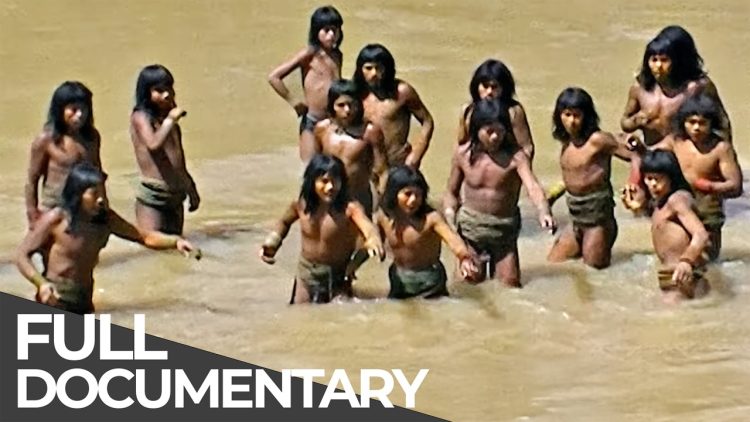
World’s Largest Isolated Tribe | Mashco Piro: Living Like 20,000 Years Ago
Deep in the Peruvian Amazon live the Mashco Piro, believed to be the world’s largest isolated Indigenous people. They fled the brutality of the rubber boom more than a century ago, and they have remained separated from modern society ever since — living, as the film’s title puts it, like 20,000 years ago. This documentary is about them, and about the question their existence forces on the rest of the world: should an isolated people be contacted at all?
The Mashco Piro’s history is a history of flight. The rubber boom, more than a century ago, brought violence to the Amazon on an industrial scale, and the Mashco Piro fled it — into the forest, away from the rivers and the settlements, and into a separation that has lasted ever since. The film treats that flight as the founding fact of the story: the isolation is not an accident of geography, and it is not a lifestyle choice. It is a response to what contact did to them, remembered across generations.
But the separation is fraying. Mysterious encounters along the river are bringing the Mashco Piro closer to the outside world — sightings, approaches, moments of contact that no one planned and no one controls. The film follows these encounters, and the anxiety they cause: each one is a small event, but together they suggest a direction of travel, toward a contact that may happen whether anyone wants it or not.
Around the Mashco Piro, the film shows, a contest is taking place. Anthropologists, villagers, missionaries and criminals all compete to shape the tribe’s future, and they want different things from it. The anthropologists want to study and protect. The villagers want safety, and an end to the fear that encounters bring. The missionaries want to reach them. The criminals — loggers, traffickers, the men who work the forest for profit — want the land, and the tribe is in the way. The documentary’s argument is that the Mashco Piro’s future will be decided by this contest, and that the tribe itself has almost no say in it.
By the end, the film has become a study in one of the most sensitive questions of our time. An isolated people, living as their ancestors did, in a forest that is shrinking around them. A world that cannot leave them alone, and cannot agree on how to approach them. The film does not offer an answer to whether they should be contacted. It offers the question, and the people around it, and the forest they live in — and it leaves the viewer with the weight of it.
What the Film Explores
The film explores the isolation first, and it is the documentary’s foundation. The Mashco Piro fled the rubber boom more than a century ago, and the film treats that flight as the key to everything that follows: the separation from modern society, the way of life that has continued apart from it, and the memory of violence that keeps the separation in place. The isolation, the film argues, is not timeless. It has a history, and the history is brutal.
A second thread follows the encounters, and the film is at its most tense here. Mysterious meetings along the river are bringing the tribe closer to the outside world, and the documentary follows what those encounters mean — for the villagers who live nearby, for the authorities who must respond, and for the Mashco Piro themselves, whose world is being entered without their consent. Each encounter is small. Together, they are a pattern.
A third thread follows the contest for the tribe’s future, and the film takes it in turn: the anthropologists, the villagers, the missionaries and the criminals. Each group has its own interest, and the documentary is interested in how those interests collide. The anthropologists argue for protection and distance. The missionaries argue for contact. The criminals do not argue at all — they act, in the forest, for profit. The film’s point is that the Mashco Piro are the subject of a debate they are not part of.
Running through the film is the question itself: should an isolated people be contacted at all? The documentary presents it as one of the most sensitive and controversial questions of our time, and it does not resolve it. It shows the arguments, the people making them, and the forest in which the answer will be lived — and it leaves the question with the viewer, where it belongs.
Key Themes & Topics Examined
- The Mashco Piro, the world’s largest isolated Indigenous people
- The rubber boom, and a flight into the forest more than a century ago
- Living apart from modern society, like 20,000 years ago
- Mysterious encounters along the river
- Anthropologists, villagers, missionaries and criminals
- The contest to shape the tribe’s future
- Should an isolated people be contacted at all?
- The Peruvian Amazon, and the forest closing in
Production & Background
The film is a Free Documentary production, from the channel’s series of documentaries on the peoples and places of the world. Free Documentary is dedicated to bringing high-quality documentaries to YouTube for free, with the latest camera equipment used by well-known filmmakers working for famous production studios.
The documentary’s subject is the Mashco Piro of the Peruvian Amazon, believed to be the world’s largest isolated Indigenous people. Its framing is the one the description gives: a people who fled the rubber boom and have lived apart ever since, and the encounters that are bringing them closer to the outside world — and the question of whether they should be contacted at all.
Recommended Companion Viewing
Explore authoritative investigative documentaries on related historical events and investigative subjects.

Gothic architecture - When cathedrals reached up to the heavens
The Secret Trade Routes of Hitler's Stolen Masterpieces
Frequently Asked Questions
What is the film about?
The Mashco Piro of the Peruvian Amazon, believed to be the world’s largest isolated Indigenous people, and the question of whether an isolated people should be contacted at all.
Why do the Mashco Piro live apart from modern society?
They fled the brutality of the rubber boom more than a century ago, and have remained separated from modern society ever since.
What is bringing them closer to the outside world?
Mysterious encounters along the river — sightings and approaches that no one planned and no one controls.
Who is competing to shape their future?
Anthropologists, villagers, missionaries and criminals — each with different interests in the tribe and its forest.
Who made the film?
Free Documentary, the channel behind a series of documentaries on the peoples and places of the world.







