
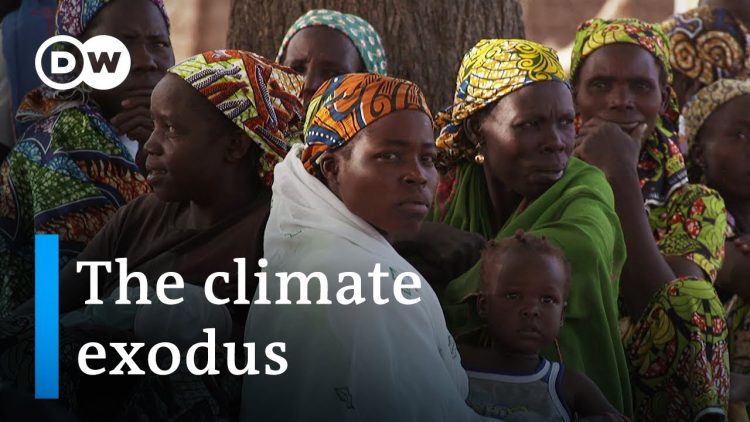
Fleeing climate change — the real environmental disaster | DW Documentary
How many millions of people will be forced to leave their homes by 2050? This documentary looks at the so-called hotspots of climate change in the Sahel zone, Indonesia and the Russian Tundra, and it begins with a lake that is disappearing. Lake Chad, in the Sahel zone, has already shrunk by 90 percent since the 1960s due to the increasing heat, and about 40 million people will be forced to migrate to places where there is enough rainfall. Migration has always existed as a strategy to adapt to a changing environment.
One of them is Mohammed Ibrahim. As Lake Chad got hotter and drier, he decided to go where the temperatures were less extreme and there was still a little water, trekking with his wife, children and 70 camels from Niger to Chad and then further south. The journey lasted several years, and many members of his herd died of thirst. Now he and his family are living in a refugee camp: they only have seven camels left. Mohammed is one of many who have left their homelands in the Sahel — not because of conflict and crises, but because of the high temperatures.
The film’s argument is that Mohammed’s story is not an exception but a pattern, and that the pattern is unjust. It is a double injustice, the film says: after becoming rich at the expense of the rest of the world, the industrialised countries are now polluting the atmosphere with their emissions and bringing a second misfortune to the inhabitants of the poorer regions. The people who are losing their homes to the heat contributed least to causing it. The film follows that argument from the Sahel to Indonesia, where rising seas and changing rainfall are forcing people from their land, and to the Russian Tundra, where warming is thawing the ground beneath whole communities.
What makes the film effective is that it stays with the people it follows. Mohammed Ibrahim is not a statistic. He is a man who counted his camels — seventy when he left, seven when he arrived — and who can tell you exactly what the heat cost him. The film does not need to argue that climate migration is real. It shows a family in a refugee camp, and a lake that has lost 90 percent of its water, and lets the viewer draw the conclusion. The question in the film’s title is not rhetorical. The real environmental disaster is not a future event. It is already happening, and it is already forcing people from their homes.
What the Film Explores
The film explores the Sahel as a climate hotspot. The Sahel is the band of semi-arid land south of the Sahara, and it is warming faster than the global average. Lake Chad, which once supported fishing, farming and herding for millions of people, has shrunk by 90 percent since the 1960s. The film shows what that means in practice: wells that run dry, pastures that turn to dust, and families that must choose between staying on land that can no longer feed them and leaving for somewhere they do not know.
It also explores the other hotspots. In Indonesia, the film shows communities facing rising seas and changing rainfall, where the land itself is becoming uninhabitable. In the Russian Tundra, warming is thawing the permafrost that whole towns are built on, and the ground is literally shifting beneath people’s feet.
Finally, the film explores the question of responsibility. The double injustice it describes — the rich world grew rich by burning fossil fuels, and the poor world is paying the price — is not presented as a slogan but as a fact about Mohammed Ibrahim’s life. He did not cause the lake to shrink. He is the one who lost his camels to it.
Key Themes
- A disappearing lake: Lake Chad has shrunk by 90 percent since the 1960s, and about 40 million people in the region will be forced to migrate.
- One man’s journey: Mohammed Ibrahim trekked for years with his family and 70 camels from Niger to Chad; only seven camels survived, and the family now lives in a refugee camp.
- A double injustice: the industrialised countries grew rich at the expense of the rest of the world, and their emissions are now bringing a second misfortune to the poorest regions.
- Three hotspots: the Sahel, Indonesia and the Russian Tundra show that climate migration is a global pattern, not a single local crisis.
- Migration as adaptation: moving has always been a way to cope with a changing environment — but the number forced to move by climate alone has risen sharply since the 1990s.
- The real disaster: the film’s title is literal. The environmental disaster is not in the future. It is already forcing people from their homes.
Production and Background
The film is a DW Documentary production, from the German broadcaster’s long-running strand of films about the environment and global affairs.
The figures the film cites have only grown more stark since it was made. Lake Chad’s shrinkage is one of the most documented cases of climate-driven environmental change in the world, and the number of people displaced by climate-related disasters continues to rise each year. The film remains a clear introduction to climate migration, because it does not argue in the abstract.
Recommended Companion Viewing
Explore authoritative investigative documentaries on related historical events and investigative subjects.

Inside the planet’s most urgent climate warning | Global Warning E1 | Featured Documentary
The melting ice of the Arctic (1/2) | DW Documentary
How heatwaves impact our lives
Climate change: Europe's melting glaciers
Frequently Asked Questions
How much has Lake Chad shrunk? Lake Chad has shrunk by about 90 percent since the 1960s, due to increasing heat and reduced rainfall.
Who is Mohammed Ibrahim? He is a herder from the Sahel who trekked with his wife, children and 70 camels from Niger to Chad and then further south, over several years, as Lake Chad dried up.
What is a climate refugee? It is a person forced to leave their home because of climate change — in Mohammed Ibrahim’s case, because of heat and drought, not conflict.
What does the film mean by a double injustice? It means that the industrialised countries became rich at the expense of the rest of the world, and are now polluting the atmosphere with their emissions, bringing a second misfortune to the inhabitants of the poorer regions who contributed least to the problem.
More to watch
- Displaced on Java – A village battling rising sea levels
- Climate change – living on the water
- This is just how unfair climate change is
- The Global North taken to court – Who pays for the climate catastrophe?
- Kiribati and climate change
The same question — who pays for the damage — is at the heart of The Global North taken to court – Who pays for the climate catastrophe?, while Displaced on Java – A village battling rising sea levels shows a community facing rising seas rather than a shrinking lake.







