
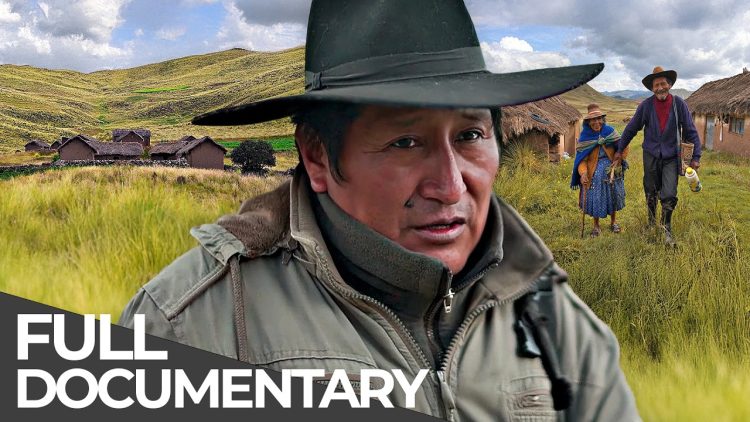
A Life at 4,000 Meters | Peru: The Quechua People’s Fight for Survival
High in the Peruvian Andes, at an altitude of 4,000 metres, the Quechua people have preserved their traditions and way of life for generations. Deeply connected to the land, they rely on ancestral knowledge to thrive in one of the world’s most challenging environments. But climate change, unpredictable weather and water shortages are threatening their future.
Life at 4,000 metres is hard in ways that are difficult to imagine from sea level. The air holds only about sixty per cent of the oxygen found at the coast, the nights are freezing even when the days are warm, and the growing season is short and uncertain. The Quechua have lived at these altitudes for thousands of years, and they built a way of life that fits the mountains: terraced fields that hold soil and water on steep slopes, crops bred over centuries for cold and drought, and a calendar of planting and harvest tuned to the rains.
The man at the centre of the film is both a farmer and an agricultural engineer, and that combination matters. He is not choosing between tradition and modern knowledge, but putting them together: using his training to understand what the old techniques do and why they work, and then teaching them to others.
Those problems are getting worse. The climate is changing faster in the mountains than almost anywhere else, and the glaciers that feed the rivers are retreating. Rain that used to come on schedule now comes late or all at once, and the water that once flowed reliably through the dry season is less certain every year. For farmers who depend on that water, a bad year is not an inconvenience, it is a threat to the harvest and to the family’s food. The film does not present climate change as a distant warning but as something already happening in the fields it shows.
What the film is really about is what gets lost when a way of life disappears. The Quechua language, spoken by some eight to ten million people across the Andes, carries knowledge about plants, weather and soil that exists nowhere else. The potatoes the Quechua grow, thousands of native varieties bred over centuries in these mountains, are a living library of genetic diversity that the whole world depends on: the potato was first domesticated in the Andes, and every potato grown anywhere descends from those first Andean farmers. When a village stops farming the old way, that knowledge goes with it.
What the film explores
The first part of the film establishes the place: the high Andes of Peru, a landscape of terraces, stone walls and thin air, where farming has been practised for thousands of years. The film explains how the Quechua adapted to the altitude, from the crops they grow to the houses they build, and how their culture is tied to the mountains themselves, which are treated not as scenery but as living beings with names and histories.
The middle of the film follows the work of reviving ancient techniques. Terraces, built by hand from stone, hold the soil on slopes where nothing would grow otherwise, and they store the heat of the day and release it at night, protecting crops from frost. Raised beds and irrigation channels, some of them centuries old, move water where it is needed. The film shows these systems being repaired and put back into use, and it explains the science behind them in plain terms: they work because they were designed for exactly this climate, by people who had no choice but to get it right.
The final part turns to the future. Young people are leaving the villages for the cities, and the knowledge of the old techniques is held by fewer and fewer elders. The film follows the effort to pass it on, through schools, through community projects and through the example of the farmer at its centre, who argues that the Quechua way of life is not something to be preserved in a museum but something to be lived, because it works. The film ends not with a conclusion but with a question: whether a tradition that survived the Incas, the Spanish and five centuries of change can survive the climate of the next fifty years.
Key Themes
- Life at 4,000 metres in the Peruvian Andes.
- Quechua traditions and ancestral farming knowledge.
- Terraces and ancient water systems, repaired and reused.
- Climate change, unpredictable weather and water shortages.
- The Quechua language as a carrier of knowledge about plants and soil.
- Native potato varieties and the Andes as the home of the potato.
Production and Background
The film is a Free Documentary production, published on the Free Documentary channel in October 2026, and it is one of a pair of films about Indigenous peoples of the Andes and the Amazon.
At twenty-two minutes, the film is short, and it does not try to cover the whole history of the Quechua people. Instead it concentrates on one farmer, one village and one season, and uses that focus to show the larger forces at work: a changing climate, a shrinking rural population and a tradition that is fighting to survive.
Recommended Companion Viewing
Explore authoritative investigative documentaries on related historical events and investigative subjects.

What Iran’s Top Security Official Said About June 2025 U.S. and Israeli Strikes
No future in Germany? Why skilled Polish workers are going home
The Ayoreo People | Paraguay: Fighting to Remain Uncontacted
Turkey: How Artists Challenge(d) Erdoğan with Gezi Protests
Frequently Asked Questions
Who are the Quechua people? The Quechua are the Indigenous peoples of the central Andes, living in Peru, Bolivia, Ecuador, Argentina, Chile and Colombia. Their language, Quechua, is spoken by some eight to ten million people, and it was the language of the Inca Empire.
Why is farming at 4,000 metres so hard? The air is thin, with only about sixty per cent of the oxygen found at sea level, nights are freezing, and the growing season is short.
What are the ancient techniques the film shows? Stone terraces that hold soil on steep slopes and protect crops from frost, raised beds and irrigation channels that move water where it is needed, and the use of native crop varieties bred over centuries for the mountain climate.
How is climate change affecting the Andes? The high Andes are warming faster than the global average, glaciers are retreating, and rainfall is becoming less predictable.
Why do potatoes matter so much? The potato was first domesticated in the Andes, and Peru alone grows thousands of native varieties.
More to watch
- The Amazon in danger – Indigenous peoples and their struggle for the rainforest
- World’s Largest Isolated Tribe | Mashco Piro: Living Like 20,000 Years Ago
- The Tribe That Left the Forest | Mlabri: Asia’s Forgotten People
- Lithium – New Gold Rush in the Andes
- The Maya of Belize – The battle for culture, the rainforest and ancient knowledge
For another Indigenous community fighting for its land, The Amazon in danger – Indigenous peoples and their struggle for the rainforest tells a parallel story from the lowlands.







