Why cities are uncovering their buried rivers
For decades, cities hid their rivers to make room for roads and buildings, and to mask the smell of polluted waterways. Rivers were put into culverts, buried under concrete, and forgotten. Now, places worldwide are uncovering them. This film goes to Sheffield, in the north of England, to find out why, and what happens when a city brings its rivers back into the light.
Sheffield is a city built on rivers. The Sheaf, the Porter Brook, the Don, the Loxley and the Rivelin all flow through it, and the city is named after the Sheaf. But for more than a century, the Sheaf and the Porter Brook have flowed in darkness, buried in brick culverts beneath the city centre. The film follows a guide into the tunnels beneath Sheffield, where the rivers still run, out of sight and out of mind, in brickwork dating back to the late 1800s, built to hide waterways that had become polluted during industrialisation.
The film shows why the rivers were buried in the first place. As Sheffield industrialised, its rivers became sewers, carrying the waste of factories and homes, and the smell became unbearable. Burying them was the Victorian solution: out of sight, out of smell, out of mind. The Sheaf was culverted in the late 1860s when Sheffield station was built, plunging the river into darkness where it meets the Porter Brook beneath the platforms. For a century and a half, passengers walked over the river that gave their city its name without knowing it was there.
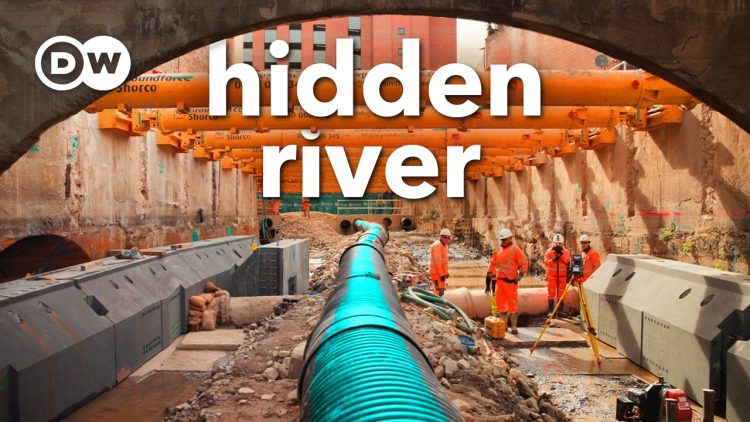
Now the rivers are coming back. The film visits the construction site at Castle Hill Park, where engineers are uncovering the River Sheaf, using temporary pipes and concrete structures to bring the water back to the surface despite the challenges of the existing infrastructure. At Matilda Street, the Porter Brook has already been brought back into daylight, in a scheme completed in 2016. And at Sheffield station itself, a lightwell opened in 2026 lets passengers look down on the Sheaf for the first time in 160 years, a small window on the lost river, protected by a steel grille.
By the end, the film has become a story about what cities gain when they uncover their rivers. The benefits are concrete: better flood management, as open rivers can hold and slow storm water; improved ecology, as daylight and plants return to the water; and cooler streets, as water and greenery fight the urban heat island effect. But the film’s argument is also about something less measurable: a city that can see its rivers again can remember what it is, and where it came from.
What the Film Explores
The film explores why the rivers were buried first, and it wants the viewer to understand the Victorian logic. Rivers in industrial cities were not just polluted, they were a nuisance, and burying them seemed like progress. The film shows the culverts beneath Sheffield, brick tunnels built in the late 1800s, and explains how they were built to hide increasingly polluted waterways after the era of the Great Stink. The burial was not an accident: it was a deliberate choice, made by cities all over the world, for the same reasons.
A second thread follows how rivers are brought back, and the film is at its most practical here. Daylighting a river is not as simple as removing a lid: the water has to be managed, the surrounding infrastructure has to be protected, and the new channel has to be designed to handle floods. The film shows the engineering at Castle Hill Park, where the Sheaf is being uncovered with temporary pipes and concrete structures, and explains the challenges of working around roads, buildings and railway lines that were built on top of the river.
A third thread follows the payoff, and the film looks beyond Sheffield to the cities that have already done it. Seoul’s Cheonggyecheon stream, uncovered after decades under a highway, is the most famous example, and the film also cites Zurich, which improved its sewage system by daylighting streams, and Utrecht, where a canal was restored. The benefits are consistent across all of them: less flooding, more wildlife, cooler air, and public spaces that people actually want to spend time in.
Running through the film is the question of limits, and the film is honest about them. Not every buried river can be uncovered: some are too deeply buried, some are too polluted, and some run under buildings that cannot be moved. The film’s closing argument is that daylighting is not a cure-all, but a tool, and a powerful one, for cities that want to adapt to a changing climate. The rivers were buried because cities wanted to forget them; the cities are uncovering them now because they have remembered why they matter.
Key Themes & Topics Examined
- Why cities buried their rivers: roads, buildings and the smell of pollution
- Sheffield’s hidden rivers: the Sheaf, the Porter Brook and the Don
- Brick culverts from the late 1800s, beneath the city centre
- The Sheaf under the station, unseen for 160 years
- Daylighting at Castle Hill Park and Matilda Street
- Seoul’s Cheonggyecheon, Zurich and Utrecht: the cities that did it first
- The payoff: flood management, ecology and cooler streets
- The limits: not every buried river can be brought back
Production & Background
The film is a DW Planet A production, reported by Julia Merk, with camera work by Neven Hillebrands, video editing by David Jacobi, supervising editors Adam Baheej Adada, Malte Rohwer-Kahlmann and Michael Trobridge, and fact-checking by Jeannette Cwienk. Planet A is DW’s series on the shift towards an environmentally friendly world. The film’s further reading includes research on the effect of buried rivers on biodiversity, the urban heat island effect, flood management and culverts, daylighting projects in New York, and Zurich’s stream daylighting.
The documentary’s subject is the daylighting of buried urban rivers, and its framing is the one the description gives: for decades, cities hid rivers to make room for roads and buildings and to mask the smell of polluted ones, and now places worldwide are uncovering them. The film’s Sheffield story, from the culverting of the Sheaf in the late 1860s to the Porter Brook daylighting at Matilda Street in 2016 and the lightwell at Sheffield station, is drawn from the public record of the city’s river restoration work, including the Sheaf and Porter Rivers Trust.
Recommended Companion Viewing
Explore authoritative investigative documentaries on related historical events and investigative subjects.

Frequently Asked Questions
What is the film about?
Why cities around the world are uncovering the rivers they buried decades ago, told through Sheffield, where the Sheaf and the Porter Brook are being brought back into daylight.
Why were the rivers buried?
To make room for roads and buildings, and to hide the smell of waterways that had become polluted during industrialisation. The Sheaf was culverted in the late 1860s when Sheffield station was built.
What is daylighting?
The opening up and restoration of a previously buried watercourse, also known in the UK as deculverting.
What are the benefits?
Better flood management, improved ecology, cooler streets, and public spaces people want to use. Seoul’s Cheonggyecheon stream is the most famous example.
Who made the film?
DW Planet A, reported by Julia Merk.